
Introduction
Selecting the right competitor research and analysis tool for your organization can be challenging. This is not only because of the numerous options available, but also because the term “competitor analysis” can mean different things depending on who you ask and your team’s objectives.
An M&CI team running an organization-wide intelligence program has a fundamentally different need than a growth marketing team focused on keyword rankings, or a brand team tracking how competitors appear on social media. Each is doing competitor research and analysis. Each needs a completely different tool. This is why most teams end up either over-investing in a platform that does not match their use case or stitching 2 or 3 tools together. Neither of these approaches are sustainable.
That’s why, in this guide, we have compiled the best competitor research and analysis software tools in 2026 into three distinct categories:
- Purpose-built competitive intelligence and analysis softwares for teams running continuous, cross-functional intelligence programs.
- SEO and digital marketing tools for teams tracking competitors’ organic, paid, and content strategies.
- Social media monitoring tools for teams focused on brand presence, audience engagement, and share of voice.
Top competitive research and analysis software tools at a glance
Here’s a quick overview of the top 15 competitive analysis software tools:
| No. | Product | Used for | Key differentiation |
| Purpose-built competitive intelligence platforms | |||
| 1 | Contify | Cross-functional market and competitive intelligence for strategy, product, marketing, and sales teams | Broadest source coverage (1M+ sources, 117 languages), best-in-class noise reduction, agentic AI (Athena), unlimited users, and automated outputs (feeds, dashboards, newsletters, battlecards) |
| 2 | Klue | Competitive intelligence and win-loss analysis for B2B product marketing and sales teams | Only platform combining competitive intelligence and win-loss in one portal; AI-generated win stories, talk tracks, and objection handling delivered into CRM and Slack |
| 3 | Crayon | Competitor monitoring and sales battlecards for B2B revenue teams | Tracks 100+ competitor data types; AI-scored intelligence by market impact; deep CRM integrations for sales enablement |
| 4 | Valona Intelligence | Market and competitive intelligence for global enterprise teams with optional analyst support | 200K+ sources in 115+ languages including paywalled publications; hybrid AI + human analyst model; validated financials via A-INSIGHTS |
| 5 | AlphaSense | Financial market research and investment intelligence for finance and strategy professionals | Premium content library (broker research, expert transcripts, SEC filings) unified in one AI-searchable interface; Generative Grid and Deep Research for earnings and M&A workflows |
| 6 | Kompyte | Competitor tracking, battlecards, and win/loss analysis for sales-led B2B teams | Backed by Semrush’s web data; AI daily summaries; bi-directional CRM integrations; IcebergIQ partnership for qualitative win/loss interviews |
| SEO and digital marketing tools | |||
| 7 | Semrush | SEO, PPC, content, and digital marketing competitive research | Largest keyword database (27B+ keywords); broadest all-in-one digital marketing suite; AI visibility tracking for ChatGPT and Google AI Mode |
| 8 | Similarweb | Website traffic analysis, audience intelligence, and digital benchmarking | 10B+ daily digital signals; AEO tracking for AI-generated search; strongest on traffic-source breakdowns and audience demographics |
| 9 | SpyFu | PPC and SEO competitor keyword and ad strategy research | 15+ years of historical PPC and SEO data; unlimited data exports on all plans; best-in-class paid search intelligence at an affordable price |
| 10 | Moz Pro | SEO keyword research, rank tracking, and site auditing | Most affordable entry point among major SEO suites; industry-standard Domain Authority metric; AI Visibility tracking (beta) on higher plans |
| 11 | Ahrefs | SEO, backlink analysis, content gap research, and rank tracking | Fastest-updating backlink index, deepest content gap and link-building tools; new $29/mo Starter plan launched Jan 2026 |
| Social media monitoring tools | |||
| 12 | Brandwatch | Consumer intelligence, brand monitoring, and deep social listening for enterprise teams | Largest social data archive; most sophisticated Boolean query builder; includes social publishing suite; LLM Insights for AI search tracking |
| 13 | Sprout Social | Social media management combined with competitive social benchmarking | Strongest combination of social listening and publishing in one platform; per-user pricing; deep reporting for agencies and brand teams |
| 14 | Talkwalker | Social listening, media monitoring, brand intelligence, and LLM tracking across social and traditional media | One of the broadest cross-channel datasets (social + news + broadcast + podcasts); LLM Insights for tracking brand presence in AI responses |
| 15 | Meltwater | Media monitoring, social listening, and PR intelligence with cross-channel coverage | Covers both social and traditional media in one platform; GenAI Lens for AI-generated content tracking; strong PR and comms workflows |
| 16 | Rival IQ | Social media competitive benchmarking and content performance analysis | Transparent, published pricing; Facebook Ads reporting; 14-day free trial; best value for social-only competitor benchmarking |
| 17 | BuzzSumo | Content research, competitor content performance analysis, and influencer identification | Strongest tool for content intelligence; tracks viral content, trending topics, and journalist databases; not a social listening tool |
Now, let’s understand what each category is and which top tools are in each.
Purpose-built competitive intelligence and analysis software tools
A purpose-built competitive intelligence and analysis software enables real-time monitoring and analysis of competitors across their digital footprint. This also includes news and PR sites, company websites, social media, forums, and job boards. These software also allow you to include internal sources such as SharePoint, Slack, and Microsoft Teams.
These platforms:
- Automate time-consuming processes for collecting data from external and internal sources,
- Perform advanced AI-based analysis, and
- Help you understand market positioning, product development trends, and competitors’ strategic movements.
Let’s take a look at the most popular competitive intelligence and analysis software tools:
1. Contify
Contify is an AI-native platform that provides a 360° view of the market, industry, and competition by delivering highly relevant, timely, and role-specific insights, helping business teams make informed and confident decisions.
Many Fortune 500 companies and fast-growing enterprises like Deloitte, EY, IQVIA, Labcorp, Airbus, Lenovo, and Wipro trust Contify for reliable intelligence insights not just on competitors but also on their customers, partners, key accounts, suppliers, and the industry at large.
These insights help identify growth opportunities, inform product strategy, enable sales, sharpen go-to-market (GTM) plans, and improve cross-team collaboration through a single, shared view of the market.
Contify key features
- Extensive Source Coverage: Access business-grade intelligence datasets from over 1 Mn+ vetted global sources, including news, company websites, regulatory portals, job boards, social media, and more, covering over 700K+ companies and over 100+ industry segments across 117+ languages. You can also integrate internal content from sources like SharePoint and Gong to unify external signals with their sales and account intelligence.
- Noise-free Intelligence Feeds: Contify filters out noise and delivers only the most relevant and reliable intelligence. This is made possible using advanced AI algorithms and techniques such as deduplication, disambiguation, and GenAI-validated tagging layered with human curation. We’re widely recognized in the industry for providing the cleanest intelligence feeds.
- Automated Insights & Analysis: Contify’s agentic AI, Athena, extracts key data points from the intelligence content and connects them to deliver continuously updated, decision-ready insights. This means raw intelligence datasets are turned into precise, actionable analysis that would otherwise take hours to compile manually. With a vast library of pre-defined insight templates, you can create auto-updating SWOT analysis, Ansoff Matrix views, competitors’ strategic objectives, product and growth strategies, battlecards, and more.
- Ask Athena: Ask Athena, Contify’s conversational AI assistant lets you ask ad hoc intelligence questions in natural language and receive trusted responses grounded in its verified external and internal intelligence datasets hosted on Contify platform.
- Intuitive Dashboards & Battlecards: Access over 50+ templates with auto-updating widgets and 20+ advanced chart types (stacked bar charts, sunburst charts, interactive timelines, geographic maps, trend lines, and more). This allows teams to create role-specific or use-case-specific dashboards and battlecards that serve strategy, marketing, and executive teams, not just sales.
- AI-Powered Live Company Profiles: Contify also provides Live Company Profiles that consolidate strategic insights, product details, customer lists, financials, leadership information, and recent developments into a single, continuously updated view. These profiles eliminate scattered research and give business teams instant strategic context for any company they track.
- Intelligence Newsletters and Alerts: Quickly create branded and easy-to-consume intelligence newsletter digests with AI-generated summaries and customizable templates. Additionally, get real-time alerts to keep teams informed as key market events unfold.
Contify pros
- Robust coverage with the availability of structured intelligence datasets on 700K+ public and private companies and 200+ topics, including industries, business events, themes, and more, continuously monitored. across 1M+ global sources.
- Noise-free intelligence feed quality backed by a multi-layer system: AI deduplication, disambiguation, GenAI-validated tagging, and human-in-the-loop curation (HITL) approach.
- Easy self-serve option to add custom sources and historical data going back up to 2 years, included by default at no additional cost or restrictions.
- Global multilingual intelligence with translated content in over 117+ languages from non-English sources.
- Custom taxonomy tagging that mirrors your organization’s structure and market landscape.
- Advanced AI capabilities through Athena Agents and Ask Athena for automated, contextual insight generation and ad-hoc research.
- Predefined prompt templates for generating insights using agentic AI workflows (Athena Agents).
- Ability to add unlimited platform users at no extra costs, enabling enterprise-wide adoption of intelligence.
- Seamless integrations with Slack, MS Teams, Salesforce, Snowflake, and email for easy intelligence distribution.
Contify cons
- Requires an initial learning curve to fully configure taxonomy, dashboards, and workflows to your organization’s needs.
- Not a fit for PR use cases such as brand monitoring. The platform’s deduplication and noise-filtering logic is optimized for unique strategic intelligence, not for tracking total media mention volume, which is the core requirement of PR programs.
Who is Contify best suited for?
Contify is ideal for mid- to large-sized enterprises and high-growth companies in IT/ITeS, SaaS, BFSI, management consulting, manufacturing, healthcare, and other fast-moving industries. It empowers M&CI professionals as well as strategy, marketing, sales, and product leaders with automated, in-depth insights on competitors, customers, partners, and the broader market, delivered as feeds, reports, newsletters, alerts, battlecards, or dashboards pushed into Slack, MS Teams, Salesforce, or Snowflake.
2. Klue
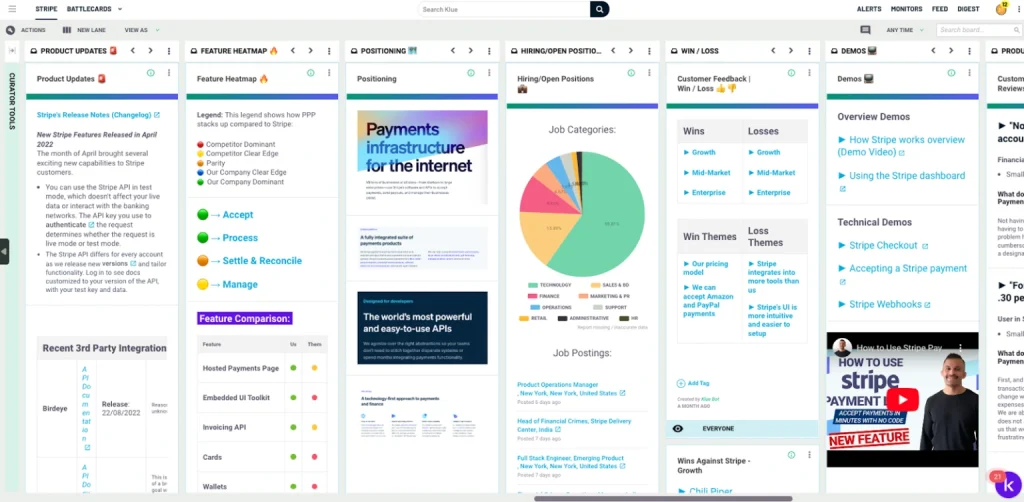
Klue is a competitive enablement platform that helps product marketing and CI teams turn competitor signals and buyer feedback into battlecards and deal-level insights they can use directly in their daily workflows.
Founded in 2015, Klue serves enterprise B2B and SaaS companies, including Shopify, SurveyMonkey, and Zendesk. Its core proposition is bringing competitive intelligence and win-loss analysis together in a single portal, rather than running them as separate programs.
Klue key features
- Competitive Monitoring from Web and Internal Sources: Klue collects intelligence from public sources – competitor website changes, news articles, press releases, product updates, and social. It also ingests internal sales call transcripts from Gong, Chorus, Clari, and Zoom, blending external signals with field-level conversations from your own revenue team.
- Dynamic Battlecards Klue offers comprehensive tools to build and maintain dynamic battlecards with sections such as “Why we win,” “Why we lose,” “Landmines to lay,” “Quick dismisses,” and more. They are accessible via Salesforce, Slack, Microsoft Teams, and mobile for high adoption among sellers who need fast answers during live calls.
- Integrated Win-Loss Analysis: It offers a built-in win-loss platform that enables you to capture objective buyer feedback through expert-led interviews and automated surveys, then combines that input with AI-generated insights, all within the same competitive enablement workflow.
- AI-generated Competitive Insights: Klue automatically produces seller-ready content from CRM data, call transcripts, and win-loss interviews. These include “Win Stories,” “What Prospects Are Saying,” “Objection Handling,” and “Talk Tracks.” These are packaged into Klue Cards and pushed to sellers.
- Newsletters: Klue’s drag-and-drop newsletter builder lets you compile competitive updates into branded digests with AI summaries. Open and click-through rate tracking gives visibility into which updates your stakeholders actually engage with.
- Workflow Integrations: It connects natively with Salesforce, Slack, Microsoft Teams, and Gong, keeping competitive intelligence inside the tools sellers and product marketers use every day.
Klue pros
- One of the few platforms that combines competitive intelligence and win-loss analysis in a single portal.
- Purpose-built battlecard templates with polished designs that serve different sales roles and competitive scenarios.
- AI-generated insights, such as win stories, talk tracks, and objection handling, that reduce manual content creation for CI teams.
- Easy-to-use drag-and-drop interface for newsletters and battlecards.
- Dedicated customer success support with hands-on onboarding.
Klue cons
- Focused primarily on competitive intelligence and sales enablement; does not support broader market intelligence use cases such as monitoring customers, partners, industry trends, or regulatory changes.
- Limited platform access during the trial period makes it harder to assess fit before committing.
Who is Klue best suited for?
Klue is ideal for product marketing, competitive intelligence, and sales enablement teams at B2B and SaaS companies that want competitive insights and battlecards integrated into seller workflows inside CRM and collaboration tools. It’s particularly useful when you need a single portal to manage both competitive intelligence and win-loss analysis, and when optimizing for seller adoption through deal-level insights.
3. Crayon
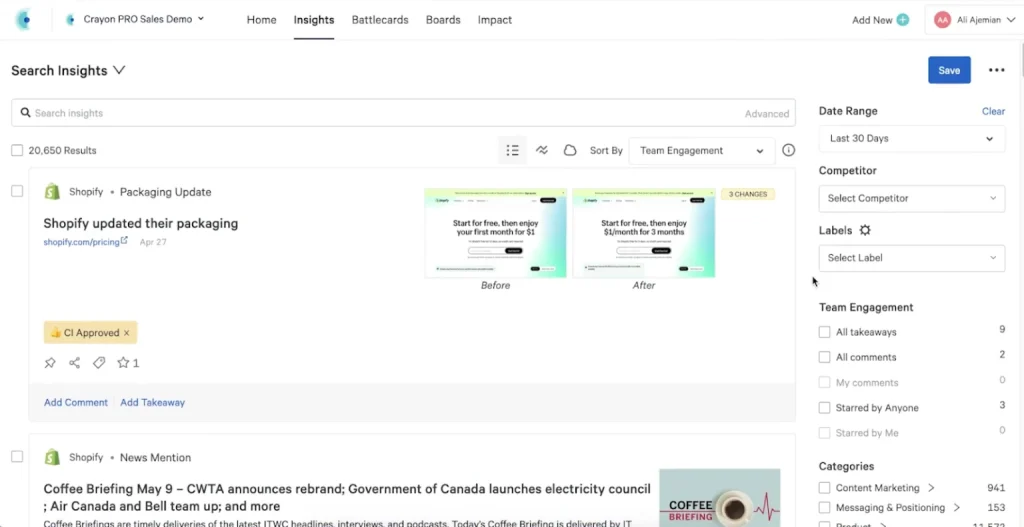
Crayon is a competitive intelligence platform that helps businesses monitor competitors and enable sales teams with real-time intelligence. The platform focuses primarily on competitor tracking and sales enablement, providing automated monitoring across various digital channels to help revenue teams stay ahead of their competition.
Crayon serves mid-market and enterprise organizations, including companies like Gong, Dropbox, and ZoomInfo. The platform helps product marketing and sales teams by transforming competitor data into useful insights through battlecards, alerts, and AI-powered analysis tools that integrate directly into existing sales workflows.
Crayon key features
- Automated Competitor Monitoring: Crayon tracks over 100 data types across competitor digital footprints, including website changes, pricing pages, product updates, job postings, news articles, social media, and review sites. The platform scores intelligence based on market impact using AI and ML.
- Battlecards and Sales Enablement: Provides tools to build dynamic battlecards equipped with competitor differentiators, objection-handling strategies, and talk tracks. These are automatically updated with real-time intelligence and integrate directly into popular CRMs like Salesforce and HubSpot.
- Crayon Answers (AI Assistant): A generative AI-powered assistant that provides conversational responses to competitive questions during sales conversations. Reps can ask questions like “How do we position against Competitor X?” and receive instant answers. However, it only analyzes battlecard content present on the platform.
- Crayon Sparks: An AI tool that connects and analyzes competitor information datasets, summarizes large volumes of updates, and turns them into sales-ready content such as SWOTs, win themes, and objection-handling snippets.
- Newsletters and Alerts: Crayon offers built-in newsletter templates and automated alerts to distribute competitive intelligence across teams. Subscribers can also receive digest-style updates via email and Slack.
- Analytics and Reporting: Tracks battlecard usage, measures sales engagement, and correlates competitive intelligence with deal outcomes to quantify ROI. Custom reports highlight patterns in competitor wins and losses to inform GTM strategy.
Crayon Pros
- Intuitive platform with a strong focus on sales enablement and battlecard creation
- AI-powered competitor website tracking with automated change detection and summaries
- Comprehensive battlecard templates designed for different sales roles and scenarios
- Many integrations with different tools to support competitor-specific sales enablement use cases.
- User-friendly interface designed for go-to-market teams
Crayon Cons
- Solely focused on competitor monitoring and doesn’t provide intelligence on other market forces.
- Users often complain about receiving duplicate content and excessive noise in their feeds.
- Limited historical data availability, and typically provided at an additional cost.
- Less suited for enterprises requiring customizations, flexibility, and their own taxonomy configurations.
Who is Crayon best suited for?
Crayon is ideal for B2B sales and marketing teams in mid-to-large-sized organizations operating in competitive markets. Teams that need straightforward competitor monitoring, battlecards, and sales enablement capabilities. It’s particularly well-suited for organizations that prioritize sales team adoption and need CI integrated directly into their existing sales workflows.
4. Valona Intelligence
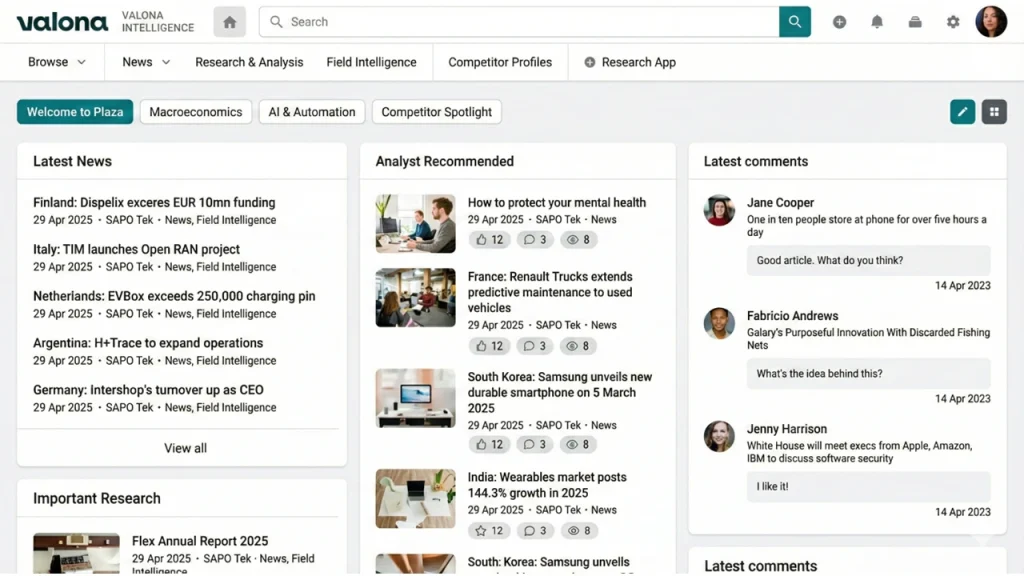
Valona Intelligence (formerly known as M-Brain) is a market and competitive intelligence platform that combines AI-powered global monitoring with optional analyst and consulting services to deliver insights into market developments and competitor moves.
Founded in 1999, it serves enterprise organizations like IKEA, Philips, and HSBC with intelligence aggregated from 200,000+ sources, including paywalled publications, trade journals, financial filings, and regulatory databases across 115+ languages.
Valona Intelligence key features
- Global Source Monitoring: Tracks 200,000+ sources worldwide, including news outlets, regulatory databases, trade journals, financial filings, and paywalled publications across 115+ languages. You can also pull in field intelligence and internal content from systems like SharePoint.
- VAL AI Research Assistant: A conversational AI assistant that answers questions in natural language and generates structured outputs like SWOT, PESTEL, and Porter’s Five Forces analyses. It also delivers executive summaries in English from sources in other languages.
- Real-Time Competitor Profiles: Profiles include earnings data and validated financials sourced from A-INSIGHTS, with auto-generated analysis to surface performance gaps, risks, and strategic opportunities.
- Dashboards and Visualizations: Pre-built dashboards with trend radars and competitive benchmarking visualizations that pull directly from Valona’s intelligence database and are designed to reduce setup time and accelerate time-to-value.
- Automated Alerts and Newsletters: Personalized alerts for smaller teams and newsletters for larger audiences, with subscriber management.
- Analyst and Consulting Services: Valona combines AI capabilities with optional analyst and consulting services, available at an additional cost, for organizations that need expert support beyond the platform.
Valona Intelligence pros
- Strong news aggregation capabilities with 200k+ sources in 115+ languages, including paywalled publications.
- Validated financial and trade flow data sourced from A-INSIGHTS adds credibility for teams tracking competitor earnings and financial performance.
- Pre-built dashboards and competitor profiles reduce setup time and help teams get to insights faster.
- Optional analyst and consulting services make it a viable option for organizations that need expert support.
- Strong customer support, consistently praised by users for quality and responsiveness.
Valona Intelligence cons
- Limited coverage beyond news and media outlets of critical intelligence sources, such as company websites, social media, review sites, job boards, and YouTube.
- The VAL AI assistant is restricted to power users (analysts), which slows self-serve adoption across product, sales, and marketing teams.
- Doesn’t provide auto-updating pre-defined insights that combine multiple updates for ready-made outputs.
Who is Valona Intelligence best suited for?
Valona Intelligence is best suited for mid-to-large organizations that primarily need competitive and market intelligence from news and media sources, with analyst support available at an additional cost and specialized foresight features. The platform is especially well-suited for companies willing to invest in tiered licensing, with dedicated power users (analysts) who manage intelligence for broader stakeholder groups.
5. AlphaSense
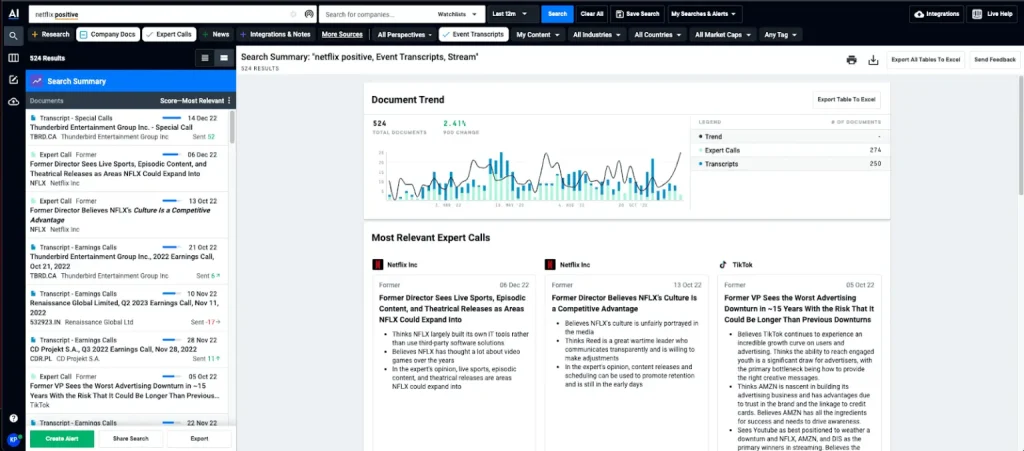
AlphaSense is an AI-powered market intelligence and search platform designed for financial and business professionals. It is helpful for teams that need comprehensive, reliable insights on public and private companies and industry trends from premium content sources.
The platform’s core value lies in consolidating premium financial content, including broker research, earnings transcripts, SEC and global filings, expert call transcripts, and regulatory updates into a single, AI-searchable interface. AlphaSense has gained recognition from leading financial research and corporate organizations in supporting market research workflows and decision-making.
AlphaSense key features
- Premium Content Library: Provides access to SEC and global filings, earnings transcripts, broker research, expert call transcripts, market news, regulatory updates, and structured financials. The platform brings together content that typically requires multiple exclusive subscriptions.
- Expert Transcript Library: Through its Tegus acquisition, AlphaSense provides access to expert call transcripts from former executives, industry operators, and domain experts. These primary research viewpoints enhance insights beyond those offered by secondary sources.
- Generative AI Suite: AlphaSense features purpose-built GenAI features that deliver AI insights, along with source citations for transparency and fact-checking.
- Deep Research runs iterative 10-30 minute research across AlphaSense content and produces detailed company primers and reports.
- Generative Grid applies prompts across multiple documents at once and produces organized tables, which can be useful during earnings season.
- Smart Summaries auto-generate tear sheets that capture key takeaways from transcripts.
- Smart Alerts & Monitoring: AlphaSense sends real-time alerts on watchlisted companies and topics. Alerts arrive through email or mobile push notifications and include highlighted keywords and links to source documents. However, it can’t be distributed to stakeholders who are not paid subscribers.
- Enterprise Content Integration: The platform also allows you to upload and index internal content, such as sales calls, win-loss interviews, documents, and research memos. Integrations with SharePoint, OneNote, Box, FileSync, and Evernote let teams apply AI search and GenAI analysis to internal knowledge.
AlphaSense pros
- A premium content library that consolidates broker research, expert transcripts, filings, and news into a single AI-searchable interface, eliminating the need for multiple exclusive subscriptions.
- The Generative AI Suite streamlines analysis, delivering quick, verifiable outputs and reducing research time.
- Smart Synonyms Search enhances understanding of business language, reducing research blind spots without complex keyword libraries.
- Enterprise Intelligence merges proprietary and premium external data for easier access.
- The mobile iOS app ensures users can stay updated and listen to earnings calls and expert interviews anywhere.
AlphaSense cons
- The platform is designed mainly for finance and investment research, but it falls short for teams needing competitive intelligence in product, marketing, or sales.
- It doesn’t track key M&CI channels, such as social media and job boards, leading to awareness gaps.
- Licensing restrictions limit access for stakeholders without paid seats, hindering broader knowledge sharing.
- Complex features and volume of content can overwhelm users untrained in finance.
Who is AlphaSense best suited for?
AlphaSense is ideal for finance and strategy professionals at large enterprises and financial institutions. It works well for teams who need access to premium content, including broker research, expert insights, and financial data, to conduct M&A due diligence, investment research, market research, and strategic planning.
6. Kompyte
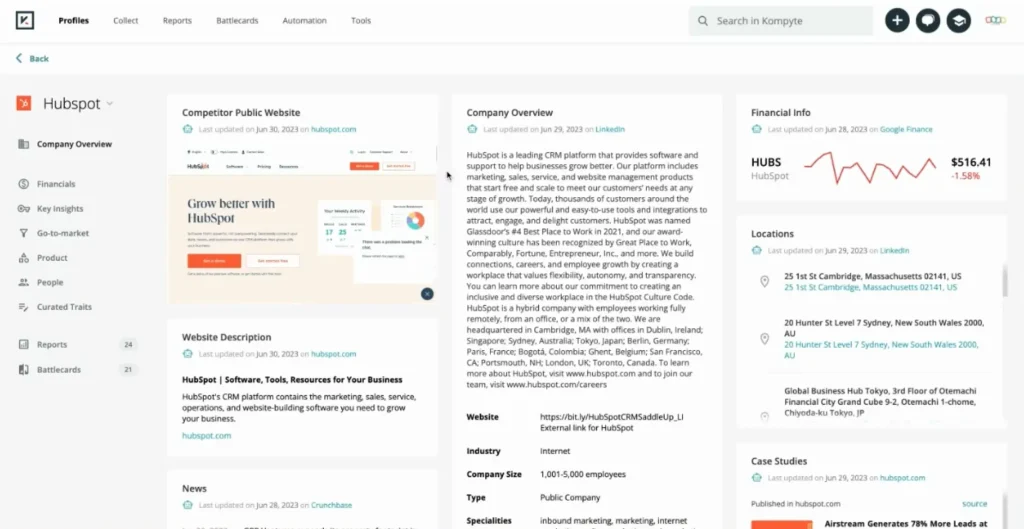
Kompyte (acquired by Semrush in 2022) is another sales enablement-focused competitive intelligence platform that helps GTM teams to track competitors, build battlecards, and understand why deals are won or lost.
The Semrush acquisition gives Kompyte access to web analytics and SEO data, alongside its own competitor-monitoring capabilities. The platform is used by sales, marketing, and product teams to centralize competitive intelligence and increase win rates on competitive deals.
Kompyte key features
- Automated Competitor Tracking: Monitors competitors across websites, social media, review sites, job postings, ads, and content, with AI filtering to surface the most relevant updates and daily summaries that reduce manual effort.
- Dynamic Sales Battlecards: The platform has several battlecard templates that pull in curated intelligence from configured sources, and can be integrated into Salesforce and HubSpot through bi-directional CRM integrations.
- Win/Loss Analysis: Tracks competitive revenue, win rates, and competitor frequency. The IcebergIQ research partnership adds qualitative buyer-interview data alongside automated win/loss calculations based on CRM data.
- AI-Powered Insights and Summaries: Kompyte GPT uses GenAI to analyze competitive data and produce instant summaries and takeaways across updates. You can also trigger on-demand AI summaries and refine the output with additional context.
- Company Profiles: Organizes competitors into groups such as top competitors or emerging threats, with each profile covering financials, products, leadership, and recent activity. Customizable dashboards let different roles focus on the metrics and competitive movements most relevant to them.
- Workflow Integrations: Kompyte integrates with Salesforce, HubSpot, Slack, and Microsoft Teams, ensuring competitive intelligence flows into the daily tools sales and marketing teams already rely on.
Kompyte pros
- The interface is easy to use, allowing sales teams to find and act on competitive insights without a steep learning curve.
- Auto-updating battlecards pushed directly to CRM mean sales reps always have current insights during active deals.
- Real-time monitoring with AI daily summaries significantly reduces manual competitive research time.
- The IcebergIQ partnership adds qualitative buyer insight to win/loss data, offering a more complete view of competitive deal outcomes than automated analytics alone.
- Dedicated customer success manager included in every plan, with strong onboarding support.
Kompyte cons
- Scope is limited to competitor monitoring and sales enablement. It lacks support for broader market-intelligence use cases, such as tracking customers, partners, and industry trends.
- There are no AI-powered automations for insights creation from multiple updates, requiring significant manual effort.
- The platform does not include translated content from non-English sources, limiting its global applicability.
- There’s no conversational AI chat interface for quick competitive answers, and adding new companies or data sources can involve restrictions or additional costs.
Who is Kompyte best suited for?
Kompyte is best suited for B2B sales and product marketing teams at mid-to-large organizations that need automated competitor tracking, dynamic battlecards, and win/loss analysis integrated directly into Salesforce or HubSpot. It works best for organizations with a defined set of competitors and a sales-led GTM motion, where getting competitive intelligence into reps’ hands quickly is the primary goal.
SEO and digital marketing competitor research and analysis software tools
SEO and digital marketing competitor analysis tools focus on real-time monitoring of competitors’ search optimization strategies, online visibility, and digital marketing performance. They track keyword rankings, backlink profiles, organic and paid campaigns, content performance, and website traffic patterns across search engines and other digital channels.
These tools provide insights into competitors’ most valuable keywords and content strategies, and help identify gaps in your own digital marketing approach. By utilizing these tools effectively, you can optimize your strategy for improved online visibility and management, thereby enhancing your company’s digital presence.
Let’s take a look at the most popular SEO and digital marketing competitor analysis tools:
1. Semrush
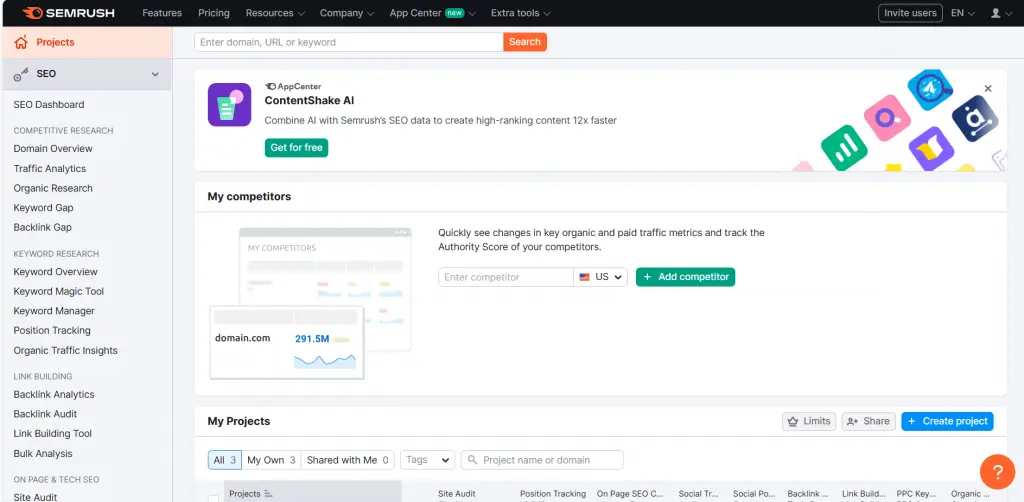
Semrush is widely regarded as the gold standard for SEO and digital marketing competitive analysis, offering comprehensive toolsets for understanding competitors’ online strategies. The platform provides in-depth insights into keyword rankings, backlink profiles, content performance, paid advertising campaigns, and social media presence across various channels.
With access to over 27.9 billion keywords and 43 trillion backlinks, Semrush enables companies to benchmark digital marketing performance against competitors and identify untapped growth opportunities. Its advanced analytics reveal competitors’ most profitable keywords, traffic sources, and content strategies, making it a helpful tool for enhancing online visibility.
Semrush key features
- Keyword Research: The Keyword Magic Tool generates keyword ideas organized by search volume, difficulty, and intent. You can explore question-based and long-tail keywords, identify featured snippet opportunities, and map out content gaps based on what competitors are already ranking for.
- Competitor SEO and Traffic Analysis: Organic Research lets teams discover competitors’ top-ranking keywords, content gaps, and traffic sources. Traffic Analytics provides a breakdown of where competitors’ traffic comes from, including organic search, paid ads, referrals, and social media, making it a practical tool for benchmarking and strategy planning.
- Backlink Analytics: Analyze competitors’ complete backlink profiles, including referring domains, anchor text distribution, and newly acquired or lost links. The Backlink Gap tool identifies sites linking to your competitors but not to you, which makes it useful for finding scalable link-building opportunities.
- Advertising Research: Gain visibility into competitors’ paid search strategies, including ad copy, landing pages, targeted keywords, and estimated budget spend. This enables teams to understand which messages are working in their market and avoid costly trial-and-error in their own PPC campaigns.
- Site Audit and Technical SEO: Site Audit crawls your website and identifies technical issues affecting search performance, with prioritized fixes and progress tracking. You can re-crawl on demand to confirm issues have been resolved.
- AI Visibility and AIO Monitoring: Semrush has introduced AI visibility tracking, which helps teams monitor how their brand and competitors appear in AI-generated search responses, including in platforms like ChatGPT and Google AI Mode. This is increasingly relevant as AI-driven search continues to reshape how customers discover information.
Semrush pros
- Extensive coverage with over 27.9 billion keywords and the fastest backlink crawler on the market.
- A complete set of tools, all in one place, for SEO, content marketing, pay-per-click advertising, social media, and competitive research.
- Advanced AI-driven features, such as Semrush Copilot, offer tailored suggestions.
- The dataset covers a wide range of regions and countries and provides keyword data in multiple languages.
- Interactive charts and graphs provide superior data visualization, making intricate competitive insights easily digestible.
- Robust customer support, backed by comprehensive documentation and educational resources.
Semrush cons
- High price, with costly add-ons that can greatly increase the total cost of ownership.
- The breadth of features poses a significant challenge for new users, potentially leading to an initial sense of overwhelm.
- Credit-based systems have limitations that can restrict the scope of research.
- The accuracy of traffic estimation varies, particularly for smaller websites and those in specialized markets.
Who is Semrush best suited for?
Semrush is great for digital marketers, SEO experts, content marketers, and agencies working with mid-to-large businesses that need in-depth information from various digital channels. It’s especially useful for businesses that need to do in-depth competitor analysis, keyword research, and plan their content strategy. The platform is best suited for teams with digital marketing experts who can fully leverage its advanced features to justify its premium price.
2. Similarweb
Similarweb is another popular digital data intelligence platform. It offers businesses a look into their competitors’ website traffic, online strategies, and broader market dynamics. This platform is a valuable resource for content marketing and SEO specialists. It allows for in-depth analysis of rivals’ content strategies and the sources driving their traffic.
With Similarweb, you can identify referral traffic patterns, visitor destinations, and understand which topics attract buyers. The platform collects over 10 billion digital data signals daily to deliver actionable web intelligence, revealing competitors’ SEO strategies, paid advertising performance, content tactics, and audience behavior, enabling data-driven decisions.
Similarweb key features
- Traffic Analytics: Benchmark your website’s traffic against competitors with a breakdown of sources, including organic search, paid ads, referrals, direct, and social. Daily and weekly traffic data, combined with engagement metrics like bounce rate and pages per visit, provide a detailed view of competitive performance.
- Audience Demographics and Behavior: Analyze visitor demographics including age, gender, and interests, alongside behavioral data. This helps teams understand who a competitor’s audience is, where they come from, and how they interact with the site.
- App Intelligence: Monitor mobile app performance metrics, user engagement levels, and download trends for both Google Play and the App Store.
- Keyword and SEO Intelligence: Access competitive keyword data powered by a database of over 5 billion keywords with unique metrics like zero-click search volume and hybrid search intent.
- Ad Intelligence: Access an ad intelligence library covering over 500 million display ads, allowing teams to analyze competitor paid campaigns, creative strategies, and landing pages across search and display networks.
- Gen AI Intelligence and AEO Tracking: Similarweb has introduced Answer Engine Optimization (AEO) tracking, enabling teams to monitor how their brand and competitors appear in AI-generated search results.
- Market and Industry Research: Industry-level benchmarking covers 210+ industries, providing context on traffic norms, channel mix expectations, and keyword trends at the category level, useful for sizing competitive opportunity or tracking market share shifts.
Similarweb pros
- Comprehensive global data coverage, encompassing millions of websites and applications in over 190 countries.
- Rich historical data spanning multiple years enables thorough trend analysis. The interface is designed for ease of use, featuring intuitive dashboard visuals.
- Comprehensive export capabilities in PDF and Excel formats.
- Chrome extension for quick website analysis and traffic assessment
- API access and integrations with popular tools like Google Data Studio, Tableau, and CRM systems.
Similarweb cons
- The starting price of $125/month may be high for small businesses or individual marketers.
- Some advanced features, such as API access, are only available in the team and enterprise packages.
- Limited functionality in the free version, lacking the depth and granularity needed for thorough competitive analysis.
- Occasional discrepancies in data accuracy compared to other platforms, which could impact decision-making processes.
Who is Similarweb best suited for?
Similarweb is best for digital marketing and market research professionals who need in-depth insights into their competitors’ activities across numerous digital channels. The platform provides comprehensive data, enabling you to examine any website or app globally. This broad scope is particularly useful for dissecting competitors’ digital strategies, establishing industry benchmarks, and spotting emerging market trends.
3. SpyFu
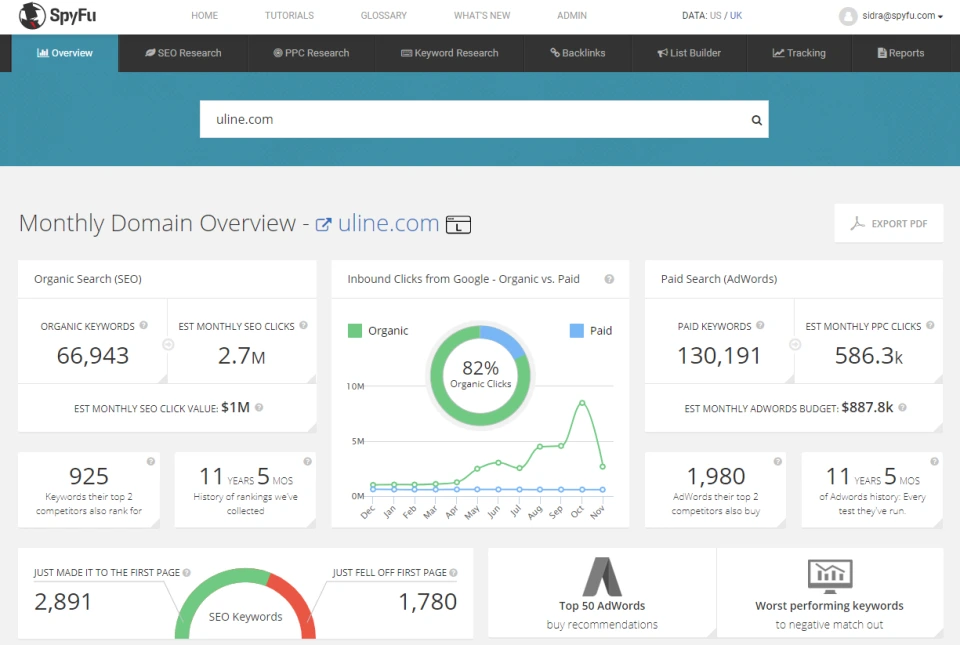
SpyFu is a tool built specifically to dissect competitors’ SEO and PPC strategies through a deep dive into historical data. It excels at reverse-engineering competitors’ search marketing efforts. The platform offers a wealth of information, revealing the keywords they’re targeting, the different versions of their ads, and how much they’re spending on both organic and paid search.
With access to over 73 billion search results across 123 million domains and more than 15 years of historical data, SpyFu enables businesses to learn from competitors’ successes and failures and identify untapped opportunities in their markets.
SpyFu key features
- Competitor Keyword Research: Uncover any competitor’s complete organic keyword portfolio, including their top-performing search terms, estimated monthly clicks, and keyword values. Teams can identify which keywords a competitor is winning, where they are vulnerable, and where untapped opportunities exist in the market.
- PPC Ad Intelligence: Gain visibility into competitors’ paid search strategies, including their exact ad copy, landing pages, estimated budgets, and campaign history going back over 15 years. This historical depth is one of SpyFu’s most cited differentiators, letting teams understand how a competitor’s paid strategy has evolved over time.
- SEO Kombat Tool: Compare keywords between multiple competitors using interactive Venn diagrams that highlight shared keywords, unique opportunities, and content gaps, making it easy to find where you can differentiate or move into underserved SERP territory.
- Rank Tracking and SERP Analysis: Monitor daily keyword movements for your own domain and competitors across Google, Bing, and Yahoo, with visual timelines of gains and losses. Rank tracking extends to 100 positions, giving earlier visibility into performance trends compared to tools that only track the top 10 results.
- Backlink Analysis: Identify competitors’ inbound link sources, view domain authority metrics, and spot link-building opportunities.
- Historical Performance: Analyze over 15 years of competitor data to understand seasonal trends, strategy evolution, and long-term performance patterns.
SpyFu pros
- Budget-friendly pricing starting at $39/month with unlimited data exports and downloads.
- Industry-leading PPC intelligence capabilities that surpass broader SEO platforms.
- Unlimited data access across all pricing tiers without restrictive credit systems.
- Deep historical archive and ad-test history give unmatched visibility into long-term competitor digital strategies.
- White-label PDF and CSV exports support agency workflows and client reporting without additional fees.
SpyFu cons
- Smaller keyword database compared to Semrush and Ahrefs, which can limit research depth for large-scale keyword planning or highly competitive markets.
- Lacks in-depth technical site audit tools, requiring additional tools for comprehensive SEO analysis.
- Data estimates for traffic, spend, and low-volume keywords can be inaccurate, particularly for smaller websites.
- Fewer data visualizations than all-in-one suites, requiring more manual slicing for nuanced insights.
Who is SpyFu best suited for?
SpyFu is ideal for digital and performance marketers, as well as SEO specialists, operating solo or in small-to-medium organizations. It is valuable for competitor keyword mining, historical ad intelligence, and unlimited data downloads. Its value shines when teams need to quickly reverse-engineer competitor campaigns, build keyword lists at scale, and deliver white-label reports without incurring the overhead of an all-in-one platform.
4. MozPro
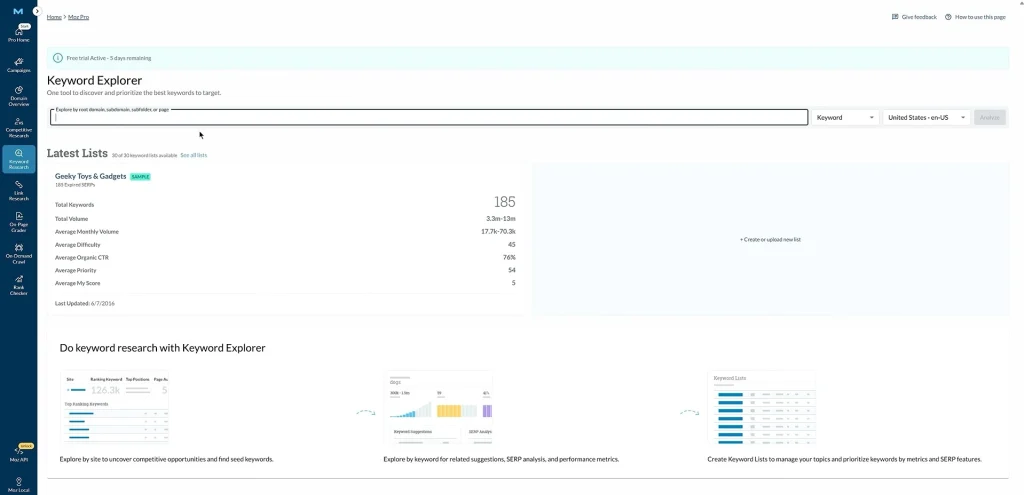
Moz Pro is a leading SEO platform that has been influential in digital marketing since 2004. It offers a cohesive suite of tools that simplify complex SEO tasks and provide actionable insights. The platform excels at providing reliable data through an intuitive interface, making it ideal for teams executing effective SEO strategies without extensive technical skills.
With access to over 500 million domains and 35 billion links, along with proprietary metrics like Domain Authority (DA) and Page Authority (PA), which have become industry standards, Moz Pro enables businesses to conduct thorough competitive research, keyword analysis, and site optimization through its integrated tools.
Moz Pro key features
- Keyword Explorer: Research keywords with clear metrics, including difficulty scores, search volume, opportunity ratings, and SERP analysis. New AI-powered keyword grouping by search intent makes it faster to identify and prioritize high-value phrases without manual sorting.
- Rank Tracker: Monitor keyword rankings across search engines and geographic locations, with a Search Visibility Score that gives an at-a-glance health check of overall organic performance. Automated weekly ranking reports can be scheduled for client delivery or internal stakeholders.
- Site Crawl and Technical Audit: Site Crawl automatically audits websites for over 60 technical SEO issues, prioritizes fixes by potential impact, and flags critical issues before they affect rankings. On-demand re-crawl lets teams verify that issues have been resolved after fixes are deployed.
- Link Explorer: Moz’s backlink tool provides access to a substantial link index with DA scoring, spam score evaluation, and the Link Intersect feature that identifies sites linking to competitors but not to you.
- Competitive Research: Domain Overview provides teams with a quick snapshot of a competitor’s search visibility, top keywords, and backlink profile. Teams can compare up to five domains side-by-side to identify where competitors are winning and where organic opportunities remain untapped.
Moz Pro pros
- Moz Pro has been present for a long time and has its proprietary metrics – DA and PA, widely recognized in the industry.
- A beginner-friendly interface that makes complex SEO tasks doable for everyone.
- Comprehensive educational resources, including tutorials and community forums.
- Excellent 24/7 customer support with responsive, knowledgeable assistance across all plans.
- Appreciated for reliable data with trustworthy keyword volumes and ranking information.
- Provides a 7-day free trial that allows a comprehensive evaluation of the platform before a subscription commitment.
Moz Pro cons
- Limited keyword database compared to competitors like Semrush and Ahrefs.
- No website traffic estimation capabilities, requiring third-party tools for analysis.
- Regional data constraints with some features currently limited to US markets.
Who is Moz Pro best suited for?
Moz Pro is ideal for small-to-medium organizations, SEO beginners, and marketing teams prioritizing educational support alongside comprehensive SEO analysis. Perfect for agencies serving local businesses that need reliable local SEO, content marketers who need accessible keyword research, and organizations building internal SEO expertise, where learning resources and community support are crucial for foundational SEO accuracy.
5. Ahrefs
Ahrefs is the industry-leading SEO and backlink analysis platform, and is appreciated for its highly accurate backlink database. It provides a full-featured SEO suite that empowers digital marketers, SEO professionals, and agencies to uncover competitor strategies, optimize content performance, and drive organic growth.
Ahrefs offers access to 28.7 billion keywords across 170 countries and 10 search engines, providing valuable insights into search landscapes and competition. Its intuitive interface delivers accurate, actionable data, making it user-friendly for both beginners and advanced SEO practitioners.
Ahrefs key features
- Site Explorer: Ahrefs’ flagship tool for analyzing any domain’s organic performance, backlink profile, and top pages in detail. Teams can quickly identify what keywords a competitor ranks for, track traffic changes over time, and surface the content driving their organic growth, making it the most commonly cited first stop for competitor research among users.
- Keywords Explorer: Keyword research across 10 search engines, including Google, YouTube, Amazon, and Bing, with 28.7 billion keywords. Traffic Potential metric goes beyond search volume to estimate realistic traffic upside, and SERP analysis provides context on what it actually takes to rank for each term.
- Backlink Analysis: One of the largest and most frequently updated backlink indexes in the industry, consistently praised for data accuracy and freshness. Enables link profile analysis, including referring domains, anchor text distribution, and do-follow vs. no-follow breakdowns, with a Link Intersect feature to find competitor link sources.
- Content Discovery: A database of over a billion web pages searchable to identify top-performing content in any niche, analyze competitor content strategies, discover viral patterns, and find link-building opportunities through advanced filtering.
- Site Audit and Technical SEO: Comprehensive technical SEO audits with over 170 checks. The new AI Technical SEO feature deploys technical fixes directly to websites without requiring developer involvement, a notable capability for lean marketing teams.
- Brand and AI Search Monitoring: Brand Radar tracks brand mentions, citations, and sentiment across AI chatbots and LLMs, enabling teams to monitor and grow their share of voice in AI-generated search results across platforms like ChatGPT and Gemini.
Ahrefs pros
- Industry-leading backlink database with 35 trillion links updated every 15-30 minutes, as claimed.
- Great data accuracy and reliability, as praised by users.
- Comprehensive multi-platform coverage spanning 10 search engines beyond Google.
- Advanced technical SEO capabilities with comprehensive site auditing tools.
- Regular feature updates and innovations keep the platform at the forefront of technology.
Ahrefs cons
- Premium pricing structure with expensive plans and no free trial available.
- Credit-based limitations on entry-level plans restrict extensive research activities.
- Limited PPC features compared to all-in-one platform competitors like Semrush.
- Steep learning curve due to the comprehensive feature set.
Who is Ahrefs best suited for?
Ahrefs is best suited for SEO professionals, digital marketing agencies, and content marketers focused on backlink analysis and competitive SEO. It’s particularly beneficial for link-building specialists and enterprise teams with budgets, helping established businesses improve organic search performance. For agencies managing multiple clients, Ahrefs provides domain verification and generous reporting limits on higher-tier plans, making it ideal for multi-site management.
Social media competitive research and analysis software tools
Social media competitor research and analysis software tools specialize in monitoring and benchmarking competitors’ activities across various social media platforms, like Facebook, Instagram, X (formerly Twitter), LinkedIn, and TikTok. They track engagement rates, follower growth, content virality, post frequency, and audience sentiment across multiple social channels.
These tools reveal competitors’ top-performing posts, their optimal posting times, and help identify gaps in your own social media approach. By utilizing these tools effectively, you can refine your content calendars, optimize ad spend allocation, and enhance audience engagement strategies.
Let’s take a look at the most popular social media competitor analysis tools:
1. Brandwatch
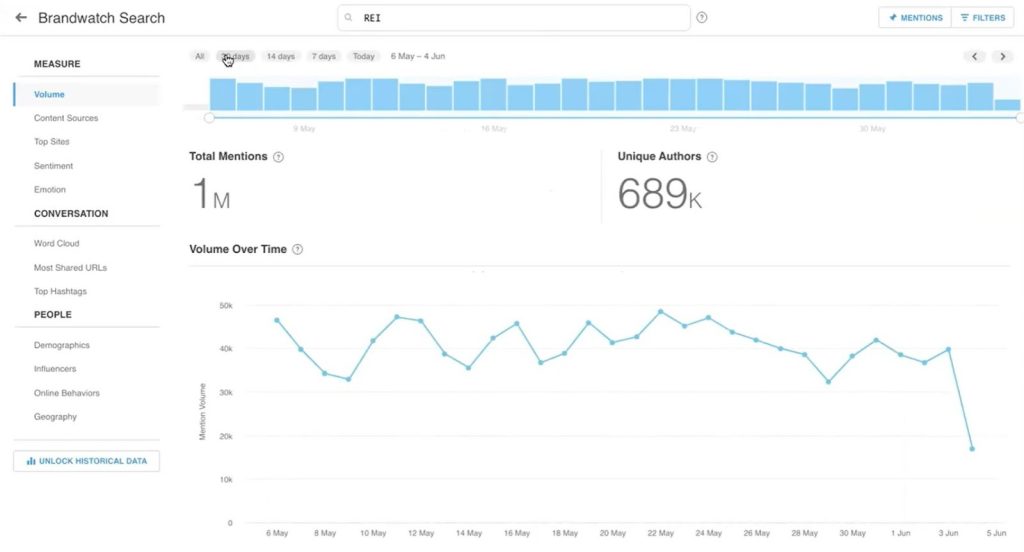
Brandwatch is one of the most established consumer intelligence and social listening platforms. Now part of Cision’s portfolio, it is designed to help enterprise brands understand online conversations, track competitor share of voice, and surface trends across social media, news, forums, and beyond.
Its core product, Brandwatch Consumer Research, is built on a dataset of 1.7 trillion historical conversations going back to 2010, with 501 million new conversations added every day from 100 million unique sites. Its AI, Iris, enables the platform’s automated insights, anomaly detection, and natural language search.
Key features of Brandwatch
- Social Listening with AI-Powered Query Customization: It scans millions of social posts in real time, with a query builder that lets analysts control which signals to surface or exclude. Iris AI automatically detects patterns and anomalies, surfacing insights that would otherwise require manual analysis.
- Sentiment and Emotion Analysis: Brandwatch’s NLP-powered sentiment engine goes beyond positive/negative scoring, breaking down conversations by specific emotions, including anger, disgust, fear, joy, surprise, and sadness, making it one of the most detailed emotion analysis tools.
- Competitive Benchmarking: Teams can define a competitive set and track share of voice, sentiment, audience engagement, and brand presence across all major social channels and online sources, and compare key performance metrics side by side in a single dashboard.
- Image and Logo Recognition: Brandwatch scans a database of 30,000+ logos to surface visual mentions of a brand, even when the brand name is not mentioned in text. This protects brand reputation and surfaces earned media that text-based listening would miss.
- Social Media Management Suite: Brandwatch provides an integrated SMM tool that includes a unified publishing inbox, content calendar, engagement workflows, and an influencer management solution.
- Crisis Detection with Smart Alerts: Platform’s AI automatically detects spikes and drops in mention volume and flags negative sentiment shifts in real time, giving PR and communications teams early warning before a developing story gains momentum.
Brandwatch pros
- One of the most comprehensive consumer intelligence datasets available, with 1.7 trillion historical conversations going back to 2010 and 501 million new conversations added daily.
- Enterprise users consistently praise emotion-level sentiment analysis as more accurate and actionable than standard positive/negative tools.
- Visual content recognition captures brand appearances that text-only listening tools miss entirely.
- Highly customizable dashboards that scale across teams and use cases within large organizations.
- An integrated social media management suite, along with listening, reduces the need for a separate publishing tool.
Brandwatch cons
- Onboarding requires significant configuration effort, and new users face a steep learning curve before achieving reliable, clean output.
- Some users report data inaccuracies and gaps in social platform coverage that can affect the reliability of share-of-voice calculations.
- A breadth of features can become a liability for teams without a dedicated admin user, as consistently extracting actionable insights requires ongoing time investment.
Who is Brandwatch best suited for?
Brandwatch is best suited for enterprise marketing, PR, and consumer insights teams with dedicated research capacity who need the deepest available social data. It delivers the most value when analysts can invest time in building precise queries, custom dashboards, and recurring reports, and when the organization needs to understand not just what competitors are saying but how audiences are also responding.
2. Sprout Social
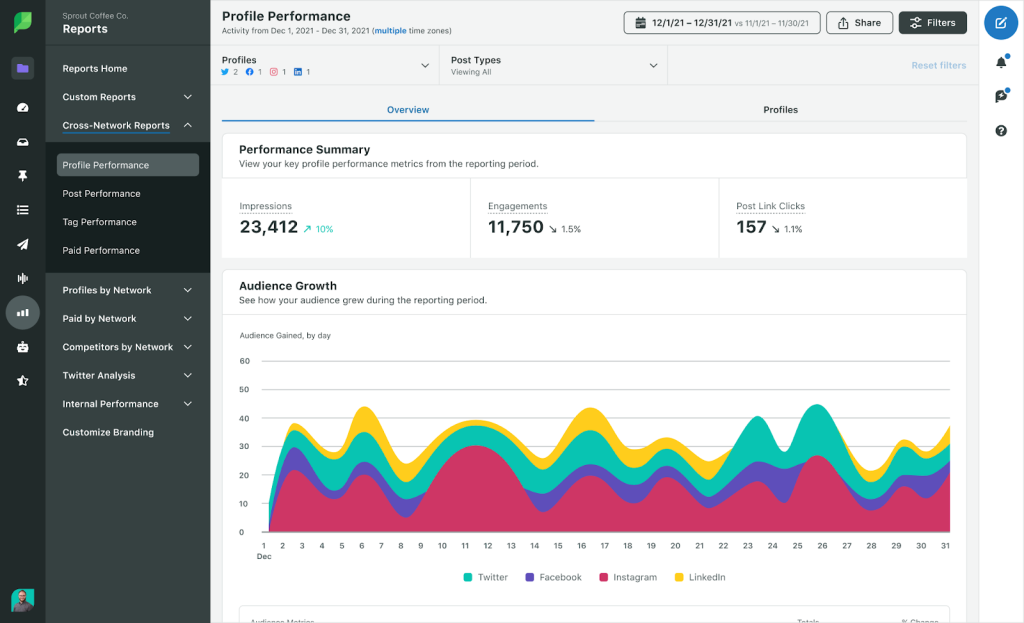
Sprout Social is a comprehensive social media management platform that combines publishing, engagement, analytics, and competitive reporting in a single suite. Founded in 2010, the platform serves organizations across a wide range of industries, from mid-market businesses to global enterprises.
While Sprout Social is primarily a social media management tool, its built-in competitor reports and optional social listening add-on make it a good choice for teams that want to benchmark their social performance against competitors without leaving the platform they already use to manage their channels.
Sprout Social key features
- Publishing and Content Calendar: A collaborative content calendar with multi-profile scheduling, bulk upload of up to 350 messages at once, and message approval workflows. ViralPost send-time optimization, Sprout’s patented technology, delivers content at optimal times based on audience engagement patterns.
- Competitive Performance Reports: Sprout’s competitor reports benchmark your brand against defined rivals across Meta, Instagram, and X on metrics including audience growth, post frequency, engagement rate, and content performance.
- Social Listening with Trellis AI: Sprout’s listening tool, built around its Trellis AI agent, tracks brand mentions, competitor names, keywords, hashtags, and sentiment across social platforms, forums, and review sites. Topic Themes let different teams within an organization isolate the portion of the conversation most relevant to their specific function.
- Smart Inbox for Customer Engagement: All incoming messages, comments, mentions, and DMs across platforms flow into a single prioritized queue with automated routing, collision detection, CSAT survey tools, and customer profile management.
- Analytics and Custom Reporting: Cross-network performance reports, audience demographic breakdowns, paid campaign tracking, and a custom report builder with scheduled delivery make Sprout’s analytics output polished enough to go directly to executive stakeholders.
Sprout Social pros
- A comprehensive social listening and management platform that combines publishing and monitoring tools.
- Smart Inbox efficiently manages high-volume customer service by preventing duplicate responses through smart organization.
- Analytics reports are polished and ready for executives.
- Broad platform coverage across X, Facebook, Instagram, LinkedIn, TikTok, YouTube, and more.
- Its collaboration features suit agencies and large teams managing multiple brands.
Sprout Social cons
- Per-seat pricing at $199/month makes Sprout one of the priciest tools in its category, with costs increasing rapidly as team size grows.
- Social listening is an add-on, not in any core plan, which raises total ownership costs for teams needing analytics and monitoring.
Who is Sprout Social best suited for?
Sprout Social is best suited for mid-to-large enterprises, global brands, and digital agencies that need publishing, customer engagement, and competitive social analytics running in a single system. It is particularly well-suited for teams that already manage their social channels on a single platform and want to layer in competitor social performance tracking without adding a separate tool.
3. Talkwalker
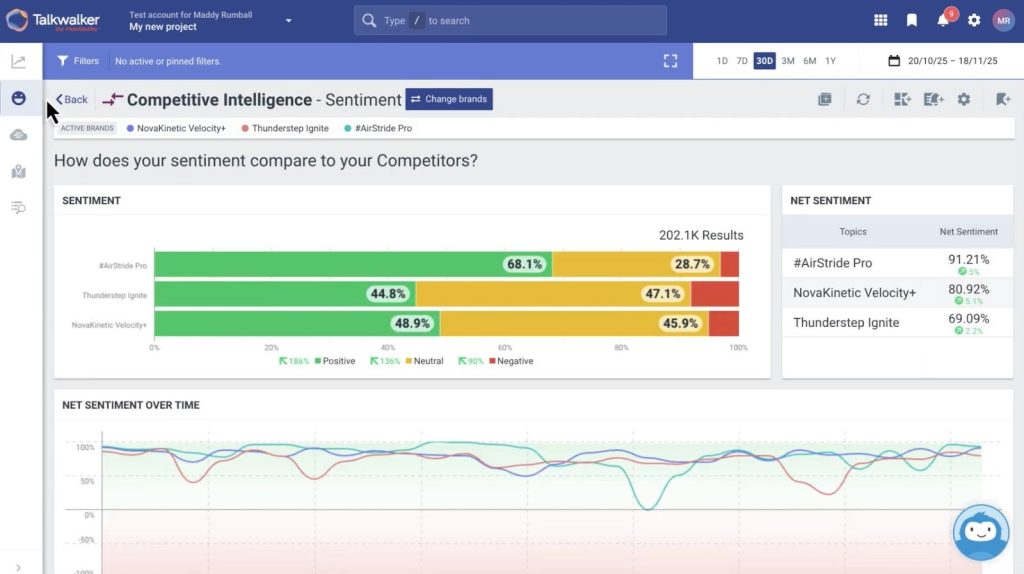
Talkwalker, now part of Hootsuite following its April 2024 acquisition, is a social listening and media monitoring platform. Its technology now powers Hootsuite Listening, available to all Hootsuite plan users in a basic version and as an enterprise add-on for deeper coverage. It covers both social and traditional media, with coverage in over 180 languages across 150 million websites.
Talkwalker key features
- Real-Time Cross-Channel Monitoring: Talkwalker tracks mentions and conversations in real time across social media, news, blogs, forums, review sites, and broadcast media, with results filterable by boolean query, sentiment, language, geography, and more. The precision query system is effective for monitoring nuanced topics in complex or regulated industries, where generic keyword tracking produces too much noise.
- Blue Silk AI: Talkwalker’s proprietary AI model for social listening analyzes data and conversations at scale, creates easy AI summaries, detects spikes and anomalies in real time, forecasts trend volumes, and predicts emerging topics before they go mainstream.
- LLM Insights: Talkwalker’s LLM Insights helps teams see how their brand and competitors appear across AI assistants like ChatGPT, Gemini, Claude, and Perplexity.
- Image and Logo Recognition: Talkwalker’s image recognition technology detects brand logos in images, photos, and videos across the web, surfacing visual brand mentions and earned-media coverage that text-based listening would miss.
- Competitive Benchmarking: Side-by-side analysis of competitors’ performance covers share of voice, engagement, content themes, and sentiment trajectory over time. Teams can track how competitor messaging campaigns or PR events are shifting audience perception and compare their own positioning accordingly.
- Crisis Management Alerts: Configurable alerts for volume spikes, keyword surges, and sentiment changes give PR teams early warning of developing issues. Alerts can be layered with geographic and channel filters for organizations managing brand risk across multiple markets or business units.
Talkwalker pros
- Offers broad global coverage with 180+ languages across 150 million websites, including social and traditional media, valuable for multinational brands.
- Blue Silk AI delivers platform-native AI summaries, anomaly detection, and trend forecasting built specifically for social listening use cases.
- LLM Insights is a differentiated capability for brands that want to understand how they are represented in AI-generated answers, a growing brand monitoring priority.
- Extensive customization of search terms, queries, and dashboard configurations allows teams to build highly tailored monitoring environments.
- Customer support is frequently highlighted by users as a differentiating positive, with active involvement during onboarding and ongoing use.
Talkwalker cons
- Some users have noted that noise management requires careful query refinement, as broader searches can surface a large volume of irrelevant content.
- Pricing is enterprise-level and not publicly disclosed, requiring a full sales engagement to assess cost fit.
Who is Talkwalker best suited for?
Talkwalker is best suited for enterprise PR, communications, and global consumer insights teams that need multilingual coverage of brand and competitor conversations across both social and traditional media. It is particularly valuable for organizations managing brand reputation across multiple markets and languages, or those that want to stay ahead of AI-generated brand narratives through LLM Insights.
4. Meltwater
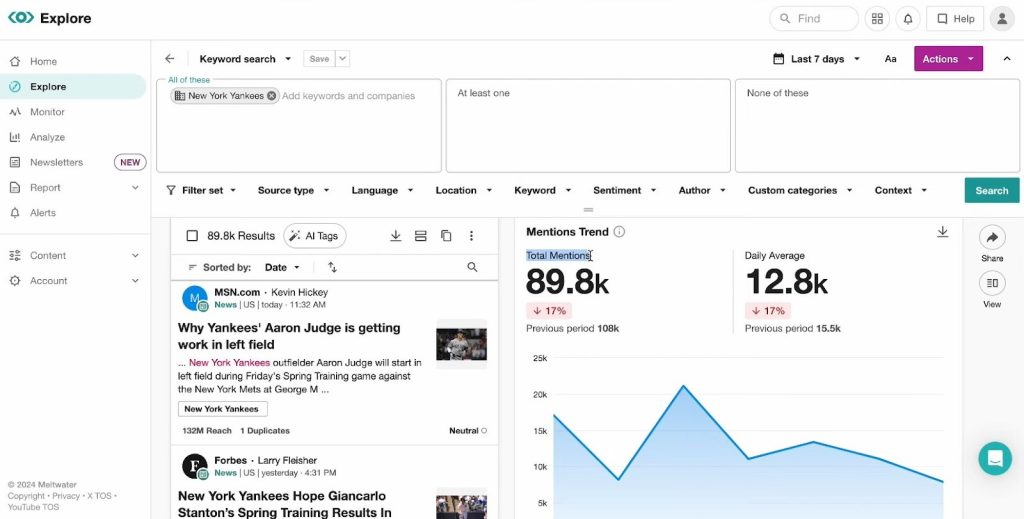
Meltwater is a media and social monitoring platform that covers over 270,000 global news sources, 15+ social media channels, 25,000+ podcasts, and broadcast media, ingesting over 500 million pieces of new content every day.
Meltwater’s product footprint covers media monitoring, social listening, consumer insights, influencer marketing, press distribution, and its GenAI Lens product, which monitors how brands and competitors are discussed across leading AI assistants like ChatGPT, Gemini, and Perplexity.
Meltwater key features
- Cross-Channel Monitoring Across News and Social: Meltwater tracks major social platforms (X, Facebook, Instagram, YouTube, TikTok, Snapchat, Reddit) as well as news, blogs, forums, and broadcast media. It offers a 15-month rolling archive and full X Firehose access for historical analysis and year-on-year comparisons.
- Mira AI Assistant: Meltwater’s AI assistant, Mira, helps users generate reports, analyze trends, and surface key insights from their monitoring data using natural language prompts. Mira Studio enables interactive search and analysis directly within the platform.
- AI-Powered Sentiment Analysis and Audience Dashboards: NLP-powered sentiment analysis surfaces tone across monitored content, with dashboards showing potential reach, social echo (engagement amplification), share of voice, top posters by volume and reach, geographic heat maps, and trending themes.
- GenAI Lens for AI Visibility Tracking: Meltwater’s GenAI Lens tracks how AI assistants like ChatGPT, Claude, and others reference brands. It includes filters for model, prompt, and date, enabling teams to monitor AI search visibility alongside traditional media presence as they converge.
- Competitive Benchmarking and Share of Voice: Teams can define a competitive set and benchmark brand performance against rivals across sentiment, coverage volume, channel engagement, and share of voice over time, tracking how competitor campaigns and announcements are landing with audiences.
- Automated Alerts and Reporting: Real-time alerts for volume spikes, keyword trends, and crisis signals are sent to the app or via email. Automated dashboards and scheduled reports can be configured to run on autopilot, minimizing manual work for recurring stakeholder updates.
Meltwater pros
- Combines social media and traditional media monitoring on a single platform, eliminating the need to run separate tools for PR and social teams.
- GenAI Lens is a differentiated capability for organizations that track AI model visibility alongside traditional brand coverage.
- Intuitive interface praised consistently by users, with easy initial setup, a Meltwater Academy for ongoing training, and responsive customer support.
- Full X Firehose access and a 15-month social archive enable robust historical trend analysis that many social-only tools lack.
- Share of Voice analytics and executive-ready dashboards translate data into clear competitive reporting that stakeholders can act on.
- Influencer marketing suite connects influencer performance to media monitoring and consumer insights, consolidating what would otherwise require separate tools.
Meltwater cons
- Users have noted delays in social data processing, which is a meaningful limitation for teams needing to respond in real time to breaking conversations.
- The platform has a noticeable learning curve and can feel complex to navigate before teams are comfortable with query configuration and dashboard setup.
Who is Meltwater best suited for?
Meltwater is best suited for enterprise communications, PR, and marketing teams that need a single platform to cover social media and traditional media monitoring without running two separate tools. It is a particularly strong fit for organizations with active PR programs, regular stakeholder reporting requirements, and optimizing AI model visibility alongside conventional brand monitoring.
Choosing the right competitor research and analysis software tool
With 15 tools across three very different categories, narrowing down the right choice requires knowing exactly what kind of competitive research and analysis your team actually needs to run and who needs to use it.
The most common mistake teams make is evaluating all these tools against the same criteria. A social media manager comparing Brandwatch to Contify, or an SEO lead comparing Semrush to Klue, is asking the wrong question. Start here instead.
Here is the process to go through when considering a solution:
1. First, identify which category matches your core use case:
- Purpose-built competitive intelligence platforms (Contify, Klue, Crayon, Valona, AlphaSense, Kompyte) are the right starting point if your team needs to continuously monitor competitors, distribute intelligence across functions, and produce outputs such as battlecards, dashboards, newsletters, and company profiles.
- SEO and digital marketing tools (Semrush, Similarweb, SpyFu, Moz Pro, Ahrefs) are the right fit if your priority is tracking competitors’ keyword rankings, backlink strategies, paid campaigns, traffic performance, and content strategies.
- Social media monitoring tools (Brandwatch, Sprout Social, Talkwalker, Meltwater, Rival IQ, BuzzSumo) are the right fit if your focus is on brand presence, share of voice, audience sentiment, or content benchmarking across social channels.
2. For purpose-built competitive intelligence platforms:
- Scope of intelligence coverage: Does the platform track only competitors, or can it also cover customers, partners, key accounts, industry trends, and regulatory developments? Narrow-scope tools like Crayon and Kompyte work well when your use case is purely sales-focused competitive enablement. For a market intelligence program that taps into and supports sales enablement and strategic decision-making use cases, Contify is the best fit.
- Data quality and noise management: Noise is the primary reason CI programs face adoption challenges by end users. While every platform in the market claims clean feeds, only a few have noteworthy capabilities. Ask vendors to demonstrate firsthand how they ensure noise filtering, and if they use technologies such as deduplication, disambiguation, and AI relevance filtering.
- AI depth beyond chat: A conversational AI interface is now table stakes. Evaluate whether the platform can auto-update insights and deliverables such as battlecards, dashboards, and company profiles as new intelligence flows in. Also, check how the vendor ensures accuracy, traceability, and auditability of information, so teams can trust outputs without manual verification.
- Customization and taxonomy flexibility: Assess the platform’s customization capabilities to support your M&CI workflows and stakeholder needs. Fixed offerings force you to adapt your process to the tool. Flexible platforms should feature custom source integration, a flexible taxonomy builder, curated news feeds, role-specific auto-updating insights with prompt-edit options, and customizable dashboards.
- Distribution and stakeholder reach: Intelligence that stays within a platform is not used. Evaluate how the platform pushes intelligence into newsletters, Slack, MS Teams, CRM, and Snowflake, and whether you can send to unlimited subscribers without per-seat costs inflating as the program scales.
3. For SEO and digital marketing tools:
- Keyword database breadth and freshness: A larger keyword database (Semrush at 27 billion, Ahrefs at 28.7 billion) surfaces more long-tail opportunities and competitive gaps. For niche or regional markets, verify coverage depth specifically for your industry before committing.
- Backlink index quality vs. size: Ahrefs is widely regarded as the most accurate and freshest backlink index. Moz Pro and Semrush are strong alternatives, but run a test on a domain you know well to validate freshness.
- PPC intelligence needs: If paid search competitive analysis is a priority, SpyFu’s historical PPC depth is hard to beat at its price point. Semrush covers PPC, but at a significantly higher cost.
- Traffic estimation vs. rank tracking: Similarweb is stronger on traffic-source breakdowns and audience behavior. Semrush and Ahrefs are stronger on keyword rankings and backlink research. Many teams use both.
- AI search and AEO coverage: With AI-generated search results reshaping how buyers discover information, check whether the platform tracks brand and competitor visibility in ChatGPT, Gemini, and Google AI Mode. Semrush, Ahrefs (Brand Radar), and Similarweb (AEO) have all added meaningful capabilities here in recent times.
4. For social media monitoring tools:
- Depth vs. ease of use: Brandwatch and Talkwalker offer the deepest datasets and most customizable query builders, but they require dedicated analyst capacity to extract consistent value. Sprout Social and Meltwater are significantly easier to adopt for teams without specialist social data skills.
- Social-only vs. cross-channel coverage: If you also need to track brand and competitor mentions across news, podcasts, and broadcast media, Meltwater and Talkwalker cover all channels on a single platform. Brandwatch and Sprout Social are primarily social-focused.
- Social management vs. pure listening: If you need competitive benchmarking and a social media publishing and engagement tool in the same platform, Sprout Social is the strongest option. Brandwatch also includes a management suite, but at an enterprise price point.
- AI model visibility: If tracking how your brand and competitors appear in LLM responses is a priority in 2026, Talkwalker (LLM Insights), Meltwater (GenAI Lens), and Brandwatch have all added this capability.
Try Contify for free
If you are building or scaling a continuous, cross-functional market and competitive intelligence program, start your 7-day free trial of Contify and see why Fortune 500 companies and fast-growing enterprises trust it for the industry’s cleanest, most actionable market and competitive insights.