Last updated
Jun 3, 2026
Last updated
Jun 3, 2026


Summary
This blog breaks down how to conduct both company SWOT and competitor SWOT to systematically evaluate internal strengths and weaknesses alongside external opportunities and threats. It explains how comparing the two reveals competitive gaps, strategic advantages, and potential risks in your market. The focus is on turning these structured insights into clear, data-driven actions that strengthen positioning and decision-making.
In today’s world of fast decision cycles and intense competition, strategy teams cannot afford to be shallow in their analysis. Every business, including yours, needs to adapt to an environment where product differentiation is harder to sustain; market conditions change faster than ever; and competitors emerge from all directions.
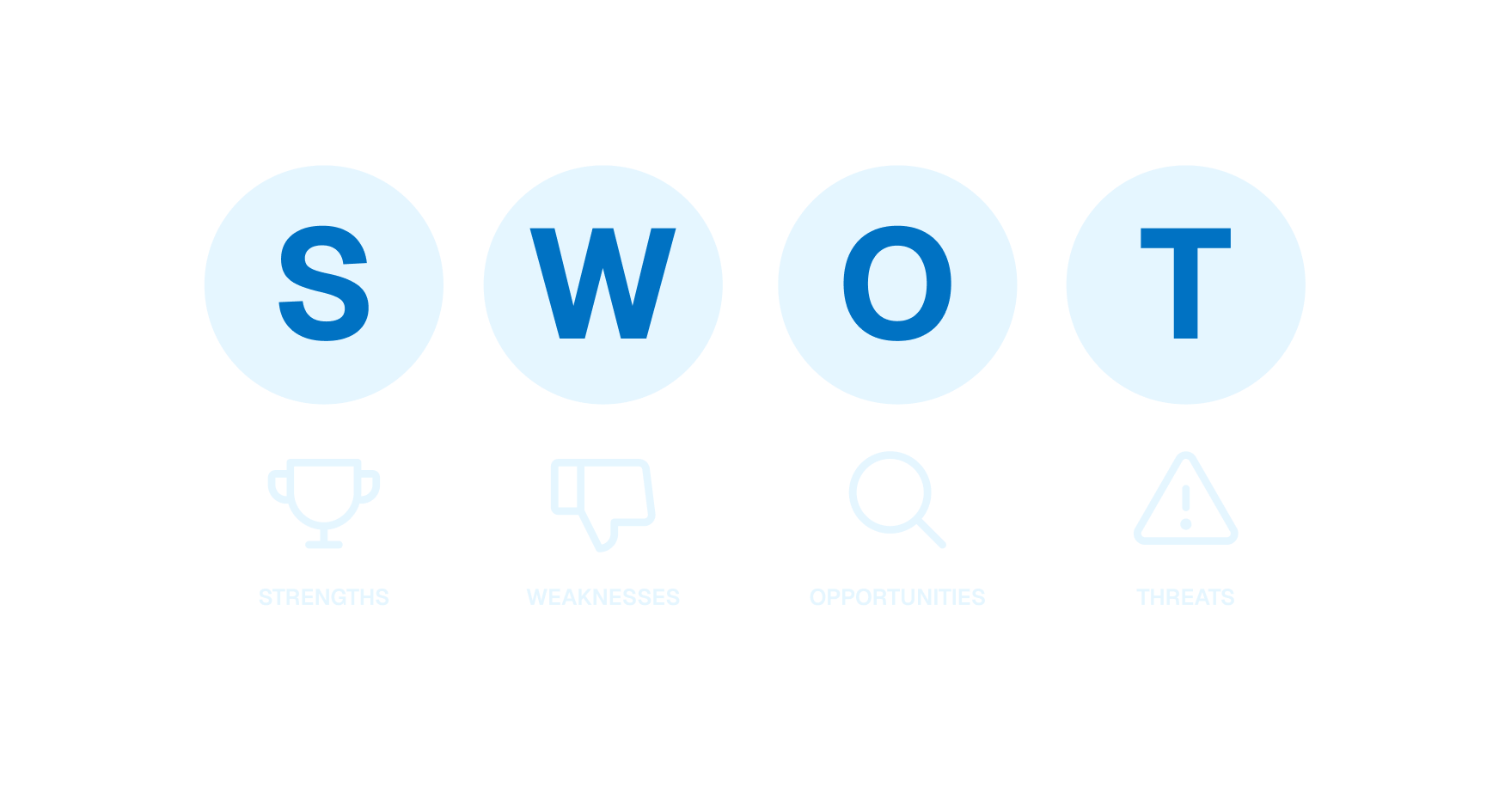
This is exactly what makes SWOT (Strengths, Weaknesses, Opportunities, Threats) analysis relevant, even in 2026.
It’s not that it’s a legacy framework; rather, it offers a classical way for leaders to cut through the noise and focus on what matters. A SWOT analysis provides a coherent picture of your business’s strengths and vulnerabilities, potential growth areas, and emerging risks.
A strategy leader in your firm can leverage a firm’s SWOT analysis to pressure-test expansion plans or reposition a product line, and to assess readiness to enter a new market. SWOT can be used by your product marketing teams to sharpen differentiation in a crowded category. Your competitive intelligence team can analyze competitors’ SWOT analyses to understand how they are evolving their positioning, capabilities, market bets, and more. Even your leadership team may use it to align investment decisions with external conditions rather than internal optimism.
This framework is relevant even in 2026 because it is simple. It forces your firm to assess itself through two perspectives simultaneously, which are:
- What is taking place in your organization?
- What is happening outside of your organization?
That combination is what makes this framework strategically useful. Organizations do not fail solely because of their weaknesses. They fail when external threats exploit those weaknesses. Likewise, companies do not just automatically grow when opportunities arrive. They grow because their capabilities enable them to seize those opportunities before others.
Many teams also get the SWOT analysis wrong here. They view it as a brainstorming data sheet rather than a decision-making tool. Participants fill in a matrix with general phrases like ‘strong brand’ or ‘high competition,’ and that’s it. This produces documentation and not insight.
A high-quality SWOT analysis should do more than just list. This should assist with questions like:
- Which strengths truly generate a sustained competitive advantage?
- What weaknesses are hindering execution, adoption, or growth?
- Which market opportunities are plausible, timely, and commercially essential?
- What are the potential threats to revenue, margin, retention, or market share?
- What should the strategic actions be that stem from these conclusions?
What is SWOT Analysis?
A SWOT analysis (work of Albert Humphrey, a management consultant who was part of the Stanford Research Institute (SRI), tracing back to the 1960s) can be defined as a structured strategic framework used to evaluate four core factors that influence business performance:
Strengths (S): Internal capabilities, assets, or advantages that help a company compete and execute effectively
Weaknesses (W): Internal limitations, capability gaps, or structural issues that reduce performance or create friction
Opportunities (O): External conditions, shifts, or trends that the business can exploit for growth, differentiation, or expansion
Threats (T): External risks that may weaken performance, reduce market share, increase costs, or limit future growth
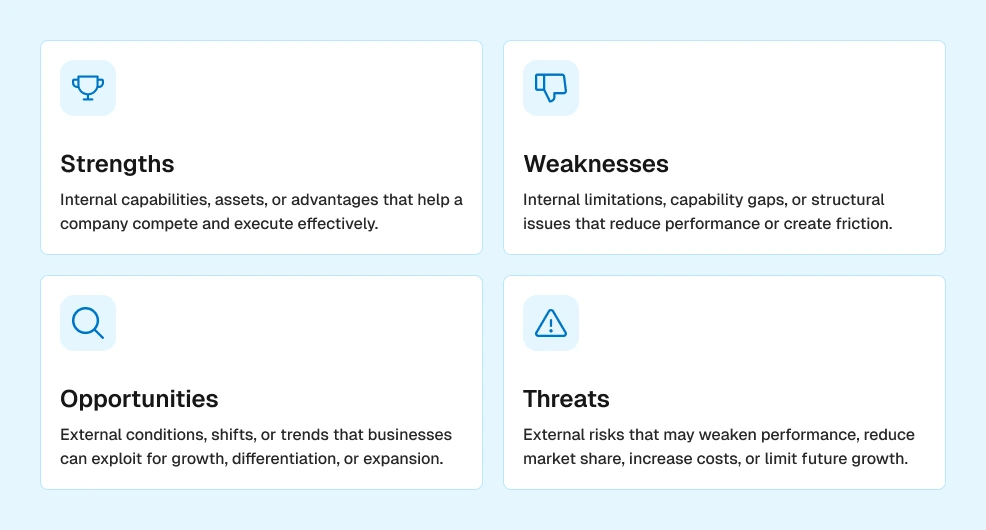
What matters is how these four elements come together. SWOT is a process for assessing whether your internal readiness aligns with external market realities. That’s the reason why the framework is often depicted in a SWOT matrix. The matrix facilitates the simultaneous evaluation of internal and external factors, allowing teams to transition from observation to action with ease.
A SWOT analysis provides information on whether your business is suited to compete effectively in its environment and, if not, what must change for it to do so.
SWOT Analysis in Business Strategy
In business strategy planning, SWOT analysis is a decision-support model that helps leadership teams make sharper calls about growth, investment, positioning, transformation, and risk.
For example, using SWOT analysis, your company may identify the following:
- A strong customer retention rate as a strength
- Slow enterprise implementation cycles as a weakness
- Rising demand for AI-enabled workflows as an opportunity
- Aggressive pricing from a well-funded competitor as a threat
Your business can have a strong product and still lose market momentum. It can have a large customer base and still be vulnerable to disruption. It can identify a major opportunity but still fail to capture it because your internal capabilities are not in place. SWOT analysis helps highlight these disconnects early.
This is especially useful in fast-moving sectors such as SaaS, technology, financial services, healthcare, cybersecurity, and digital media, where your strategy must respond to changing customer expectations, market shifts, and competitive positioning at speed.
Purpose of SWOT Analysis in Strategic Planning
The purpose of SWOT analysis is to improve the quality of strategic thinking and reduce the risk of blind spots. A strong SWOT analysis supports strategic planning in five important ways.
1. It clarifies where your business actually stands
Many organizations operate with conflicting internal views about performance, capability, and market position. SWOT brings those views into one framework and forces clearer judgment. That is particularly valuable when leadership teams are evaluating high-stakes moves such as market expansion, repositioning, pricing changes, product investment, or acquisition strategy.
2. It improves prioritization
Strategy often fails because teams try to do too much at once. A robust SWOT helps identify which issues are strategically important and which are secondary. It separates real growth levers from distracting ideas.
3. It strengthens market responsiveness
External conditions change fast. New entrants emerge, customer expectations shift, regulations evolve, and AI changes category economics. SWOT helps businesses interpret these changes through the perspectives of internal readiness.
4. It makes competitive analysis more actionable
When used for competitor analysis, SWOT helps you interpret competitor actions to identify strengths, weaknesses, strategic intent, and potential risks.
5. It supports better cross-functional alignment
A useful SWOT is easy for your leadership, product, marketing, sales, and intelligence teams to understand. That shared visibility helps align planning, execution, and messaging across functions.
That is also one of the reasons why SWOT analysis is still widely used alongside newer methods such as market sensing, scenario planning, win-loss analysis, category intelligence, and AI-assisted research. SWOT does not replace those approaches but expedites them.
Why SWOT Analysis is Important for Your Business
Identifying Competitive Strength
Every organization has strengths, but not all strengths are strategically meaningful. A strong brand, for example, may drive awareness but not conversion. A large customer base may not translate into expansion revenue. A robust product may still lose in the market if positioning is weak.
SWOT analysis helps you isolate which strengths actually create a competitive advantage.
This involves asking sharper questions:
- Which capabilities are difficult for your competitors to replicate
- Which assets directly influence customer acquisition, retention, or pricing power
- Which of your strengths align with current and emerging market demand
For example, in a SaaS environment, strengths such as fast deployment, strong integrations, or AI-enabled automation directly impact time-to-value and customer stickiness. These are not just features but strategic levers.
By identifying and prioritizing these strengths, you can:
- Double down on differentiation in crowded markets
- Align messaging with real value drivers
- Allocate resources toward scalable advantages
This is a key reason why a SWOT analysis is widely used in go-to-market (GTM) and positioning strategies.
Understanding Market Opportunities
Opportunities are often the most misinterpreted element of SWOT analysis. Many teams list broad trends such as “market growth” or “digital transformation” without evaluating whether those trends are accessible, relevant, or monetizable for their specific business.
A more effective approach is to treat swot opportunities as actionable growth pathways rather than abstract trends.
This requires:
- Connecting external trends to internal capabilities
- Assessing timing and readiness
- Evaluating commercial impact, not just strategic appeal
For instance, the rise of AI across industries presents a clear opportunity. However, the real question is whether your business has:
- The data infrastructure to support AI use cases
- The product architecture to integrate AI features
- The market positioning to capture AI-driven demand
Without this alignment, opportunities remain theoretical. SWOT analysis helps you filter opportunities through a practical perspective, enabling you to:
- Prioritize high-impact growth areas
- Enter new markets with greater confidence
- Identify adjacent use cases or customer segments
This is particularly valuable in industries where innovation cycles are fast, and opportunity windows are short.
Supporting Strategic Decision Making
At its core, the purpose of SWOT analysis is to support better decisions. Strategy is often constrained by uncertainty. Leaders must decide where to invest, what to prioritize, and how to respond to competitors without having complete information. SWOT analysis reduces this uncertainty by structuring available insights into a coherent view.
It supports decision-making in areas such as:
- Market entry and expansion strategy
- Product roadmap prioritization
- Pricing and packaging decisions
- Competitive positioning and messaging
- Risk management and contingency planning
For example, when evaluating a new market, a SWOT analysis can highlight:
- Whether your company’s strengths align with local customer needs
- Whether internal weaknesses could slow execution
- Whether the opportunity is large enough to justify investment
- Whether competitive threats are already entrenched
This structured view enables leadership teams to make strategic, realistic decisions.
In addition, SWOT analysis plays an important role in continuous strategy cycles. When integrated with competitive intelligence platforms, market signals, and performance data, SWOT analysis becomes a dynamic decision tool.
How To Do SWOT Analysis: A Step-by-Step Guide
Below is a step-by-step SWOT analysis process that can be used for both your internal strategy and competitor SWOT analysis.
Step 1: Define the Business Objective
Every effective SWOT starts with a clear objective. Without a defined goal, the analysis becomes too broad and loses strategic value. The objective determines what data you collect, what factors you prioritize, and how you interpret insights.
Typical reasons for conducting SWOT analysis include:
- Evaluating market entry into a new region or segment
- Assessing product positioning in a competitive category
- Supporting annual or quarterly strategic planning
- Conducting a swot analysis of a company before investment or acquisition
- Performing competitor SWOT analysis to understand rival positioning
A well-defined objective should answer the following questions:
- What decision are we trying to support
- What scope are we analyzing (product, business unit, or entire company)
- What timeframe are we considering
For example, instead of saying “analyze our business,” a stronger objective would be:
“Assess our competitive position in the enterprise SaaS market over the next 12 months.”
Step 2: Identify Internal Strengths and Weaknesses
Once the objective is clear, the next step is to evaluate internal factors. This is where teams often rely too heavily on perception. A more effective approach is to ground the analysis in data.
A few sources to consider for gauging data include:
- Product performance metrics and usage data
- Customer feedback, reviews, and win-loss analysis
- Sales cycle data and conversion rates
- Financial performance and cost structures
- Operational efficiency and delivery timelines
When identifying your strengths, focus on capabilities that directly impact revenue, retention, or expansion; assets that competitors cannot easily replicate; and areas where your company consistently outperforms peers.
When identifying your weaknesses, assess execution or delivery bottlenecks, gaps in product, pricing, or positioning, areas where competitors consistently win deals, and internal dependencies that limit scalability.
Step 3: Conduct Market Opportunity Analysis
Opportunities should be derived from real market signals, not assumptions.
This step requires analyzing external data sources such as:
- Industry reports and analyst insights
- Customer demand trends and search behavior
- Emerging technologies such as AI, automation, or platform shifts
- Competitor product launches, partnerships, and investments
- Regulatory or economic developments
The goal is to identify actionable opportunities, not just trends.
To do this effectively, you can ask the following questions:
- Is this opportunity aligned with our strengths
- Do we have the capability to execute on it within a reasonable timeframe
- What is the potential impact on revenue or market share
For example, identifying “AI adoption” as an opportunity is too broad. A more actionable insight would be: “Growing demand for AI-driven workflow automation in mid-market enterprises aligns with our existing product architecture.”
Step 4: Evaluate External Threats
Threat analysis requires a forward-looking perspective. Rather than listing obvious risks, you should focus on threats that could materially impact performance in the near to medium term.
Key sources of threat intelligence include:
- Competitor strategy shifts, such as pricing changes or repositioning
- New entrants or startups with disruptive models
- Changes in customer expectations or buying behavior
- Macroeconomic pressures affecting budgets or demand
- Technological disruption, especially AI-led innovation
When evaluating threats, prioritize them based on likelihood of occurrence, potential business impact, and the speed at which they could materialize.
For example, a competitor introducing a lower-priced product tier may affect acquisition, and a platform shift toward AI-native solutions may affect long-term relevance.
Step 5: Build the SWOT Matrix
Once all inputs are gathered, the next step is to structure them into a SWOT matrix. This is where your insights are synthesized and made actionable.
A typical SWOT matrix looks like this:
| Internal Factors | External Factors |
| Strengths | Opportunities |
| Weaknesses | Threats |
To make the SWOT matrix useful, teams should:
- Prioritize the most impactful factors in each quadrant
- Eliminate generic or low-value inputs
- Link internal and external elements to identify strategic actions
For example, you can use your strengths to capitalize on opportunities, address weaknesses that increase exposure to threats, and identify areas where strengths can offset competitive risks.
The final output should be a set of clear strategic implications, such as:
- Invest in specific capabilities
- Enter or exit certain markets
- Adjust positioning or pricing
- Respond to competitive moves
Sample SWOT Analysis for a Company (Supply Chain-Dependent Manufacturing Company)
Let’s consider a global manufacturing company in the consumer electronics sector that relies heavily on international suppliers and just-in-time inventory systems.
Objective
Evaluate resilience and competitive positioning amid ongoing global supply chain disruptions.
SWOT Matrix
| Strengths | Weaknesses | Opportunities | Threats |
| Diversified supplier base across multiple regions | High dependence on overseas manufacturing hubs | Shift toward supply chain digitization and predictive analytics | Geopolitical instability affecting trade routes |
| Strong relationships with key logistics partners | Limited real-time visibility across supply chain tiers | Nearshoring and regional manufacturing expansion | Rising logistics and raw material costs |
| Established brand and global distribution network | The lean inventory model is vulnerable to disruption | Increasing demand for supply chain transparency | Supplier concentration risks in critical components |
| Investment in digital supply chain tools | Slow decision-making due to centralized operations | Adoption of AI for demand forecasting and planning | Competitors are building more resilient supply networks |
This swot analysis example for a business highlights how internal and external factors interact in a disrupted environment. Here are the key takeaways from the SWOT analysis:
1. Strength does not equal resilience
While the company has a diversified supplier base, its reliance on overseas manufacturing exposes it to delays and geopolitical risks. This shows that not all strengths are future-proof.
2. Weaknesses amplify external threats
Limited visibility across supply chain tiers becomes a critical weakness when disruptions occur. Without real-time intelligence, response time increases and operational risk compounds.
3. Opportunities require capability alignment
The shift toward AI-driven supply chain planning is a clear opportunity. However, slow internal decision-making may prevent the company from capitalizing on it quickly.
4. Threats are systemic, not isolated
Rising costs, geopolitical instability, and competitor resilience are interconnected threats. Addressing them requires structural changes, not short-term fixes.
Competitor SWOT Analysis
A competitor SWOT analysis helps you answer these specific questions: where is this rival strong, where are they exposed, and what does that mean for your strategy?
By doing this, you avoid making two common mistakes:
- Overreacting to visible competitor activity
- Underestimating structural weaknesses behind strong market perception
For competitive intelligence, the value of SWOT is in turning competitor signals into strategic conclusions that your product, marketing, sales, intelligence, and leadership teams can act on.
How to Perform a SWOT Analysis for Competitor Research
When performing SWOT analysis for Competitor Research, it is best to start with a narrow scope. Do not analyze a competitor at the company level unless your objective is set accordingly. Focus on a product line, customer segment, geography, or a strategic move such as AI positioning, enterprise expansion, or a pricing change.
Then gather evidence from current, observable sources such as:
- Product releases and roadmap signals
- Pricing and packaging updates
- Customer reviews and implementation feedback
- Win-loss notes from sales
- Earnings calls, investor decks, and leadership commentary
- Partnership announcements
- Hiring patterns by function and region
Once the evidence is collected, sort it into four questions:
Strengths: What does the competitor do consistently well that affects win rates, retention, expansion, or pricing power?
Weaknesses: Where does the competitor show execution gaps, customer friction, or capability limitations?
Opportunities: Which market shifts are likely to improve the competitor’s position if they execute well?
Threats: Which external changes could weaken their current advantage or slow their growth?
Competitive Strength Analysis
Do not treat every visible capability as a strength. For example, frequent feature launches are not automatically a strength. They matter only if they improve customer outcomes or buying decisions.
A better way to assess strength is to ask questions like: Is the capability proven in the market? Does it affect commercial performance? Can the competitor sustain it over time? Is it differentiated? Can others match it easily?
How to Identify Competitor Weaknesses Reliably
Competitor weaknesses can be inferred from several intelligence signals. These indicators include:
- Recurring complaints in customer reviews
- Long onboarding or deployment cycles
- Missing functionality in strategic use cases
- Discount-heavy selling
- Weak support experience
- Inconsistent positioning across channels
- Delayed response to category shifts, such as AI adoption or platform changes
For example, one negative review does not indicate a weakness. Repeated complaints across reviews, analyst commentary, and sales feedback usually do. A useful weakness can be a strategic asset for your team. It should point to a place where you can win on product, messaging, customer experience, or execution.
Competitor Opportunities and Threats
Strengths and weaknesses explain how a competitor performs today. Opportunities and threats explain where that performance is likely to shift. This is where most SWOT analyses lose depth. Teams either list generic trends or overstate risks without linking them to actual competitive impact.
A useful competitor SWOT analysis treats opportunities and threats as directional signals. They indicate where your competitor is likely to gain an advantage or become vulnerable.
Identifying Competitor Opportunities
Not every market trend is a competitor opportunity. It becomes one only when the competitor is positioned to act on it. Start with observable market changes and then test whether the competitor has already shown intent or capability in that direction.
Look for signals such as:
- Consistent product investments in a specific area
- Hiring patterns aligned with a new capability or segment
- Partnerships that expand reach or distribution
- Messaging shifts toward a new category or use case
- Early traction in a segment that is beginning to scale
The question is not whether the opportunity exists. It is whether the competitor can realistically capture it.
For example, demand for AI is widespread. That alone is not useful. If a competitor has already integrated AI into core workflows, has referenced customers, and is positioning around measurable outcomes, the opportunity becomes specific and near-term.
A strong opportunity should signal a likely shift in competitive dynamics, such as improved win rates, expansion into a new segment, or greater pricing leverage.
Evaluating Competitor Threats
Threats are often easier to list and harder to interpret. Your focus should not be on what could go wrong in general, but on what could weaken the competitor’s current advantage.
Start by identifying where the competitor is most dependent. This could be a segment, a pricing model, a distribution channel, or a product architecture.
Then assess what external changes could put pressure on that dependency.
Common patterns include:
- Simpler or lower-cost alternatives entering the same segment
- Shifts in customer expectations that make the current product harder to sell
- Platform or technology changes that reduce relevance over time
- Concentration risks, such as reliance on a small number of large customers or partners
For instance, a competitor that relies on long enterprise sales cycles may face pressure if buyers begin prioritizing faster implementation and quicker time-to-value. That is not just a market trend. It directly affects their ability to compete.
A useful threat highlights where performance could degrade, not just where risk exists.
Using These Insights in Strategy
This part of the SWOT is not about documenting the market. It is about anticipating competitor movement.
If a competitor has a clear path to capitalize on a market shift, you should expect pressure in that area before it becomes visible in pipeline or revenue data. If a competitor is exposed to a structural threat, it creates a window for your team to move faster, position more effectively, or win deals that were previously harder to secure.
The output should not be a longer list. It should be a sharper view of:
- Where the competitor is likely to become stronger
- Where they are likely to slow down
- What does that mean for your positioning, product focus, and execution priorities
Without this, competitor SWOT remains descriptive. With it, the analysis becomes predictive and far more useful for decision-making.
Downloadable Competitor SWOT Analysis Template (Structure)
You can replicate this competitor SWOT analysis template in a spreadsheet, document, or intelligence platform:
- Step 1: Define competitor and scope
- Step 2: Fill in strengths and weaknesses using internal and external signals
- Step 3: Map opportunities and threats based on market conditions
- Step 4: Rank each factor by impact (high, medium, low)
- Step 5: Add a final section: Strategic Implications
Example:
| Factor | Type | Impact | Evidence | Implication |
| Strong mid-market adoption | Strength | High | Win-loss data | Compete in the enterprise instead |
| Slow onboarding | Weakness | High | Customer reviews | Position on speed |
Common Mistakes To Avoid When Conducting a SWOT Analysis
The problem with most SWOT analysis efforts is not the framework. It is how loosely it is applied. Below is the common list of mistakes that one must avoid to reduce the value of a SWOT analysis, and its corrective measures:
Using Generic or Non-Actionable Inputs
The most common issue is a lack of precision. If a SWOT analysis includes inputs that could apply to any company in the category, it will not yield useful outcomes.
Examples of low-value inputs can include “Strong brand”, “High competition”, “Growing demand”, “Innovative product”, etc. A useful input must clearly define the factor and explain how it affects performance. For example:
- “Strong brand” becomes “high brand recall in mid-market, driving inbound pipeline and lowering acquisition cost.”
- “High competition” becomes “pricing pressure from lower-cost vendors reducing win rates in the SMB segment.”
Confusing Activity with Advantage
Many SWOTs overstate strengths by listing visible activities rather than proven advantages. Common examples include frequent product releases, AI feature announcements, expansion into new markets, partnerships, integrations, and more. These should be treated as signals, not conclusions, as is often the case.
A factor should be classified as a strength only if it improves customer acquisition, retention, or expansion, creates pricing power or a cost advantage, or is difficult for competitors to replicate. For example, launching AI features is not a strength unless customers adopt them, they improve outcomes such as productivity or decision-making, and they influence buying decisions.
Weak or Assumed Identification of Weaknesses
Weaknesses are often the least developed part of a SWOT because teams rely on assumptions rather than evidence. A reliable weakness should be observable through data or repeated signals, linked to execution gaps or lost opportunities, and relevant to competitive outcomes. Examples of this include:
- “Slow onboarding leading to delayed time-to-value and lower conversion from trial to paid”
- “Limited enterprise features reducing competitiveness in high-value deals”
In competitor SWOT analysis, weaknesses must be inferred from patterns such as customer complaints, feature gaps, and delayed response to market shifts.
Misclassifying Opportunities and Threats
Another common issue is treating opportunities and threats as generic market trends rather than as distinct factors. A few common examples of this can include statements like “AI is an opportunity” or “Competition is a threat”. These statements are partially complete because they do not explain relevance.
A valid opportunity or threat must be external to the business, directly connected to performance or positioning, and evaluated in the context of internal capability.
For example:
- Instead of “AI is an opportunity,” use “growing demand for AI-driven automation aligns with existing product architecture and can increase deal size.”
- Instead of “competition is a threat,” use “new entrants offering lower pricing models are increasing churn risk in price-sensitive segments.”
Lack of Prioritization
A SWOT analysis that lists too many factors becomes difficult to use. A few common factors that indicate a lack of priority include long, unranked lists in each quadrant, equal weighting of all inputs, and no distinction between high- and low-impact factors. This leads to analysis without direction.
A better approach in this situation would be to limit each quadrant to the most critical factors, rank inputs by business impact, and focus on factors that affect revenue, growth, cost, or risk. For example, a minor feature gap should not be given the same weight as a structural weakness such as high customer churn.
No Link Between SWOT and Strategic Decisions
The most critical failure when conducting SWOT analysis is stopping the assessment at the formation of the SWOT matrix. A SWOT analysis that does not lead to decisions has no value.
After completing the matrix, teams should explicitly define:
- Where to invest
- What to fix
- How to position
- Which risks to mitigate
- Which competitors to respond to
For example, a weakness in onboarding should translate into a product and customer success initiative, a competitor threat should lead to positioning or pricing adjustments, and an opportunity should trigger investment or a go-to-market focus.
Treating SWOT as Static in a Dynamic Market
Many organizations treat SWOT as a one-time exercise tied to annual planning. This approach fails in environments where competitors ship features continuously, AI is changing product expectations, pricing models evolve rapidly, and customer behavior shifts quickly.
A SWOT analysis built once becomes outdated faster than one can imagine.
To stay updated, the following practices can be incorporated:
- Update SWOT inputs regularly using new intelligence
- track how competitor strengths and weaknesses evolve
- Revisit assumptions when market conditions change
To stay on top of things, modern teams integrate SWOT with ongoing competitive intelligence workflows rather than treating it as a standalone activity.
How Modern Teams Use Intelligence Platforms like Contify for SWOT
Building a SWOT analysis manually is a grueling, time-intensive process. By the time your analysts sift through earnings calls, press releases, social media, and competitor websites to compile data, the final matrix is often outdated. Modern market and competitive intelligence (M&CI) teams are abandoning static documents. Instead, they use AI-native platforms like Contify to turn SWOT analyses into living, auto-updating frameworks that continuously reflect the realities of their market landscape.
Here is how you can leverage Contify to operationalize your SWOT analysis:
1. Automating continuous insight generation with Agentic AI
Instead of starting research from scratch every quarter, intelligence teams use Contify’s agentic AI engine, Athena, to synthesize millions of unstructured updates into decision-ready insights. The platform continuously extracts key data points, such as product launches, funding rounds, and M&A activities, and connects them contextually. By leveraging pre-built, customizable strategy frameworks, including SWOT templates, Contify automatically populates and refreshes these analyses as new intelligence flows into the system. This shifts the team’s focus from gathering data to interpreting strategic implications.
2. Grounding Strengths and Weaknesses in verified, noise-free data
A SWOT analysis is only as valuable as the evidence supporting it. Contify aggregates intelligence from over one million vetted global sources, including news, regulatory portals, job boards, and review sites, alongside a company’s internal data, such as CRM notes and sales call transcripts. When mapping a competitor’s Strengths and Weaknesses, the platform analyzes direct market signals such as customer sentiment, feature enhancements, and financial performance.
To ensure enterprise-grade reliability, Contify applies a multi-layered filtering process, including deduplication and GenAI-validated tagging, to deliver entirely noise-free intelligence feeds. Crucially, every AI-generated SWOT insight includes inline source citations linking back to the original evidence. This traceability eliminates the risk of AI hallucinations, enabling executives and strategy teams to rely on the analysis for high-stakes decision-making confidently.
3. Spotting Opportunities and Threats ahead of the market
Identifying external market forces requires continuous, 360-degree monitoring. Teams use Contify to track emerging Opportunities and Threats by monitoring shifts in industry regulations, technological disruptions, and competitor vulnerabilities.
- Visualizing Trends: Analysts use Contify’s One-Click Trend Analysis to instantly transform filtered intelligence datasets into dynamic charts, timelines, and topic clouds. This makes it easy to spot early market shifts or surges in competitor activity in specific regions.
- Detecting Distress Signals: By configuring smart filters, teams can automatically detect threat indicators, such as competitors’ operational challenges, layoffs, or negative news, enabling them to mitigate risks proactively.
- Eliminating Regional Blind Spots: Because crucial market signals often surface first in local-language publications, Contify monitors over 200,000 non-English sources and provides auto-translated intelligence in 117+ languages. This ensures that global threats and opportunities are captured instantly without requiring manual translation workflows.
4. Distributing actionable SWOT insights into daily workflows
An intelligence framework delivers zero value if it sits unread in a local drive. Modern teams ensure their SWOT analyses reach the right stakeholders by embedding them directly into role-specific, auto-updating dashboards.
Beyond dashboards, Contify enables M&CI teams to distribute these strategic insights enterprise-wide. Using the platform’s newsletter builder, analysts can share AI-summarized SWOT findings with unlimited subscribers across the organization. Furthermore, through native two-way integrations, these insights and real-time alerts can be pushed directly into the collaboration tools teams use daily, such as Slack, Microsoft Teams, and Salesforce. This ensures that sales, product, and leadership teams are always aligned on competitive positioning and equipped to respond to market changes with agility.
FAQs
How do you create a SWOT analysis for a company?
To create a SWOT analysis of a company, follow these steps:
- Define the objective of the analysis
- Identify internal strengths and weaknesses using performance data
- Analyze external opportunities based on market trends
- Evaluate threats from competitors and external risks
- Organize findings into a SWOT matrix and derive strategic actions
The focus should be on evidence-based inputs and decision relevance.
What is a competitor SWOT analysis?
A competitor SWOT analysis evaluates a rival company’s strengths, weaknesses, opportunities, and threats using observable signals such as product updates, customer feedback, pricing changes, and market activity.
It helps businesses understand competitor positioning, identify gaps, and make more informed strategic decisions.
Why is SWOT analysis important for strategic planning?
SWOT analysis is important because it provides a structured view of internal capabilities and external conditions. It helps organizations:
- prioritize strategic initiatives
- identify competitive advantages
- anticipate risks
- align teams around key business realities
This improves the quality and speed of decision-making.
What is the difference between SWOT analysis and market analysis?
SWOT analysis evaluates both internal and external factors affecting a business, while market analysis focuses only on external conditions such as customer demand, competition, and industry trends.
SWOT combines internal performance with market context, making it more actionable for strategy.
How often should businesses conduct SWOT analysis?
SWOT analysis should not be treated as a one-time exercise. In fast-changing markets, businesses should review and update it regularly, especially when:
- entering new markets
- launching new products
- responding to competitor moves
- planning quarterly or annual strategy
Many teams now treat SWOT as a continuously updated framework rather than a static document.
What is the purpose of SWOT analysis in competitive intelligence?
In competitive intelligence, SWOT analysis helps structure and interpret competitor data. It enables teams to:
- identify where competitors are strong or vulnerable
- track changes in positioning over time
- connect market signals to strategic implications
This makes competitor insights more actionable.
Can SWOT analysis be used for competitor analysis?
Yes, SWOT analysis is widely used for competitor analysis. By evaluating a competitor’s strengths, weaknesses, opportunities, and threats, businesses can:
- identify differentiation opportunities
- anticipate competitor moves
- refine positioning and messaging
It is a core tool in competitor research and strategy.
What tools help automate SWOT analysis?
SWOT analysis itself is a framework, but tools can support the process by providing relevant inputs.
Competitive intelligence platforms such as Contify help by:
- tracking competitor and market updates
- filtering relevant signals
- centralizing intelligence across teams
What are the four elements of a SWOT analysis?
The four elements of a SWOT analysis are:
- Strengths: Internal capabilities that create advantage
- Weaknesses: Internal limitations that affect performance
- Opportunities: External factors that can drive growth
- Threats: External risks that can impact the business
These are typically organized into a SWOT matrix for clarity and decision-making.