Last updated
May 13, 2026
Last updated
May 13, 2026



Summary
Competitive intelligence is not about collecting more competitor data. It is about knowing which signals matter before they impact your market. This blog breaks down how to analyze competitors, track the right metrics, validate insights, and turn scattered updates into strategic action. It also shows how CI tools help teams cut through noise, automate reports, and deliver intelligence faster to decision-makers.
Why Does Competitive Intelligence Analysis Matters?
The global business world is intensely competitive and operating in a highly VUCA environment, along with the power of AI. Having a competitive advantage over other players in your business is not only a sound business strategy but a necessity. This can be achieved by thorough research into your competitor’s profile, their marketing strategy, social networks, job postings, etc. Gathering this information, known as Competitive Intelligence (CI), gives you a lot of ammunition to use against your competitors, but it is all for naught if you’re unable to analyze and decode it to your advantage.
This process, called competitive intelligence analysis, is more important than data collection itself. According to Harvard Business Review, the goal of strategic intelligence is not to collect market information but to use that information to generate insights that, in turn, support ever-changing perspectives. It involves creating competitor analysis reports, comparing metrics, and utilizing tools at your disposal.
This actionable guide is a compendium that provides you with everything you need to know about this process and the role of competitive intelligence tools in achieving it. Let’s begin!
What Is Competitive Intelligence Analysis?
Competitive Intelligence Analysis’ definition often refers to the aggregation or analysis of competitive intelligence in a way that furnishes you with a comprehensive understanding of a competitor’s products, services, value proposition, capabilities, and weaknesses.
It is similar to competitor analysis, but a much broader term that includes extensive information on topics beyond just your competitors. The information gleaned from such an analysis should be highly specific and timely, enabling quick decision-making. It should be collated into a report, including all relevant competitor analysis metrics, and created using robust tools to give you an accurate head-to-head with your competition.
You could also use a competitive and market intelligence platform like Contify for your market intelligence analysis requirements. However, competitive intelligence analysis should never be used to duplicate a competitor’s strategy, as without access to proprietary information, what works for them might not work for you.
Competitive Intelligence Analysis Techniques
Competitive intelligence gathering is half the battle. Analyzing and collating it into a report ensures its proper distribution within your company in the most efficient and organized manner. The steps involved are pretty simple.
Identifying Direct and Indirect Competitors
Any company will have several competitors that they track using CI. Thus, your competitive intelligence report must include both direct competitors who are very active in your target market and new competitors emerging in the industry, as well as top companies in a similar industry or with the same business model. Including the right mix of competitors in your report ensures you get a well-rounded blend of strategies, tactics, and best practices to apply in your space.
Analyze Competitive Data and Market Trends
“What do you hope to gain from this report?” is the first question you should seek to answer. Compile the report based on the areas you wish to explore or the questions you want answered. The ultimate goal is to compare yourself against the competition, so you can leverage best practices and enhance your current performance. Typically, the report should contain competitive insights and intel, in addition to:
1. Details on your business’s target market
2. Features of your product compared to your competitors’ products
3. Positioning of the competitor’s product
4. Current and projected market share, sales, and revenues
5. Comparisons of pricing models
6. Analysis of marketing strategy and social media strategy
7. Details of customer ratings of the product/service features of each competitor
Transform Competitive Insights into Strategic Action
Ensure the report is easy to read and digestible. Plot all your metrics and intel on a grid, like a spreadsheet, for efficient data organization. Create additional tabs for each of the top three to five competitors, covering the different metrics mentioned earlier. You could also create tabs for metrics and list insights/intel from different competitors there. How you organize the report view is up to you.
For example, you could use a competitive matrix. A competitive matrix is a graphical representation of how your competitors perform across various criteria, such as product features, pricing, market share, and customer satisfaction. It can help you identify your competitive advantage, market gaps, and areas for improvement.
Viewing the Competitive Intelligence Analytics in a report form allows you to identify trends, factors, and patterns. Prioritize the action items and tests gleaned from this report for your company’s success.
Key Metrics to Track in Competitive Intelligence Analysis Framework
Companies usually have predefined quantitative and qualitative metrics against which they benchmark their organization against competitors. These metrics are a part of competitive intelligence analytics. Although these metrics may be slightly different for each organization, and most likely set as per the requests of the executive/leadership team of the organization, they usually include the following key metrics:
1. Overall Revenue
Overall revenue is always part of the key metrics for every organization and provides a breakdown of its planning, efforts, and strategies.
2. Win Rate
The win rate of any company, also known as the win/loss ratio, is calculated by dividing the number of won sales deals by the number of lost sales deals. It reflects the efforts of the sales and marketing teams, and can also help uncover strengths and opportunities.
3. Product Metrics
Of course, without a product or service, there is no company. Product metrics focus on driving awareness, demand, sales, and usage of a product or feature, whether new or old. They include, but are not limited to:
– Trials started and/or demos requested
– Content views, including product page views and video views
– Press coverage for the announcement of a new product
– New customer or feature(s) upgrade revenue
– Product usage and/or adoption of a new feature
Product metrics, both your own and your competitors’, can help build new campaigns, features, and strategies, or end old ones.
4. Customer Happiness/Retention
Customer happiness or retention is another highly important factor that affects a business. Customer happiness is usually sourced from product reviews, customer surveys, and net promoter score (NPS), while customer retention is calculated using this formula: Number of customers at the end of the period – Number of customers acquired during the period / Number of customers at the start of the period.
5. Qualitative Feedback: Internal and External
Statistics sometimes lie, or rather are not always reliable, which is why qualitative feedback is always a part of every analysis. Both internal and external qualitative feedback is important, as it’ll help you fully leverage your CI insights.
Beginning with internal feedback, what your primary consumer or stakeholder has to say about your CI analysis is crucial. After all, they are the ones who will use this information. Internal surveys must focus on the usage of CI content, the HOW, WHEN, and WHY it is being used, IF it is being used, as well as WHAT is useful and what isn’t. This will help you make improvements to your competitor analysis reports.
External feedback helps a company understand how it’s perceived, a key concern for every organization. External surveys should be provided to prospects (companies or individuals) to gain awareness of how they see each company (yours and your competitors’) in the market; this will help you understand whether the differentiation efforts are working or not.
Common Challenges in Competitive Intelligence Analysis
Competitive intelligence analysis often looks simple from the outside: collect competitor data, compare it, and use it to support business decisions. In practice, it is harder. Teams deal with scattered data, fast-changing competitors, unclear signals, and reports that do not always translate into business value.
These challenges can weaken the quality of competitive intelligence reports and make it difficult for sales, marketing, product, and leadership teams to act with confidence.
1. Information Overload
Competitive intelligence teams often track a wide range of sources, including competitor websites, pricing pages, product updates, press releases, customer reviews, news mentions, social media activity, and sales feedback. The volume of competitive intelligence data can quickly become difficult to manage.
The bigger issue is that not all competitor information has the same value. A minor website change, a routine social post, and a major pricing update may all appear in the same feed. This makes it harder to separate important market signals from low-value noise.
When information overload increases, competitive intelligence analysis becomes less focused. Teams may spend more time collecting and sorting data than understanding what it means for the business.
2. Tracking Multiple Competitors
Competitor tracking becomes complex when a business has to monitor several types of competitors at once. Direct competitors, indirect competitors, regional players, new entrants, and substitute solutions can all influence the market in different ways.
Each competitor may need to be tracked across product features, pricing strategy, market positioning, customer sentiment, marketing campaigns, partnerships, hiring activity, and sales messaging. As the number of competitors grows, competitive benchmarking becomes harder to maintain.
This can create gaps in competitive intelligence reports. Some competitors may be tracked in detail, while others may be missed until they become a serious threat. For growing companies, this lack of visibility can affect product strategy, sales enablement, and go-to-market planning.
3. Validating Competitive Intelligence
One of the hardest parts of competitive intelligence analysis is knowing which information can be trusted. Competitor data is often incomplete, outdated, biased, or taken out of context.
A competitor’s website may overstate product capabilities. Customer reviews may reflect isolated experiences. News coverage may focus on announcements rather than actual business impact. Sales feedback may reveal useful patterns, but it can also be influenced by individual deal situations.
This makes validation a major challenge in market and competitive intelligence. When teams rely on weak or unverified sources, they risk building reports around assumptions instead of reliable insights. Poor validation can lead to inaccurate competitor profiles, misleading competitive analysis, and weaker strategic decisions.
4. Turning Insights into Action
Many businesses collect competitive intelligence, but struggle to use it effectively. A report may include competitor updates, pricing changes, product comparisons, and market intelligence, yet still fail to show what the information means for the business.
This creates a gap between competitive intelligence analysis and decision-making. Sales teams may not know how to use the insights in customer conversations. Marketing teams may not see how competitor positioning affects messaging. Product teams may not understand which competitor moves matter most for the roadmap. Leadership may receive updates without a clear view of business impact.
When competitive intelligence stays at the level of information, it loses value. The challenge is not only finding competitor insights, but making them clear, relevant, and useful for the teams responsible for strategy, revenue, and growth.
Role of CI Tools in Competitive Intelligence Analysis
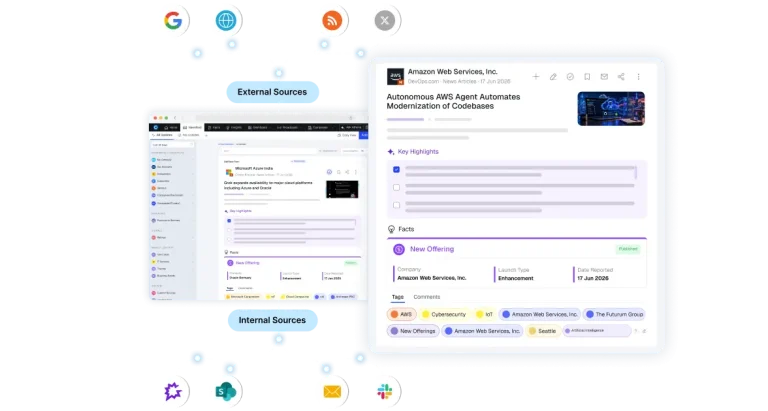
Gathering and analyzing competitive intelligence requires significant effort and research across a company’s various teams, including sales & marketing, business strategy, product, and executive/leadership. There’s usually a dedicated CI team as well. Competitive intelligence tools can help reduce these efforts and augment them, which is why they’re desirable. There are a number of CI tools like Contify available on the market, which help optimize your time and maximize productivity in the following ways:
1. Set KPIs: CI tools that leverage artificial intelligence and/or machine learning (like Contify) allow you to set KPIs (key performance indicators), which in turn help you glean relevant and critical insights. You can use custom filters and group competitors to fine-tune your results.
2. Cut through the noise: Filtering irrelevant data from intelligence manually can take up a lot of bandwidth. CI tools can help refine your data sources so that you only track the data points that matter most to you and your organization.
3. Integrate with daily tools: CI tools can integrate with other tools you and your teams use daily, such as Google Drive and your CRM, and provide multi-channel publishing. This helps simplify collaboration and distribution to stakeholders.
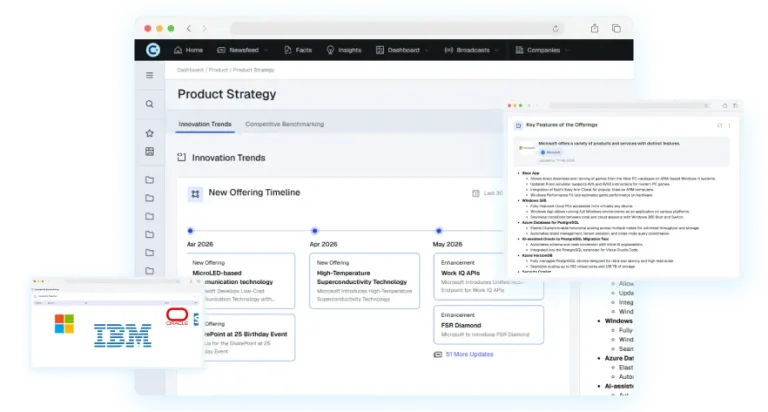
4. Organize insights and information: Unless and until your intelligence is distributed in an organized and readable format, your stakeholders will have problems making the most of it. CI tools can help you with tasks like creating taxonomies, filtering your insight feeds, saving your go-to filters, printing insights in a report format, and more, making it easier to digest.
5. Automate key reports: CI tools can help you automate the generation of key reports, which will help reduce manual effort and time. Reports and dashboards will be generated using your preset preferences.
6. Set alerts: There are certain competitors and/or topics you’re especially interested in. Using CI tools, you can save time and increase the visibility of these updates by enabling and customizing alerts tailored to your use cases.
The role of CI tools is thus to make things not only easier but also much more efficient for you, your teams, and your organization.
Best Practices for Competitive Intelligence Analysis
Competitive intelligence analysis becomes more useful when teams focus on the right competitors, the right sources, and the right business questions. A strong process helps turn competitor data, market updates, customer feedback, and internal knowledge into clear insights that sales, marketing, product, and leadership teams can actually use.
1. Focus on Actionable Competitive Insights
The best competitive intelligence reports do not simply collect competitor updates. They explain what those updates mean for pricing, product strategy, sales enablement, customer retention, market positioning, or business growth. This keeps the focus on decision-ready competitive insights instead of raw competitor data.
2. Prioritize High-Impact Competitors
A business does not need to track every company in the market with the same depth. Competitive intelligence analysis should focus on competitors that affect revenue, appear often in sales conversations, target the same customer segments, or influence buyer decisions. This makes competitor monitoring more focused and useful.
3. Validate Competitive Information Sources
Reliable competitive intelligence depends on strong source validation. Teams should compare information from competitor websites, pricing pages, customer reviews, press releases, analyst mentions, job postings, and internal sales feedback before using it in a report. This reduces the risk of building a competitive analysis around incomplete or outdated information.
4. Continuously Monitor Market Changes
Competitive analysis should be ongoing because markets shift quickly. Competitors may change pricing, launch features, update messaging, enter new regions, announce partnerships, or target new industries. Continuous competitor monitoring helps teams spot these changes early and keep their market intelligence current.
5. Use Competitive Intelligence Dashboards
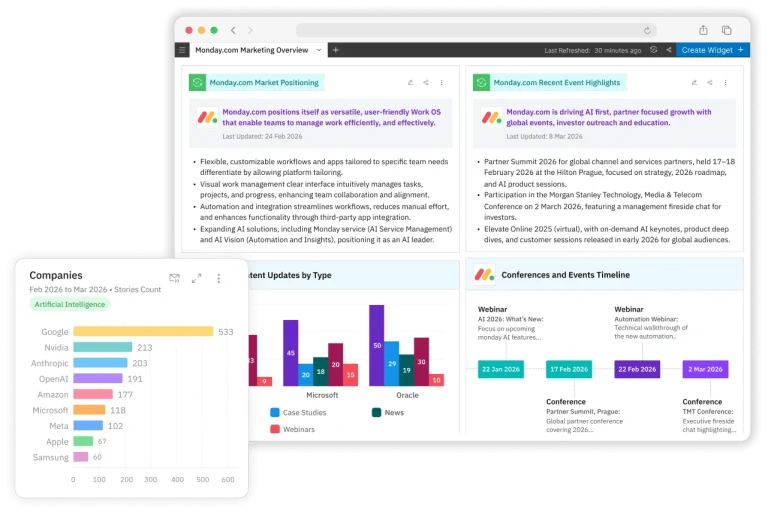
Competitive intelligence dashboards make it easier to organize competitor insights by product, pricing, market trends, customer sentiment, sales activity, and industry developments. Instead of searching through scattered updates, teams can view key intelligence in one place and compare competitor movements more clearly.
6. Set Up Alerts for Critical Competitor Moves
Not every market update needs immediate attention, but some changes can affect strategy quickly. Alerts for competitor product launches, leadership changes, pricing updates, funding news, partnerships, regulatory changes, or major customer wins help teams stay aware of important developments without manually checking every source.
7. Share Insights in the Right Format
Competitive intelligence is more effective when each team receives insights in a format they can use. Sales teams may need battlecards and objection-handling points. Marketing teams may need positioning insights. Product teams may need feature comparisons. Leadership teams may need market trends and competitor benchmarking.
8. Combine External and Internal Intelligence
Strong competitive intelligence analysis should include both public market data and internal knowledge. External sources show what competitors are saying and doing in the market, while internal sources such as sales calls, customer feedback, win-loss notes, and CRM data reveal how buyers actually respond. Together, they create a fuller view of the competitive landscape.
Frequently Asked Questions
2. What should be included in a competitive intelligence report?
A strong CI report includes competitor developments, market trends, potential risks or opportunities, strategic impact analysis, and clear recommendations. It should be tailored for the audience, whether it’s product, marketing, or leadership teams.
3. How do companies gather competitive intelligence data?
Companies use a mix of tools and sources like news sites, social media, investor briefings, job listings, and customer reviews. Many also rely on intelligence platforms like Contify to automate tracking, filtering, and organizing relevant insights.