Industry
Chemical Manufacturing
Headquarters
Japan
Employees
Approximately 5,000
Founded
1916
Testimonial

A significant share of our most relevant industry content comes out of Japan in Japanese. Our team is based in the UK and North America, so that content was essentially invisible to us. Contify translated it and surfaced it alongside everything else. That’s something we didn’t find in other platforms.
– Marketing Director, Global Specialty Chemicals Manufacturer
Executive summary
Heading into a new fiscal year, the senior management of this firm, which operates in the specialty chemicals industry, tasked its Global Marketing Group with building a competitive intelligence program. It involved tracking 5 competitors and 4 strategic customer accounts across semiconductor materials, aerospace composites, specialty chemicals, and commercial inkjet printing. No additional headcount was allocated, and no tooling existed, so the function had to be built from within existing capacity.
Initially, the team relied on manual web searches and also utilized general-purpose AI tools. But these AI assistants had major limitations: they hallucinated, fabricated sources, and lacked business context. As a result, the team spent most of their time gathering and verifying information rather than analyzing it, and stakeholders received the intelligence too late.
Furthermore, commercially relevant intelligence published in Japanese trade journals remained completely inaccessible to non-Japanese-speaking team members.
The company adopted Contify as its chemical market intelligence platform to improve its M&CI workflow. Contify centralized monitoring across vetted global sources, including niche sites in chemical space, applied AI-driven algorithms to filter noise, automated validated stakeholder-specific insights delivery, and operationalized multilingual coverage across 117+ languages.
About the company
A Japan-headquartered specialty chemicals manufacturer with approximately 5,000 employees and commercial operations in North America and Europe, operating across 3 divisions: functional materials, color materials, and optical materials. The firm competes in the specialty chemicals market against some of the largest multinational firms in each of its product segments.
Its products serve technically demanding end markets, including epoxy resins for semiconductor packaging and aerospace composites, water-based inks for commercial inkjet printing, and polarizers for automotive head-up displays and consumer electronics.
Competitive intelligence was managed by a 4-person team within the Global Marketing Group, serving corporate leadership, divisional strategy teams, and sales organizations across all 3 divisions.
The challenges
Manual research consumed team capacity before any analysis could start
Senior management formally tasked the Global Marketing Group with delivering regular competitive intelligence for the first time, with no existing process or infrastructure to support it.
- Niche industry signals: In the specialty chemical industry, competitive moves, chemical company news, and capacity shifts rarely surface in mainstream press. Major developments, such as qualifying a new resin for aerospace or changing capacity at a facility, appear in niche trade publications, supplier bulletins, and regional industry journals. Therefore, staying informed requires diligent monitoring of these sources.
- Sourcing bottleneck: The team tracked 5 global competitors across 4 markets through manual web searches, which consumed most of their working hours before analysis.
- Failure of generic AI: To relieve this bottleneck, the team initially used general-purpose generative AI tools. However, outputs from these AI assistants contained hallucinations and fabricated sources, posing another challenge: the time-consuming task of manual verification.
Intelligence was not reaching the stakeholders who needed it
Five internal groups needed competitive and market intelligence regularly: corporate leadership tracking specialty chemicals industry outlook, strategy team evaluating expansion opportunities in semiconductor and aerospace materials, and 3 divisional sales teams preparing for conversations with key accounts.
- Siloed knowledge: Without a structured distribution mechanism, relevant updates stayed with whichever individual happened to find them.
- Critical workflow gaps: There were no automated briefings for leadership before quarterly reviews, no competitor product updates reaching account managers before customer conversations, and no shared repository where product managers or sales leaders could independently check the competitive landscape in their segment.
- Resource constraints: Serving a matrixed global organization on a fully manual, ad hoc basis was not a sustainable ask for a lean 4-person team.
High-value intelligence was locked in assets that the team could not efficiently use
The company routinely subscribed to premium specialty chemicals industry reports covering epoxy resin volumes, semiconductor materials demand, and ink market forecasts.
- Siloed reports: These reports, typically 100 to 200 pages long and purchased for several thousand dollars each, contained some of the most granular competitive data available on specialty chemicals market trends.
- Delayed insights: Extracting relevant findings required a full manual read of each massive document. This task fell to whoever on the team had capacity at the time, meaning critical insights often surfaced weeks after a report originally arrived.
- Language barrier: Compounding this issue, a significant share of the most relevant industry content and regional data sets circulated exclusively in Japanese. This formatting constraint made it completely inaccessible to the non-Japanese team members based in the UK and North America, creating a persistent structural blind spot.
Contify’s solution
To address the limitations of manual research and the unreliability of AI, the company onboarded Contify to create a structured, automated intelligence program. Contify centralized intelligence gathering, used specialized AI to filter noise and deliver validated insights.
A monitoring infrastructure tailored to the company’s competitive reality
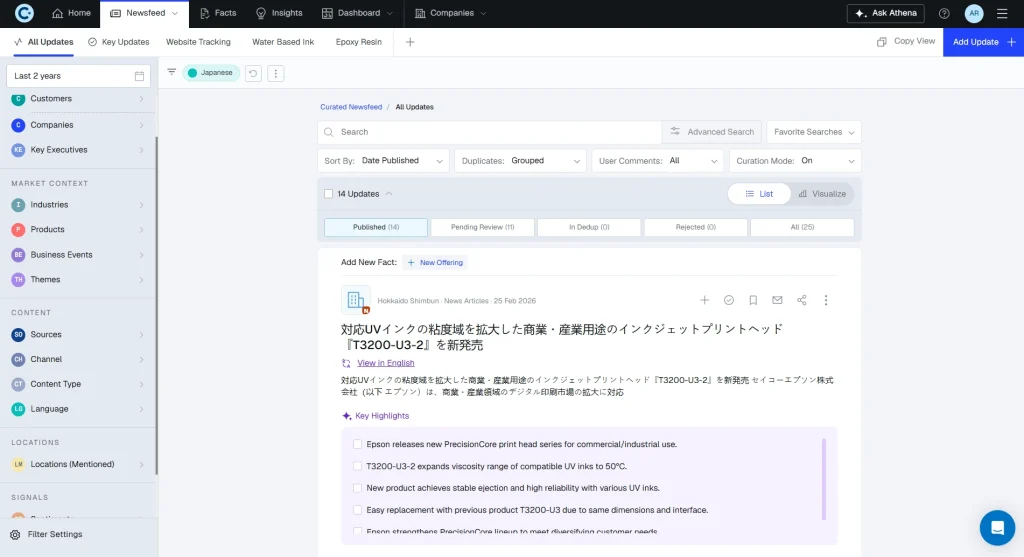
Contify configured the chemical market intelligence platform around the company’s specific market structure rather than generic industry categories.
- Precision tracking: The platform automated continuous monitoring for 5 core global competitors and 4 strategic customer accounts across semiconductor materials, aerospace composites, commercial inkjet printing, and the overall specialty chemicals market, all in a single portal.
- Niche source ingestion: Contify’s proprietary crawling infrastructure enabled the addition of public niche trade publications, regional supplier bulletins, and technical journals where critical specialty chemical company news and other developments actually surface.
- Eliminating the language blind spot: Contify’s multilingual engine translated content from 117+ languages into English, making Japanese trade journal intelligence accessible in the UK and North America. This integration made Asian market insights consumable to global stakeholders.
Integrated premium research documents that previously remained trapped for surfacing high-value intelligence
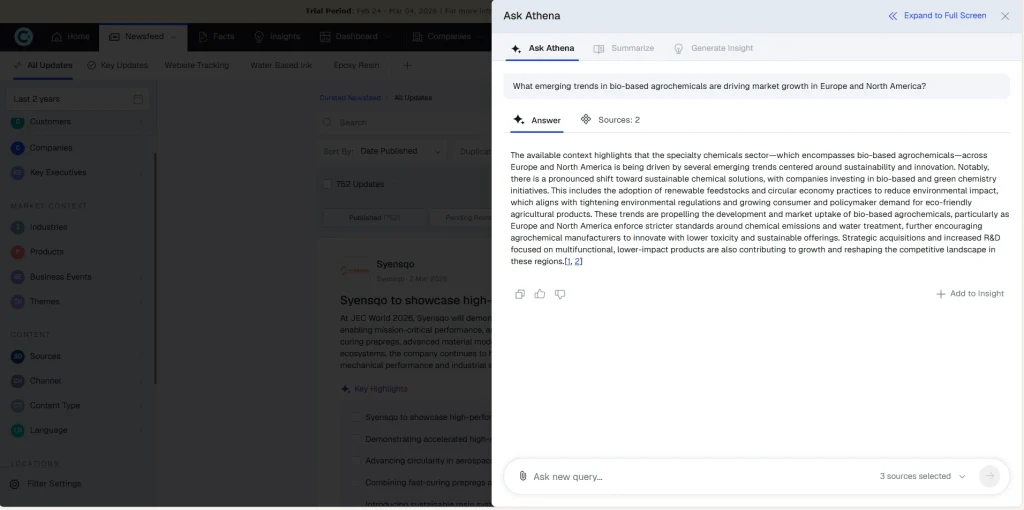
Contify’s internal document-ingestion capability with SharePoint integration transformed the way the team used its existing research assets. Instead of letting expensive, 200-page specialty chemicals industry reports gather digital dust and rarely being cross-referenced, Contify brought them into a single portal.
- Centralized document ingestion: The company’s specialized reports on epoxy resin volumes, semiconductor demand, and ink market forecasts were synced directly into the platform and indexed alongside live external intelligence.
- Conversational insights via Ask Athena: Using Contify’s conversational AI assistant – Ask Athena, users queried these dense documents in natural language, surfacing insights that combine perspectives from both internal and external intelligence datasets.
Automated, role-specific insights delivery across the enterprise
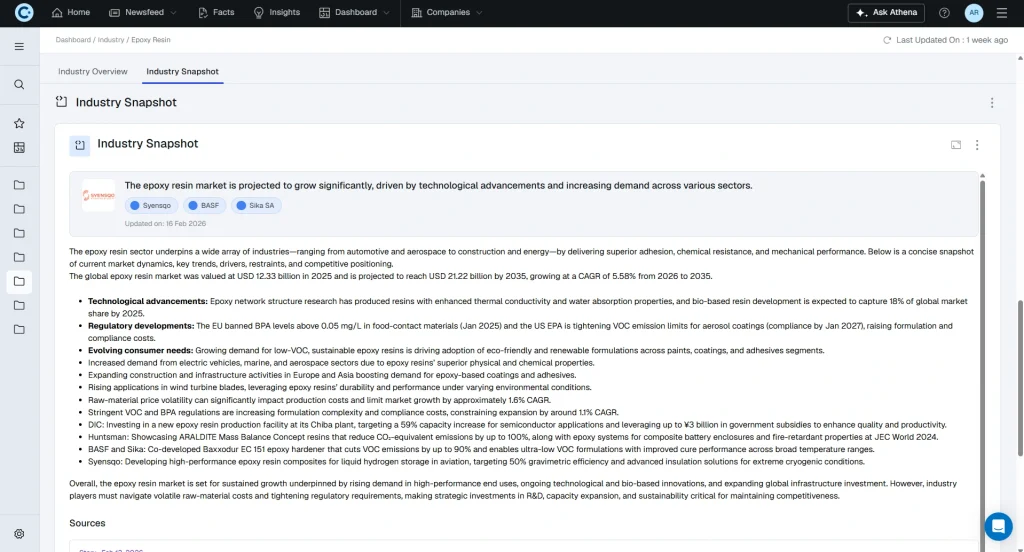
Contify replaced the team’s manual, ad hoc process for distributing insights with automated workflows tailored to the specific needs of its 5 distinct stakeholder groups.
- Leadership & strategy: Senior executives received consolidated, executive-ready market summaries covering the specialty chemicals industry outlook ahead of their quarterly planning reviews, while the strategy team received continuous specialty chemicals market trends and competitor briefings aligned to their specific expansion targets.
- Workflow-embedded sales enablement: The 3 divisional sales teams received critical competitor product updates and account triggers right before customer conversations. Through out-of-the-box integrations, these insights were pushed directly into Salesforce and MS Teams, ensuring teams had the intelligence they needed exactly where they already managed their workflows.
Key results
Analysts shifted from information gathering to market analysis
The global marketing team used to spend most of its time on manual research – searching, organizing, and validating information before it could analyze. With Contify’s automated information aggregation, deduplication, verification, and synthesis workflows, they could now focus on interpretation and communication. For competitive intelligence in chemical manufacturing, this is what the shift from manual to automated looks like.
Regional intelligence that had been structurally inaccessible entered the standard workflow
Competitive data from Japanese-language trade journals and regional industry publications had been structurally unavailable to the UK and North America-based team members. Contify’s multilingual engine brought that content into the team’s newsfeed in English, alongside all other intelligence. For the first time, market signals on semiconductor materials and epoxy resin dynamics from Asian sources became a routine part of the global team’s weekly review.
Expensive market research reports started delivering their full analytical value
The team held subscriptions to specialist market research publications, dense 100 to 200-page documents purchased at several thousand dollars each, that were rarely cross-referenced because of the manual effort needed to extract relevant findings. With Contify’s document ingestion and Ask Athena, those reports became queryable. Users could retrieve targeted insights across the entire corpus via a natural-language query rather than re-reading documents end-to-end.
Each stakeholder group received curated chemical intelligence relevant to their work, without manual distribution effort
Before Contify, relevant updates reached only the analyst who happened to find them. Leadership had no structured briefings before quarterly reviews. Sales teams had no competitor product updates before customer conversations. Contify’s automated newsletters and Salesforce integration changed that — each of the 5 internal groups received curated chemical intelligence on a defined schedule, without the team having to compile and route it manually.
Impact
| Aspect | Result |
| Reduction in time spent on information gathering vs. analysis | 70% |
| Time from requirements to live platform | Under 2 weeks |
| Analyst hours reclaimed per week | 20+ |
| Speed of insights delivery to stakeholders | 3x faster |
| Improvement in effective utilization of existing research subscriptions | 3x |
| Asian market coverage after Contify | 100%, real-time |
Why choose Contify for market intelligence for chemical companies
Chemical market intelligence in specialty sectors demands more than generic monitoring. The signals that matter most, such as capacity shifts, product qualifications, supply chain moves, and M&A activity, are often buried in niche journals, regional bulletins, and foreign-language content. Relying on manual research or generic AI tools creates blind spots and increases the risk of unreliable outputs and hallucinations.
Contify is purpose-built to address these exact challenges through specialized capabilities:
- Unmatched niche source coverage: Contify uses a proprietary web-crawling infrastructure to monitor specialized trade publications, regional supplier bulletins, and technical journals that lack standard RSS feeds.
- Global, multilingual reach: The platform eliminates language barriers by tracking content across 117+ languages and providing contextually accurate English translations.
- Noise-free, validated insights: By combining Large Language Models (LLMs) with custom Knowledge Graphs, Contify’s Athena AI filters out irrelevant noise and delivers citation-backed, validated insights.
- Unified internal and external intelligence: Contify breaks down information silos by seamlessly integrating premium research reports and internal documents via SharePoint alongside external market signals.
- Automated, role-specific delivery: The platform shifts teams from manual reporting to automated, continuous intelligence delivery through auto-updating dashboards, newsletters, and CRM integrations.
Competitive intelligence for chemical manufacturers means tracking the right sources, in the right languages, and getting those findings to the right people before they need them. That’s what this program delivered, and it is exactly what Contify is built to do.
To learn how Contify approaches chemical industry competitive intelligence, request a demo today.


