Last updated
Jul 6, 2026
Last updated
Jul 6, 2026


Summary
- A best-in-class CI report should answer ‘what does it mean for stakeholders’, ‘what to do next’, and ‘what is likely to happen’, instead of just focusing on ‘what has happened’.
- CI reports are evolving from static, reactive documents into dynamic, prescriptive, continuously updated, and source-verified intelligence dashboards. Purpose-built AI intelligence platforms are enabling this shift.
- Automating signal collection, validation sources, synthesis insights, and delivery decision-ready intelligence reports in real time is becoming the new standard for powering product development, GTM strategy, and business strategic decision-making.
Your competitive intelligence (CI) program is only as effective as the quality of its reports.
If leadership and stakeholders can’t use your CI reports for strategic planning and decision-making, then the reports aren’t delivering their purpose, and your intelligence program is probably running in the dark.
A well-curated competitive intelligence report does more than tell you about your competitors’ moves. It also reveals ‘where they’re heading next’, and more importantly ‘what you can do next’ as a response. The only agenda of such a report is to equip stakeholders with the insights, context, and confidence needed to make smarter, faster business decisions.
But, for decades, intelligence professionals have faced several challenges in creating competitive intelligence reports, from gathering information across fragmented sources and filtering signals from noise to analyzing large volumes of data and delivering timely, continuous intelligence to stakeholders.
In 2026, that’s no longer the case.
Thanks to AI, many of the traditional challenges associated with competitive intelligence have become significantly easier to manage. But not all AI tools are equal when it comes to competitive intelligence.
General AI tools like ChatGPT or Claude may be useful for occasional research and analysis, but are not built for intelligence workflows.
Whereas, purpose-built AI intelligence platforms are designed specifically for the competitive intelligence function, continuously monitoring competitors, validating signals, and delivering source-backed, real-time intelligence that not only improves the quality, relevance, and reliability of your reports, but also strengthens their strategic value for the decision-makers.
With these platforms, intelligence teams spend little to no time on manual data gathering and verification, and significantly more time on analysis, interpretation, and strategic recommendations. This results in the delivery of faster, more reliable, and more actionable intelligence reports.
This guide explains how you can create best-in-class competitive intelligence reports with AI, how purpose-built AI intelligence platforms differ from general AI tools, understand their practical use cases and limitations, and build reports that not only inform stakeholders but also drive strategic action.
What is a Competitive Intelligence Report?
A competitive intelligence report is a structured document that presents curated and analytical insights about the companies you consider your competitors. It consolidates the most relevant intelligence about your rivals, such as pricing changes, product launches, feature updates, mergers and acquisitions, partnerships, funding activities, leadership changes, and market positioning, and translates it into actionable business insights.
A CI report also highlights what has changed since the last reporting cycle, rather than just listing individual events. This is useful, especially for senior management, to understand how the competitive landscape is shaping, and what actions to take to strategically respond to those changes.
For example, if your competitor launches an AI feature, it may not demand an immediate action from you. But, if the last 4 reports about the competitor show that it has launched multiple AI capabilities, hired talent on AI leadership, acquired an AI startup, or rebranded its messaging around AI, then the bigger story becomes clear: your competitor is set for a strategic AI shift. This insight will now help your leadership to take proactive measures before the competitor gap widens.
Therefore, a CI report also informs you of periodic signals from your competitors that are vital to connect the dots and take timely actions.
How CI Reports Have Evolved with AI
AI has led CI reports to evolve from reactive (what competitors did) to descriptive (what the market looks like) to predictive (what will happen) to prescriptive (what you should do).
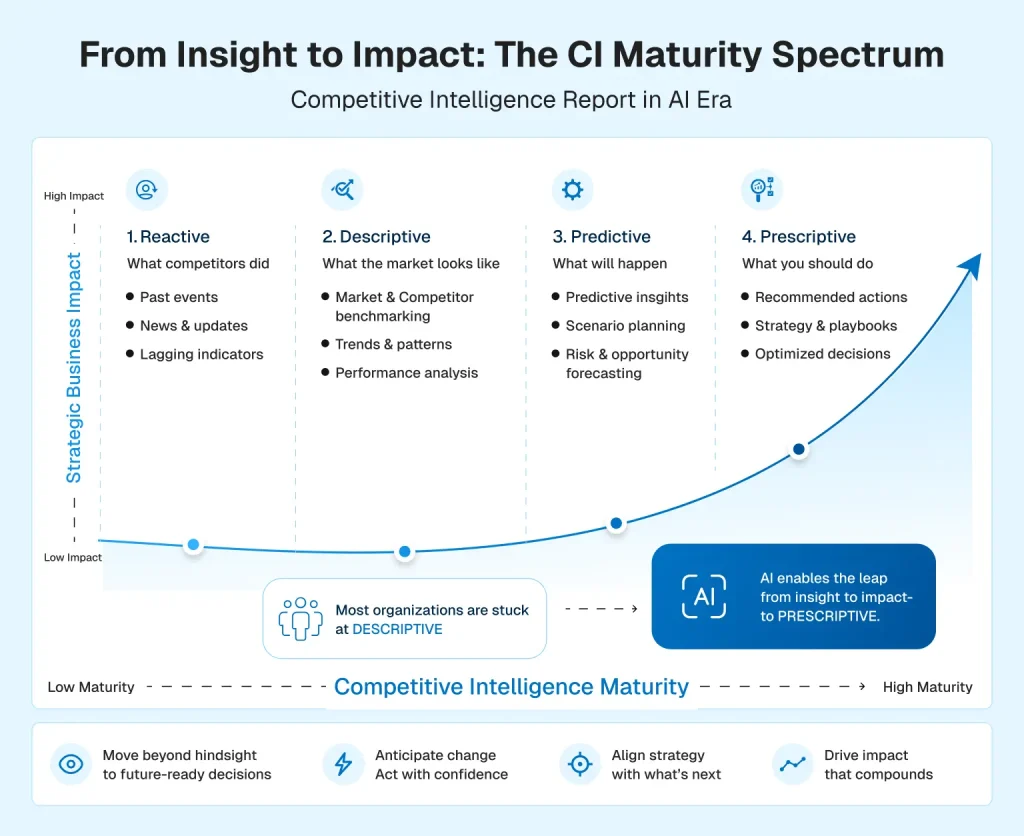
Most organizations are stuck at descriptive. AI enables the leap to prescriptive CI reports.
Read more: Competitive intelligence in the new world of AI
Key Components of a Best-in-Class CI Report
- Competitor Profiles: At-a-glance information about basic firmographic, such as the company’s size, employee count, revenue, social links, overview, headquarters location, and more.
- Customer & Accounts Intelligence: An in-depth breakdown of your competitor’s customer segment, organized by geographies, size, and industry to understand their market penetration. Also, add analysis of your competitor’s customers’ feedback from review platforms (G2, Trustpilot, etc).
- Product & Service Intelligence: Include a timeline of recent enhancements, developments, or new releases in your competitor’s product or service catalogue to stay informed on their pace of innovation.
- Leadership & Human Resources: A curated list of recent hiring or layoff initiatives, along with the latest job postings by your rival companies to know their focus areas and where they plan to expand or shrink.
- Strategic Moves & Investments: A detailed timeline of acquired companies or mergers to know how your competitors are expanding capabilities or entering a new market. Also, it’s critical to include recent joint ventures, collaborations, and partnership initiatives. Moreover, add intelligence regarding if your competitors have invested or raised any funding recently.
- Financial and Performance Health: Include reported yearly and quarterly revenue and profits. Breakdown of their sales performance organized by location, product line, and industry segment.
- Analysis Frameworks: Add different business frameworks, like SWOT or Ansoff, to analyse gathered information regarding your competitors. This helps to know the strengths, weaknesses, opportunities, and threats of your competitors with respect to your company.
- Strategic Action Plan: It should have a comprehensive, actionable plan, guiding key decision-makers with concrete steps regarding competitive positioning, GTM strategy, revenue enablement, product development, and risk mitigation for future planning.
- Appendices: Insert visuals like charts and graphs in your CI report to make it easy to understand the key insights of your analysis. Also, add references, sources and citations to your insights for confident decision-making.
Types of Competitive Intelligence Reports
Delivering the right report in the right cadence to the right stakeholder is all it takes for your CI programs to create meaningful business impact. But not all reports are the same. Therefore, it’s vital to understand what type of reports fits well for your stakeholders’ unique needs and enterprise-wide strategy.
The type and format of a report should ideally be set before starting a CI program.
Here are some core types of CI reports:
Competitor Profiles Report: It is the most widely used CI report, and the foundation on which other report types are built. It contains information about your key competitors, typically covering five to ten companies, including their basic profile, organizational structure, product offering, pricing, go-to-market, customer base, messaging, and recent strategic moves.
Competitor Analysis Report: This report represents a detailed analysis of one specific competitor or a group of competitors. Such reports help you to uncover your competitors’ strategy, strengths, weaknesses, priorities, and likely future direction. Unlike competitor profiles, which primarily focus on descriptive information, competitor analysis reports focus on interpreting developments, identifying patterns, and assessing their implications for your business. These reports help leadership teams anticipate competitor moves, evaluate potential risks, and make more informed strategic decisions.
Competitor Benchmarking Report: In this report you get a structured, side-by-side comparison between your rivals’ offerings and your offerings. These comparisons are based on defined parameters like product capabilities, pricing tiers, customer satisfaction scores, market share, or operational metrics. Unlike competitor analysis reports, this report helps you understand where your offerings are stronger, where they can be improved, and where opportunities exist to address competitive gaps and enhance differentiation.
SWOT Analysis Report: This report evaluates the strengths, weaknesses, opportunities, and threats (SWOT) framework. In a SWOT analysis report, strengths and weaknesses are internal factors that are judged against your competitors. Strengths represent what you have or do better than your competitors, for instance, proprietary technology, a stronger brand, or superior product capabilities. Weaknesses represent areas where you fall short, such as higher product costs, limited resources, or capability gaps. Whereas, opportunities and threats are determined by external factors such as customer behavior, market trends, regulatory changes, or industry shifts. Opportunities are emerging areas that you can capitalize on, while threats are external forces that could be harmful to your business.
A key nuance to remember is that competitors themselves, especially new market entrants, often fall under threats, while changing customer needs and pain points often represent opportunities, unless they are left unaddressed.
Product Intelligence Report: This gives you intelligence regarding your competitor’s product such as feature sets, architecture decisions, recent releases, roadmap signals, pricing, integration ecosystem and more. This gives you a broader bird’s-eye view of the continuous product evolution and a larger strategic vision of your rival companies.
AI Footprint Report: Since the global adoption of AI, this report has become a key part of advanced competitive intelligence programs. It’s a niche, AI-specific report that gives intelligence in four key areas: AI capabilities embedded in the product, AI vendors or models they are leveraging, AI talent they are hiring, and AI-first messaging they are promoting.
Customer Insights Reports: It offers you what your competitors’ customers are saying about them on review platforms (G2, Trustpilot, app stores), win/loss interviews, social listing, community forums (Reddit, Quora, etc), and analyst commentary. These insights help you to understand what gaps they are facing, what frustrates them, and what they wish to see in a product/service. This opens up improvement and scaling opportunities for your product roadmap, better sales pitch and value proposition.
Emerging Threat Report: This report constantly gathers, analyzes and produces insights across diverse signals like funding rounds, hiring patterns, patent filings, technological investments, and partnerships initiatives – so you can stay informed about emerging threats rather than getting surprised.
The Intelligence Cycle: A Framework for CI
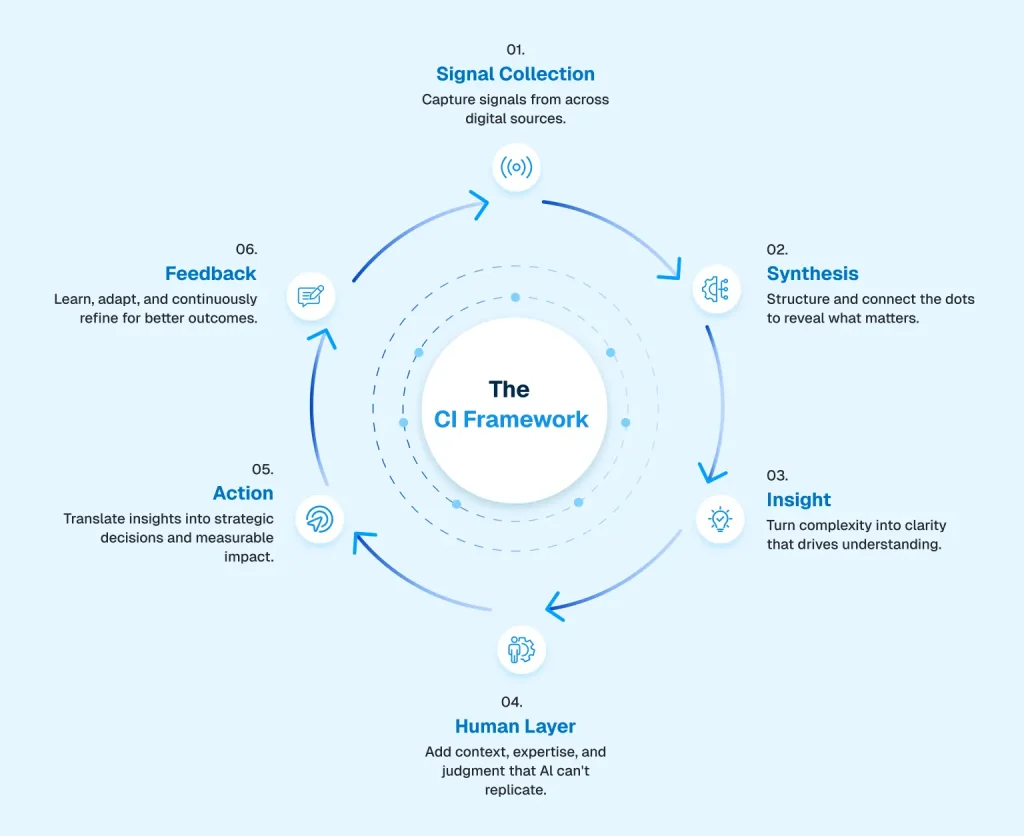
This is what the competitive intelligence lifecycle looks like:
Signal Collection → Synthesis → Insight → Human Layer → Action → Feedback
Before creating a CI report, plan what is the goal that you would want to achieve. A useful starting point is to ask: What decisions do your stakeholders need to make? This should drive the goals of your CI program. While stakeholders can tell you the decisions they need to make, they cannot define the goals of your CI program themselves. An intelligence professional is required to turn those needs into clear intelligence goals, priorities, and reporting requirements.
Once you establish the decision context, define what intelligence you need, which teams will require it, and from where it will come. Valuable and actionable competitive reports are a byproduct of clear context-setting.
Start by defining Key intelligence topics (KITs) and key intelligence questions (KIQs) for your requirements.
KITs are broad, strategic intelligence themes that are critical to your organization’s goals and decision-making.
KIQs, on the other hand, are the specific intelligence questions that need to be answered to support those themes and guide business actions.
Signal Collection: It includes the collection of your competitors’ data through various sources like public data (news, competitor website, regulatory filings, customer reviews, etc), internal sources (docs, videos, CRMs, win\loss reports, etc), or premium research sources.
Synthesis: Traditionally, CI analysts conduct this step manually while creating reports. Now, purpose-built, AI-powered intelligence platforms (not general AI tools like ChatGPT, Claude) are reducing time and enhancing efficiency in this process. It can summarize, extract key highlights, facts, tag entities, determine sentiment, remove duplicates, organize data, and filter only context-aware insights.
Insight: AI answers key questions like “what has changed”, or “what does this mean for our business”, and recommends “what steps to take next”. It also identifies patterns, suggests actions and delivers insights in pre-defined CI reports format, such as SWOT.
Human Layer: Human judgment is a critical step in an AI-powered competitive intelligence framework to cross-verify AI outputs, checking nuances, and reassuring context. This holistic approach (AI+ human) is vital to ensure every single piece of intel is accurate, reliable, and contextual – every time.
At Contify, we have been advising our clients on the importance of the human layer in AI-powered competitive intelligence. When engaging with one of our Swiss-based clients, a multinational flavours and fragrance manufacturer, their intelligence leader told us:
“I think what appeals to me here is that you have humans reviewing and validating the AI output. That’s one of my concerns with AI generally that it makes things up or pulls in irrelevant things. The fact that there’s a human layer there is reassuring.”
Action: This is what the senior management does as a result of your report.
Feedback: This stage is often overlooked yet very crucial. It helps in fine-tuning and ensuring that your competitive intelligence reports remain aligned with stakeholder decisions and strategic priorities. Receiving constructive feedback on reports from senior management allows intelligence professionals to continuously evolve their reporting approach, identify areas for improvement, and better align intelligence outputs with stakeholder strategic priorities, making future reports more relevant, actionable, and valuable.
Moving from the foundational lifecycle to report creation itself, a great CI report is always built around strategic questions, not just topics. These questions are based on strategic decisions that need to be taken by senior management.
For example:
- Should we enter a new market?
- How should we respond to a competitor’s aggressive pricing strategy?
- Is a rival preparing to expand into our core customer segment?
- Which emerging technologies are most likely to disrupt our product roadmap?
- Are competitive dynamics shifting enough to warrant a change in positioning?
Once your decision context is set, your CI reports become significantly more focused and relevant. You know which signals to track, which developments matter, what analysis to prioritize, and which recommendations will create the greatest value for stakeholders.
As a result, your report evolves from reactive and descriptive reporting into predictive and prescriptive intelligence that drives strategic business impact.
Step-by-Step Process to Build the Best CI Report with AI
General AI tools like ChatGPT, Gemini, Claude, or Perplexity can be used to create a competitive intelligence report. Let’s see how:
Step 1: Define your Intelligence Questions Clearly
Carefully list down the intelligence questions that are tied to your business goals and strategy, and you need to answer for decision-making. After you draft your questions, use AI tools to pressure-test it. Try using this prompt in ChatGPT or Claude:
“I am building a competitive intelligence report. My intelligence question is: [your question]. Act as a senior strategy advisor and challenge this question. Is it specific enough to generate actionable intelligence? What assumptions is it embedding? What related questions should I also answer to give leadership a complete picture?”
Step 2: Map your Competitor Landscape
Once you have decided the intelligence questions, define your competitive landscape. This will include your direct competitors, emerging ones, and those competitors that pop up during sales or client calls.
Pro top: Ask your sales team: what platforms are your prospects looking for as an alternative to your platform? Those are your key competitors. Also, check with your customer success teams on what names do they hear from existing clients while they engage with them.
Try using this prompt in Perplexity or ChatGPT:
“I work in [industry/category]. Our known direct competitors are [list]. Based on recent funding activity, product launches, and market positioning, which companies are emerging as potential competitive threats in this category that are not yet widely tracked? What signals suggest they are moving in this direction?“
Note: The output may not be exhaustive or perfect as general AI tools don’t have adequate context, nuances, and subtleties regarding your competitive landscape. It also can’t access your internal database (CRM notes, Slack conversations or knowledge base, etc) and premium content repositories to fetch hidden signals.
Step 3: Using General AI Tools for Data Sourcing, Analyzing, and Report Creation
Once you have defined your competitive landscape, general AI tools can help you gather publicly available information such as recent news, product updates, pricing changes, and broad market developments and organize that data into basic summaries and frameworks.
Pro tip: In both AI tools, make a separate project for your competitor research and conduct all future research in the same chat window, so that the AI will gain more context about your competitors and requirements over time.
Having said that, this step also has real limits.
Without having the access to your internal data, premium content sources, or a continuously updated intelligence layer, the output is surface-level and requires significant manual effort to verify and contextualize. Pattern recognition, trend prediction, and context-aware analysis, the things that make CI reports truly decision-ready, are where general tools consistently fall short.
In fact, almost all enterprises and intelligence leaders who were once excited about leveraging general AI tools are now sharing these limitations of AI.
In a recent discussion with our client, which is a French multinational food and beverage corporation, its intelligence leader shared:
“I’ve been using Claude AI myself to create newsletters, actually, but it’s still very manual, it requires a lot of prompting, and I’m not sure the output is always reliable. My concern is really around quality of the output. Because we are presenting this to senior leadership, I need to be confident that what we’re presenting is accurate and not AI-generated hallucinations”.
Step 4: Adding Implications or Recommendations to Your Report
Once you are done with data analysis, use ChatGPT or Claude to create the first draft of strategic implications. It involves answering the “what’s next” questions for your stakeholders.
Use this prompt in Claude or ChatGPT:
“Based on the following competitive intelligence findings about [competitor] — [paste your key findings] — identify the three to five most significant strategic implications for a company that competes directly with them in [market/segment]. For each implication, describe: what it means for our competitive position, what decision it should inform, what the risk of inaction is, and what an initial recommended response might look like. Be specific. Do not use generic strategic language.”
Don’t take the generated response as the final one. This is your first draft. General AI tools don’t know your historical strategic moves, nuanced and contextual awareness of competitive landscape, and relevancy of any data. That’s why it is important to interrogate every point and rewrite the actionable insights with the full context depth that you have for your competitive intelligence program.
Limitations of General AI Tools In CI Reports
General AI tools like ChatGPT or Claude have serious limitations when it comes to creating reliable and best CI reports:
1. Hallucinations and Fabricated Sources
A survey by Gartner revealed that 53% of consumers don’t trust AI tools when it comes to search and information gathering.
One of the biggest reasons is hallucinations.
General AI tools are trained on massive amounts of public data. These tools are, fundamentally, language models capable of understanding and responding in natural language, but not reliable for factual accuracy or insights. Since they are based on probabilities rather than strict rules. If you ask them for competitive insights, they may provide answers that appear reliable most of the time, but they can also generate fabricated information, inaccurate claims, or cite sources that are either incorrect or don’t exist at all.
For example, you might ask an AI tool whether Competitor X launched a new pricing plan last quarter. The tool may confidently respond “yes” and even attach a source, only for you to discover later that the source never mentioned any pricing changes.
If that inaccurate information makes its way into a competitive intelligence report and is later used by a sales representative during a customer conversation or product demo, it will lead to serious credibility issues, poor decision-making, and most likely, a lost deal.
Our client from a German-based, world-leading mail and logistics company shared:
“We use some general GenAI tools but they have limitations. Like I’ll ask it to compile something about a competitor and it might give me outdated information or just make up something that’s not accurate. So the reliability of the data is key for us.”
2. No Inherent Business Context
General AI tools have little to no contextual awareness of the business of your company, your specific industry, product portfolio, competitive landscape, strategic priorities, or internal taxonomies.
AI does not automatically understand the business nuances required to connect dots and generate meaningful intelligence.
For example, a competitor hiring 20 AI engineers may look like a significant competitive threat. But if your company knows that the competitor recently acquired an AI startup and is simply integrating existing teams, the strategic implication becomes very different. A general AI tool is unlikely to understand that context unless it is explicitly provided.
One more interesting example to look at is: ask any general tool (like ChatGPT) to fetch intelligence signals around the “Visa”. And it will probably get confused between ‘Visa’ the global payment giant, a local regional firm using the same name, and thousands of content published around the same word but in the context of immigration or travel. With no customization or entity recognition (that is trained on your competitive landscape), these AI tools could pass noise rather than actual signals, burying the information that really matters.
This is why human expertise remains critical while creating Competitive reports.
3. General AI tools are Reactive, Not Proactive
General AI chatbots primarily work on a query-response model.
While scheduled AI tasks can automate parts of monitoring, they still come with serious limitations, including struggling to generate absolute precision responses (that are non-negotiable for sensitive business decision-making). Like regular AI interactions, they can hallucinate facts, generate inaccurate insights, or misinterpret competitor developments. They also have limited access to business context, internal systems (can’t automatically send email to a third party), and proprietary data sources.
In addition, scheduled workflows are not always reliable, as missed runs, delayed updates, or monitoring gaps can occur without notice.
Similarly, it will not automatically update your reports, dashboards, or intelligence workflows without additional automation and monitoring systems in place.
Think of it this way.
Suppose a competitor launches a new offering. A general AI tool can explain the announcement when you ask about it. But intelligence rarely works in isolation.
There may be supporting signals hidden inside sales call transcripts, CRM notes, win-loss reports, customer feedback, or analyst conversations that, when combined with the announcement, reveal a much larger opportunity or threat.
General AI tools struggle to connect these dynamic and fragmented sources without specialized workflows, integrations, and business context.
4. Lack of Transparency
General AI tools operate as black boxes. This means they generate responses, but do not explain the reasoning or logic behind them. For instance, if general AI tools like ChatGPT or Claude surface insights for your CI report, there is usually no clear audit trail explaining why a specific answer was produced, how a particular conclusion was reached, why certain sources were prioritized, or how the model weighted different inputs to arrive at a recommendation.
Also, in many cases, if you ask ChatGPT the same question twice, you may receive two different answers each time, often with equal confidence and no explanation for the discrepancy.
For competitive intelligence, where a single insight can influence a pricing decision, a product investment, or a go-to-market shift, that inconsistency is not a minor inconvenience, it is a structural reliability problem.
General AI tools often struggle to provide that level of traceability and explainability because, by default, they are not designed for this level of sophistication.
CI Report Best Practices for Organizations
Here are core enterprise-grade practices for CI reporting:
- Keep an executive summary section with actionable insights: Before starting, answer these questions: What decisions does your stakeholder need to make? What do they know already? Everything that is below their threshold, they don’t need it. Talk about strategic decisions they need to make, early or emerging threats and signals critical for enterprise-wide operations. Try to keep the executive summary in 4-5 pointers.
- Focus on prescriptive insight, not reactive data: An indispensable CI report points out what probably can happen as an effect of a particular event, and what should be done next as a response. If you have a purpose-built AI intelligence platform, it can automatically predict patterns and suggest actionable steps that are aligned with your competitive history, business dynamics and contextual factors.
- Include summary & control the level of details: Don’t just list data like news header, include summarization and breakdown the relevant context in 2-3 bullets if needed. If you have voluminous vetted insights, then your AI-powered intelligence platform can generate enterprise-level summaries and bullet pointers that are easily digestible.
- Include visuals: Best CI reports contain visuals for easy readability and comprehension. Don’t make it like an industry report. Keep it precise and visually interesting. Factors like timelines, roadmap, revenue analysis, comparison, SWOT analysis, etc become digestible when presented through charts or graphs.
- Apply consistent branding: Branding the report with the company’s theme shows professionalism and discipline. It establishes trust over time within executives and stakeholders, and becomes a valuable asset that is used during management meetings.
- Cite every insight to its original source: This is a non-negotiable in a professional CI report. As one intelligence leader at a global financial services organization shared with us:
“I need fact-based insights. My leadership team will push back hard if I present something that is not supported by verified data. So the accuracy and sourcing of the data, that’s non-negotiable for me.“
Modern AI-powered intelligence platforms like Contify automate citations for every insight, giving confidence to decision-makers in both insight and the evidence behind it.
Common CI Report Failures – And How to Avoid Them
Here are some common mistakes that most intelligence professionals make while crafting a CI report:
- Describing only what happened instead of what it means. Your competitive report is not a news summary, it’s a strategy document. Rather than listing what has happened, focus equally on what has changed since the last report and what can be the next steps of action for key stakeholders.
- Intelligence doesn’t reach to the right decision-makers. To fix this, map each report you are drafting to a specific decision, a specific decision-maker, and a specific decision window.
- Hallucinated data from general AI tools can derail your CI program. Prioritize purpose-built competitive intelligence tools rather than general AI tools, so you always get verified, contextual, and real-time data to generate your competitive intelligence reports.
- No Human-in-the-loop in the CI program. While AI sources, filters, synthesizes data, and even predicts trends, it’s ideal to add a human layer to verify the analysis and interpretation of data by AI. The most successful CI programs don’t leverage AI to replace humans. Rather, they empower humans to focus on connecting dots, challenge assumptions, and translate insights into strategic actions, while AI does the rest of the work.
Moving From A Static CI report to A Dynamic Report with Purpose-built Intelligence AI
| Feature | General AI-based CI Report | Contify AI-powered CI Reports |
| Data Freshness | Snapshot in time; becomes outdated quickly. | Auto-refreshed with real-time intelligence. |
| Data Collection | Manual prompts & repeated research. Risk of inaccurate competitor facts, unsupported claims, and fabricated details. | Continuous AI-powered monitoring. |
| Source Validation | Requires manual fact-checking and validation of hallucinated outputs. | Every insight links back to its source. |
| Report Maintenance | Reports must be recreated and updated manually. | Dashboards update automatically. |
| Visualization | Static charts and documents. | Interactive dashboards, timelines, maps, and widgets. |
| Role-Specific Views | One report for all stakeholders. | Tailored dashboards for each team. |
| Trend Discovery | Manual analysis of large datasets. Trend discovery can be a black box with limited source traceability. | AI surfaces trends, threats, and opportunities automatically. |
| Delivery/ Collaboration | Shared via PDFs, slides, or spreadsheets. | User-friendly web platform with live dashboards, secure sharing, permissions, and real-time access. |
| Workflow Integration | Exists outside daily workflows. | Embeds into Salesforce, HubSpot, Power BI, Teams, and more. |
| Scalability | More competitors = more manual work. | Scales automatically across competitors and markets. |
| Analyst Effort | High effort spent verifying and formatting data. | More time spent on strategy and decision-making. |
| Intelligence Model | Reactive and point-in-time. | Proactive, continuous, and decision-ready. |
Even if you create CI reports using general AI tools, which also require additional manual verification work, the report will still be static. Today’s business ecosystem does not change in days but in hours. By the time you create and prepare a report using general AI tools, markets may have already shifted. AI-generated Static reports (PDFs and Docs) are as good as stale reports in the AI world because it:
- Usually gets updated on a monthly or quarterly basis, which means your decision-makers are constantly acting on outdated data.
- Don’t surface real-time market shifts.
- Result in reacting to competitor moves (product launches, price updates, or strategic developments) rather than acting proactively by predicting patterns based on context and relevance.
- Can’t get auto-refreshed during time-sensitive requirements.
- Derail sales and revenue efforts because reps rely on outdated or stale intelligence, which can result in losing a deal or sharing misinformation during prospect calls.
Using Purpose-built, AI Intelligence Platforms for Dynamic & Source-Verified Reports
In the age of agentic AI, if you are mainly using general AI tools to create your CI reports, you are barely scratching the surface of what’s possible. Faster CI reports mean nothing if they are not verified, reliable, and decision-ready on which stakeholders can act on.
Imagine an agentic AI engine that is fully fine-tuned for your competitive landscape and generates highly customizable, auto-refreshed, and role-specific reports that are as fast (and even predictive) as your competitor landscape.
Contify is an AI-powered intelligence platform purposely designed to automate decision-ready CI reports by using its proprietary Agentic AI engine.
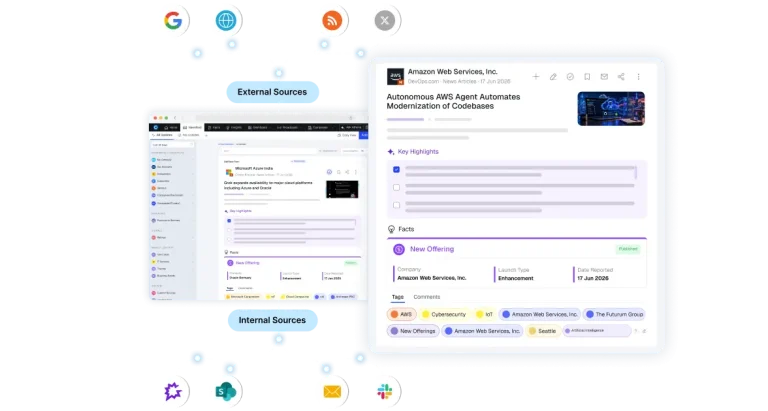
It gathers data from:
- More than 1 million vetted sources such as news, company websites, regulatory filings, industry publications, press releases, job postings, patents, social media, earnings calls & transcripts, investor relations pages, review sites, government portals, procurement & tender portals, trade journals, podcasts, videos & webinars, and more.
- Internal databases like organization’s knowledge base, CRM data, meeting transcripts and more.
- Premium or paid data sources like regional journals, industry-specific reports, analyst research, expert commentary, and market intelligence databases.
- 117+ foreign language content and automatically translating that data into English, offering multilingual intelligence.
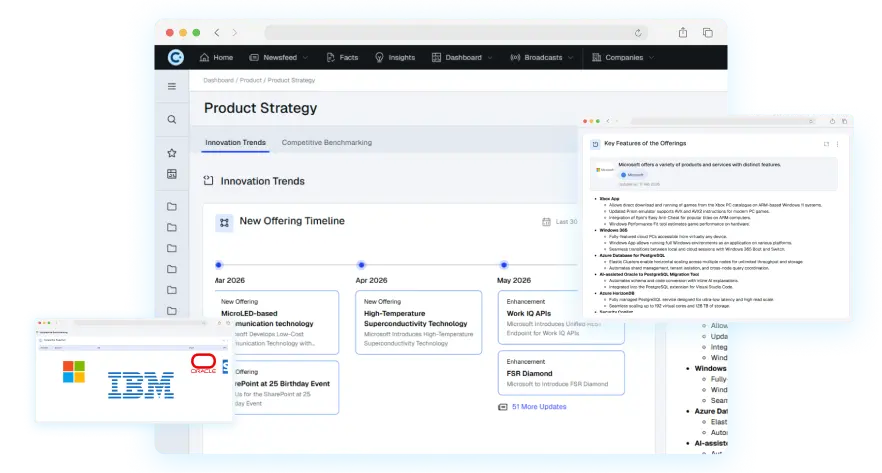
Rather than spending time on adding frameworks and formatting your reports, Contify offers 50+ in-built templates. It also allows you to choose from 20+ charts such as column and bar charts, word clouds, timeline widgets, geographical regional coverage maps, and bubble or sunburst charts, which makes financial or comparison data easy to read for stakeholders. You can even create your customized templates based on your unique requirements in a few clicks.
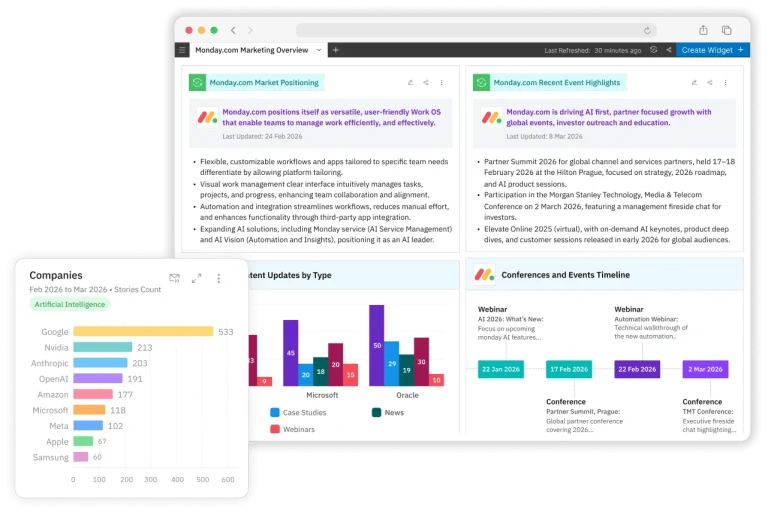
For instance, the image below shows the Contify dashboard, showcasing real-time, auto-updated, and source-verified insights on ‘positioning and claims’ of a competitor.
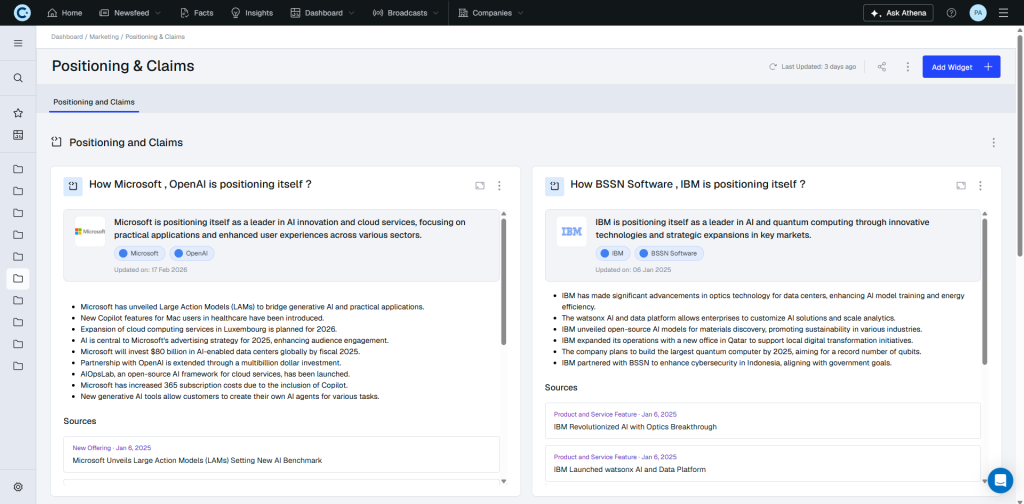
In Contify dashboards, you can define the categories (or widgets) for which you need insights. For example, if you want company profiles, M&A initiatives, social media activities, website changes, or pricing updates in your reports, you can add dedicated widgets for each of them. These widgets automatically refresh over time, delivering real-time, citation-backed insights without requiring you to collect data manually every time or constantly check for updates.
You can also add these widgets to your internal tools such as HubSpot, Salesforce, Power BI, and more, so you get the insights you need directly within your existing workflow. On the other hand, you can also integrate widgets from your own tools into Contify’s dashboards and share them with stakeholders for faster collaboration.
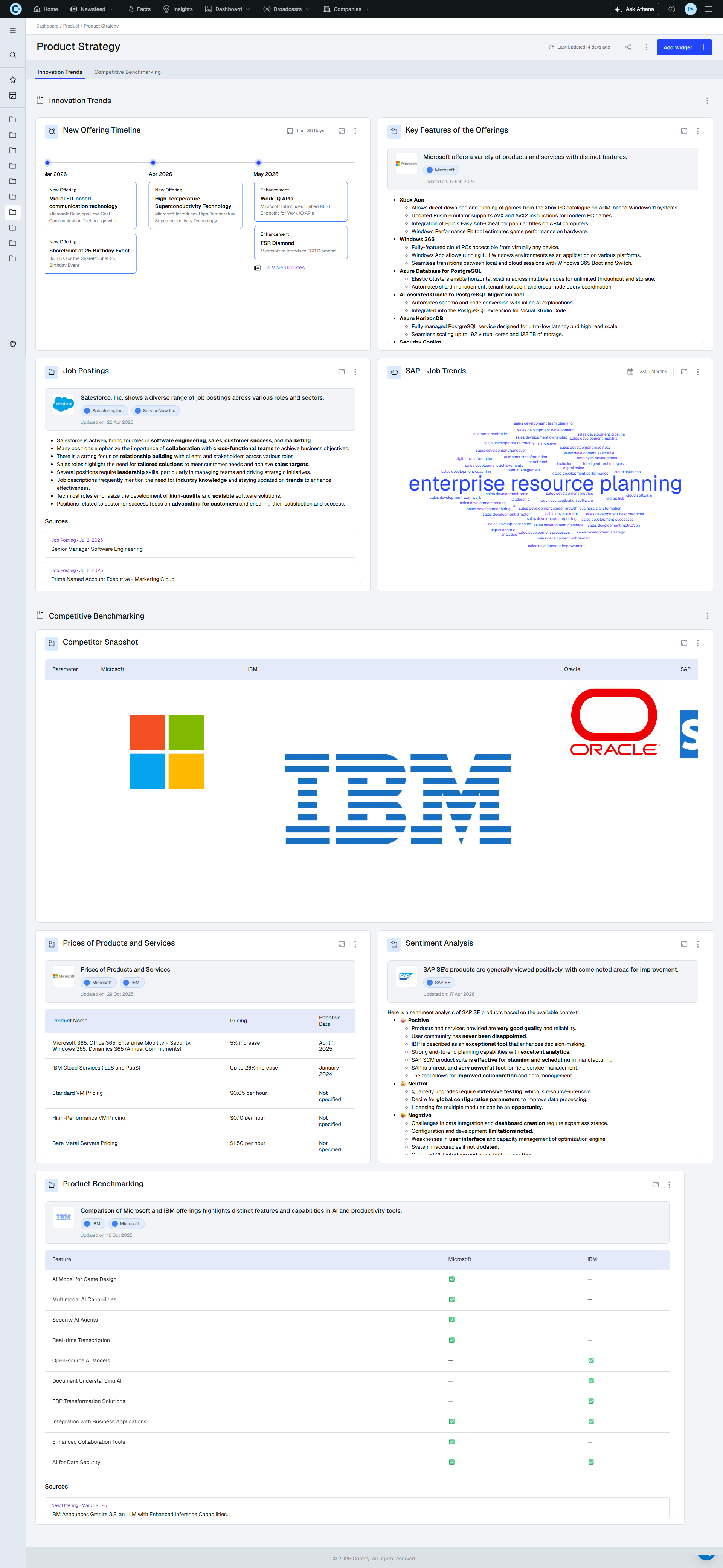
Unlike AI-generated static reports, you can share these live dashboards, or provide access to unlimited users in your entire organization with role-based access controls. These dashboards ensure that stakeholders receive timely, continuously relevant, and filtered intelligence along with decision-ready insights across the enterprise, making intelligence more collaborative and accessible across business functions.
With Contify, your CI reports become dynamic and live rather than static and stale.
- Your CI reports are now a single source of truth (SSOT) where insights from external and internal sources are synthesized together, all linking to the original sources - enabling a 360-degree view of your competitive landscape.
- These reports will be role-specific, tailored to each team or function. Let's say your sales team needs regularly updated battlecards for prospect calls. Instead of manually creating battlecards, Contify auto-populates contextual data, deduplicates it, and updates the battlecards automatically with objection handling and landmines to lay. The battlecards are automatically updated with the latest information and recommended talking points, helping sales teams respond with confidence during customer conversations.
Conclusion
The best competitive intelligence report is one that gives timely, actionable recommendations to stakeholders, so they can strategically plan business responses and not only stay relevant but grow faster than competitors in today’s hyper-competitive market landscape.
With AI developments, the future of CI reports is dynamic, not static. As the competitive landscape is turning more complex and fast-moving than ever before, organizations require continuous, source-backed, role-specific, collaborative, and relevant intelligence that has to be available at the times when decisions are made.
Instead of relying solely on general-purpose AI tools that are designed for general purposes, not specific to competitive intelligence workflows, organizations should consider purpose-built, AI-powered market and competitive intelligence platforms like Contify, which delivers AI-powered competitor intelligence reports, helping you spend less time in data gathering and verifying and more time in analyzing and recommending actions that your job role is actually meant for.
FAQ's
How often should competitive intelligence reports be updated?
Competitive intelligence reports should continuously evolve to provide real-time and actionable insights into the competitive landscape, enabling organizations to make predictive rather than reactive decisions.
For decades, however, these reports have been created by organizations on a weekly, bi-weekly, monthly, quarterly, or annual basis, based on business requirements. This periodic approach often creates a reactive intelligence process, where critical developments are captured and reported only after they have already begun influencing the market and competitive dynamics.
Purpose-built AI-powered intelligence platforms are now changing that. CI reports are no longer static documents created at fixed intervals. Instead, they are delivered as role-specific, decision-ready intelligence through dynamic dashboards that continuously update and can be accessed whenever needed.
What is the difference between competitive intelligence and market intelligence?
Competitive intelligence is generally structured insights that are related only to the companies that you consider your rivals. This process includes intelligence about your direct competitors, indirect competitors, and emerging competitors.
A competitive intelligence program monitors your competitors' activities and developments to give you actionable insights such as product launches, pricing changes, partnerships, acquisitions, leadership moves, hiring activity, marketing campaigns, customer wins, and strategic initiatives, so you can stay relevant with smarter strategic responses in today's hyper-competitive business environment.
On the other hand, market intelligence covers the broader aspects of the market in which your organization operates. In addition to competitive insights, market intelligence monitors customers, industry trends, market dynamics, regulatory developments, technological changes, and other external factors, so you can understand not only what your competitors are doing, but also what is happening across the broader market around you.
What are the best competitive intelligence tools available today?
Contify is a leading AI-powered market and competitive intelligence platform that delivers real-time, relevant, source-verified, hallucination-free, and decision-ready insights to key stakeholders and leadership teams through the power of agentic AI—tailored to each team's specific requirements.
Unlike general AI tools, Contify curates intelligence from more than 1 million publicly vetted sources, internal documents (knowledge bases, CRM data, and other enterprise systems), and premium/paid content.
This enables a 360-degree view of your market and competitive landscape while significantly reducing the time your intelligence analysts spend on gathering data and verifying it, allowing them to focus more on interpretation and strategic planning.
Can AI replace competitive intelligence analysts?
The analyst's job will always remain crucial in an intelligence program, but their priorities and focus will change. General-purpose AI tools such as ChatGPT or Claude act as black boxes and produce hallucinated data, which again burdens intelligence analysts with a manual and time-consuming task to verify. Having said that, AI is meant to empower intelligence analysts, not to increase their workload further. The real effectiveness of AI is measured when analysts get more time for data interpretation and strategic planning rather than collecting and verifying data. That is where tools such as Contify come in play, which is a purpose-built tool for AI-powered intelligence, automating the analyst's data mining and verification work. It can also automate analyzing data and delivering decision-ready intelligence directly to your inbox.