Last updated
Aug 17, 2026
Last updated
Aug 17, 2026


Summary
- This blog provides 19 top market and competitive intelligence sources, what to track in each, and how to use them in your intelligence program. It categorizes these sources into groups: external intelligence sources and internal intelligence sources.
- External intelligence sources are company websites, news and press releases, social media, online forums, review websites, SEO footprints, regulatory portals, industry associations, trade publications, patent databases, job postings, analyst reports, statistical databases, financial filings, funding databases, and premium content platforms.
- Internal intelligence sources are stakeholder interviews, CRM and deal notes, customer success interactions, win-loss interviews, sales call transcripts, and internal collaboration tools.
- The blog introduces the M&CI Sources Pentagon, a framework that organizes all 19 sources into five intelligence dimensions: Competitor Footprint, Market & Ecosystem, Voice of Customer, Field Intelligence, and Internal Data. Monitoring all these five dimensions together provides a 360-degree market view, enabling faster, more informed strategic decisions.
Whether you’re building a new intelligence program or strengthening an existing one, one question inevitably comes up: Which market and competitive intelligence sources should you actually monitor?
The simple answer is any source that can provide answers to your business’s strategic questions for smarter decision-making.
These questions could be regarding competitor strategies, customer needs, market shifts, emerging technologies, regulatory changes, or other areas of focus. The right sources are the ones that provide reliable signals to answer those questions.
But the challenge is that your competitors and the market generate invaluable data or signals almost every day, and these signals are buried beneath an ocean of irrelevant, duplicated, and low-value information. With GenAI and the ease of writing and publishing content at scale, this noise is only increasing in volume, making it increasingly hard to separate and filter the right signals from the noise for strategic decision-making.
To simplify this challenge, these intelligence sources can be grouped into two broad categories: external and internal.
These two categories cover all sources required for comprehensive intelligence on your competitors and also the broader market you operate in. When combined and synthesized, these sources help you connect scattered signals into contextual and decision-ready intelligence, enabling a true 360-degree view of your competitive and market landscape.
In this blog, we’ll explore the top market and competitive intelligence sources in both categories, the strategic insights they offer, and how they help build a 360-degree view of your entire market and competitive landscape.
Top 19 Market and Competitive Intelligence Sources
External Sources of Competitive Intelligence
- Company websites – positioning, pricing, and messaging shifts.
- News and press releases – funding, launches, and leadership moves.
- Social media, online forums, and SEO footprints – brand narrative and keyword share.
- Review websites – verified buyer sentiment and complaint patterns.
- Regulatory portals – filings, approvals, and compliance disclosures.
- Industry association and trade publications – sector-specific, insider-level trend signals.
- Patent databases – R&D pipeline and product roadmap clues.
- Job postings and hiring signals – where competitors are expanding or cutting back.
- Analyst reports and market studies – independent competitor benchmarking and market sizing.
- Statistical data aggregators – category-wide demand and adoption trends.
- Financial and corporate filings – revenue segments, risk factors, and earnings language.
- Funding databases – capital runway and strategic investment priorities.
- Premium content aggregators – deep-dive, paywalled regional and archival research.
Internal Sources of Competitive Intelligence
- Intelligence stakeholder interviews – frontline competitive insight from sales and product.
- CRM and deal notes – competitor mentions by deal stage and outcome.
- Customer success and support interactions – churn signals and post-sale competitor mentions.
- Win-loss interviews – the real reasons buyers chose you or a rival.
- Sales call transcripts – unfiltered buyer language and objections.
- Internal messaging and collaboration tools – ad-hoc sightings from non-CI teams.
How to Evaluate Market and Competitive Intelligence Sources Before You Start Collecting
The value of intelligence depends on how it is used. In the same way, the value of a market or competitive intelligence source is not universal. A source is valuable if it helps to answer the strategic questions that influence your business decisions.
Finding the right sources is central to any intelligence program. But before you define the sources to monitor, it’s important to first evaluate what strategic decisions you need to make or questions you need to answer, and evaluate sources on the basis of their potential to provide signals that can support your decision making.
The value of a source depends on two main factors: the industry you operate in and what signals you want to capture to enable strategic decisions.
For instance, organizations operating in highly regulated industries, such as BFSI or healthcare, must monitor regulatory announcements, government notifications, compliance updates, policy changes, and similar developments.
On the other hand, these same signals may hold the least value for organizations operating in the FMCG space as their decisions are more likely to be influenced by factors such as consumer demand, retail distribution, pricing strategies, promotional campaigns, and shelf presence.
Even if two organizations operate in the same industry, their source prioritization can still differ based on the specific business goals or intelligence questions they have at any particular time.
Let’s say there are two cybersecurity enterprises. One is focused on launching a new product this quarter. Its product team will most likely prioritize sources that provide signals related to competitors’ websites, product pages, pricing, messaging, digital advertising, and customer reviews to understand how competitors position similar offerings.
Meanwhile, the second company’s priority this quarter is to expand into new geographies through acquisitions. For them, sources that provide intelligence on financial filings, funding activity, leadership appointments, M&A announcements, regulatory developments, and earnings calls will become far more valuable than competitor website changes.
Why is 360-degree Intelligence Important in Today’s Market and Competitive Landscape?
In today’s complex and interconnected business ecosystem, if you are only tracking a few rivals, you might be making strategic decisions without the broader picture of where the market is heading.
A 360-degree intelligence view is not a ‘nice-to-have’ strategy but a standard for getting a complete view of the entire market ecosystem. It monitors and provides intelligence on your customers, industry segments, partners, emerging technologies, regulatory shifts, supply chain, in addition to competitor moves. Therefore, your intelligence program should be built on a combination of external and internal sources for a 360-degree view of your market and competitive ecosystem.
Consider Intel’s recent struggle to capture the AI opportunity, which demonstrates how a 360-degree intelligence view can offer you a competitive edge. The warning signs were not limited to a single competitor or technology trend. Generative AI startups such as OpenAI were emerging, Nvidia was building its dominance around both AI chips and a deeply embedded software ecosystem, customers were shifting data-center spending toward AI accelerators, and new players were developing custom silicon. Reuters reported that Intel even discussed investing in OpenAI in 2017 and 2018, but ultimately did not pursue the deal, partly because its then-CEO did not expect generative AI models to reach the market soon enough.
These were separate market, competitor, customer, and technology signals, individually not pointing towards anything groundbreaking. However, connected, they pointed to a much bigger shift: the center of gravity in computing was moving toward AI-first and started eating Intel’s market share.
That’s what a 360-degree intelligence does. It helps organizations build a unified, single source of truth for all strategic insights, connect seemingly separate developments, and uncover the larger shift in the market landscape.
Market Intelligence Sources Pentagon
Gaining a 360-degree view of your market and competitive landscape is less complicated than it appears. Of course, it will need a purpose-built intelligence platform to support continuous, automated, and efficient market monitoring. But the crucial first step is to understand what it will take to get a complete picture of your market landscape.
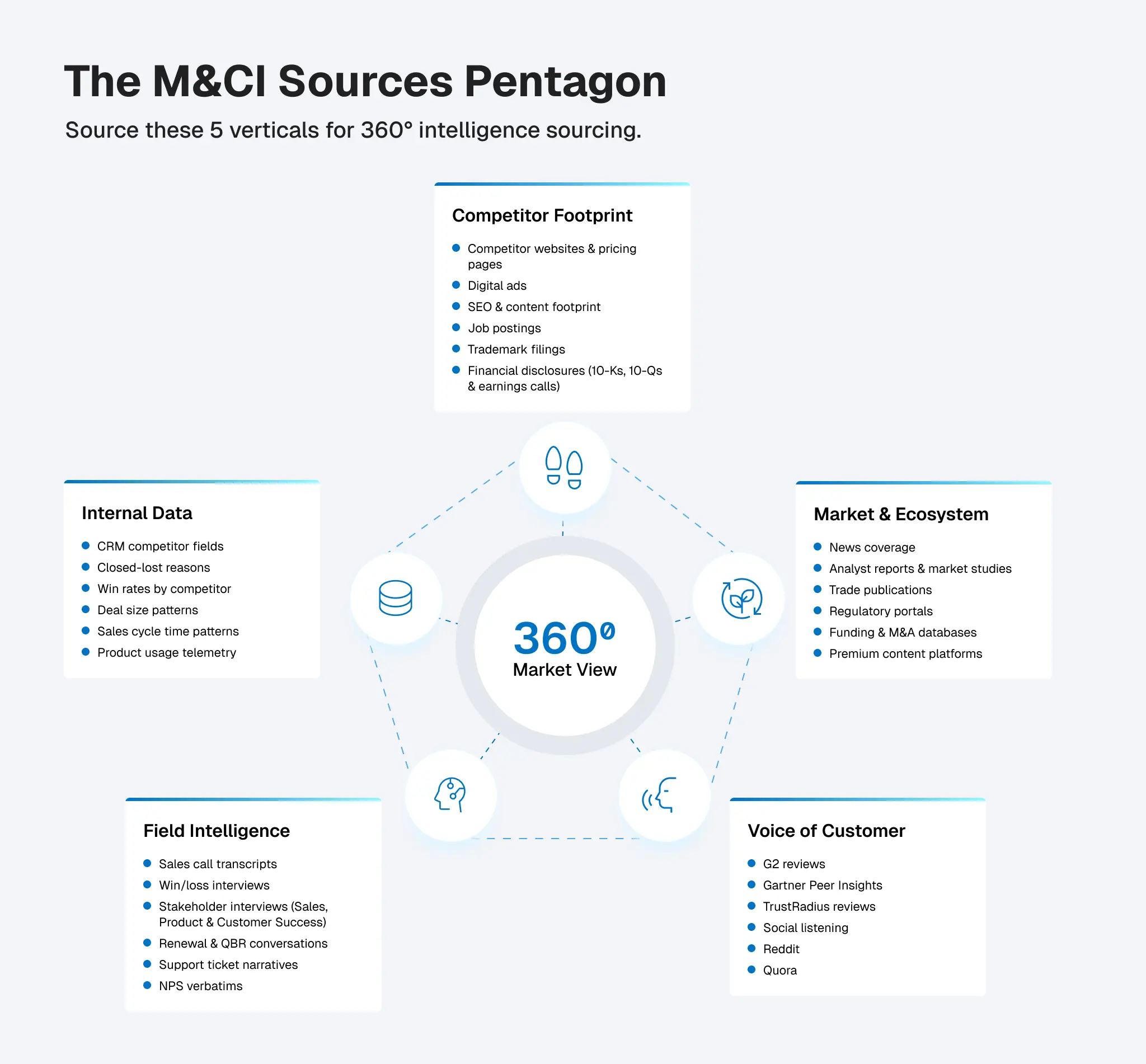
Complete intelligence, the 360-degree view, draws from five distinct categories of sources. We call this the M&CI Sources Pentagon. Three vertices are external, two are internal, and every intelligence use case you run draws on a different combination of them.
Sorting a source into its vertex takes two questions. Is the information in your custody? If not, who wrote it – the competitor, a third party, or a customer? If it is in your custody, is it a human narrative or a system record? Five answers, five vertices.
Source these 5 verticals for 360° intelligence sourcing.
| Pentagon Vertex | Intelligence Question It Answers | Source Categories That Feed It |
| 1. Competitor Footprint | What are competitors claiming, building, and investing in, in their own words? | Competitor websites & pricing pages, release notes, press releases, digital ads, SEO & content footprint, executive posts & webinars, job postings, patents, trademark filings, financial disclosures. |
| 2. Market & Ecosystem | Where is the market heading, and what does any single competitor’s move mean in that context? | News coverage, analyst reports & market studies, trade publications, Industry associations, regulatory portals & policy changes, statistical & government data, funding & M&A databases, premium content platforms. |
| 3. Voice of Customer | What do buyers and users actually experience, with you and with your competitors? | G2 reviews, Gartner Peer Insights, TrustRadius reviews, social listening, Reddit, Quora, commissioned market surveys. |
| 4. Field Intelligence | What is the market telling your people that no one else does? | Sales call transcripts, Win/loss interviews, stakeholder interviews (Sales, Product & Customer Success), renewal & QBR conversations, support ticket narratives, NPS verbatims, partner feedback, Internal channel observations. |
| 5. Internal Data | What is the measurable impact, where are you winning, losing, and at what rate? | CRM competitor fields, closed-lost reasons, win rates by competitor, deal size patterns, sales cycle time patterns, product usage telemetry, support metrics, past research repository. |
Why a pentagon and not a checklist?
There’s a hierarchy of difficulty here, and it runs opposite to the hierarchy of value. The external vertices are the easiest to cover and available to every one of your competitors. The internal vertices, field intelligence and internal data, are hard to systematize, and that’s precisely why they’re the moat. Anyone can subscribe to the same news feeds you do. Nobody else has your win/loss interviews.
Top External Market and Competitive Intelligence Sources
As the name suggests, external intelligence sources provide signals from publicly available domains and third-party platforms. These sources form the foundation of competitor analysis and broader market and competitor monitoring.
1. Company websites
Homepage, product pages, pricing page, blogs, case studies, leadership mentions, and investor relations pages are all goldmines among external sources. This source provides signals that come directly from competitors, in their own words. Through this, you get to understand competitors’ marketing direction and positioning. Therefore, this is one of the most in-demand sources of competitive intelligence intelligence sourcessources of intelligence available by organizations in the market.
What to track:
- Check competitors’ hero messaging and value proposition pages. (Positioning and messaging shifts are surfaced here.)
- Competitors’ ICPs by monitoring case studies, customer logos, and pricing restructuring strategies.
- Product offerings: what is added, removed, or reorganized.
How to use it: Staying aware of every change on your competitors’ websites is not practically possible for intelligence professionals due to time constraints, so a purpose-built intelligence platform will ensure only meaningful changes are surfaced. Ultimately, the purpose of using this source is to track changes on competitors’ websites, understand their positioning, and then decide your business strategy accordingly. For instance, if you catch early that your competitor has changed its pricing tiers, then you can inform your sales team in time for more informed prospecting.
2. News & press releases
Product launches, new hires, M&A initiatives, funding, newswire announcements, and more, these sources tell you what narrative and perception your competitors are setting for investors, customers, partners, and the market. Through this, you can surface their vision, current focus, and future direction, helping you shape your own business strategy.
What to track:
- New partnership and integration launches.
- Executive hiring and departure releases.
- Product launch coverage.
- Language used to frame growth claims.
How to use it: Press releases typically signal initiatives that were already decided a few months before the information goes public. So treat these signals as confirmation, not as discovery. Having said that, don’t forget to cross-verify the information in the releases against your existing signals to get an accurate timeline and complete picture of your competitor’s strategy.
3. Social media, online forums, and SEO footprints
Social media tells you what kind of brand image your competitors are trying to build: is it friendly, thought leadership, or customer-centric? Forums tell about the sentiments and experiences of your competitors’ buyers. SEO efforts indicate which keywords they are leading in terms of online traffic share. Put these signals together, and you can compare your organization’s brand identity with competitors’ and provide your marketing team with execution-ready insights for content strategy.
What to track:
- Positioning intent of executive thought leadership themes on LinkedIn.
- How many times and how frequently your competitors’ products/services are mentioned on Reddit, Quora, etc.
- Keyword ranking changes and new content cluster buildouts.
- Shifts in share of voice across key category topics.
How to use: Check which keywords your competitors are creating content around. Also, keep an eye on whether they are producing industry-specific, use-case-led, or thematic content in bulk. By analyzing these signals, you can understand your rivals’ product and service prioritization and assess their quarterly focus, helping you build hyper-focused product and inbound marketing strategies.
4. Review websites
Third-party review platforms like G2, Gartner Peer Insights, Capterra, or Trustpilot offer reviews from verified customers about competitors, which reveal about their product quality, implementation experience, support, and value. This is unfiltered data at scale that comes directly from your competitors’ buyers. Whether positive or negative, by collecting these reviews, you can invalidate your competitors’ claims and enhance the value proposition of your offerings.
What to track:
- Common complaint across reviews (a structural weakness, not an outlier)
- Size and industry of companies that are putting reviews to identify actual versus stated ideal customer profiles (ICPs) of your competitors.
- The reviewer comments that name your product as an alternative, and the rating trend direction over time.
How to use: Instead of single-liner or one-time feedback, look for patterns, repetition, and how long these reviews have been floating around. For instance, if you notice negative reviews about your competitor for a long time regarding platform interface, performance, or customer service, you can use them in demo calls to better position and showcase your platform’s strengths. You can use them in your pitch decks, comparison pages, and other sales enablement assets.
Moreover, Salesforce says that customer reviews about your platform are a valuable source of business insights, which you can use in the website’s social proof section, on social media, during demo calls, and for product or service refinements.
5. Regulatory portals
In today’s uncertain business landscape, shaped by government and industry policies, it is crucial for organizations to comply with evolving regulations. Signals related to product approval filings, compliance disclosures, trademark applications, licensing, and more tell you about the safety and legal standards on which you can make future business decisions. Complying with regulatory policies is not only a necessity but also a source of competitive advantage.
What to track:
- Trademark applications (new product or brand names in development).
- New entity registrations in markets of strategic interest.
- Product approval or certification filings.
- GDPR and CCPA compliance disclosures.
- Licensing or operating permit changes.
How to use it: Set jurisdiction-specific alerts for competitor entity names. Use compliance certifications to enhance your business’s trust, credibility, and market reputation. Regulatory filings are event-driven rather than continuous, so alert-based monitoring is more efficient than periodic manual checks.
6. Industry association & trade publications
Sector-specific publications, industry bodies, trade journals, and association newsletters are all great sources of competitive intelligence that give insider, expert-led, and highly niche insights about a specific industry. Make this source vital if you don’t want to miss market intelligence on localized industry benchmarks, early trend signals, regulatory shifts, technology developments, and competitor product disclosures that are rarely available on other platforms.
What to track:
- Category-level trend coverage that will affect all players.
- Competitor executive quotes and bylines in trade publications.
- Industry association reports and white papers.
- Conference agenda topics from leading industry bodies.
How to use it: Monitor key trade publications covering your industry. Map the same competitors, technologies, and market themes in each publication to verify if a signal is just an isolated opinion or a trend in the industry.
7. Patent databases
The Patent Database helps you identify signals such as a secret R&D pipeline, an upcoming product roadmap, and a global expansion plan. By tracking these sources, you can spot a competitor’s product roadmap, explore market whitespaces, and gauge the risk of patent infringement lawsuits.
What to track:
- Volume trend of filings over time (a sudden increase signals a serious R&D push).
- Technology classification codes on new filings (reveal the specific domain they’re investing in).
- New inventors listed (R&D team growth signals).
- Abandoned patents (capabilities being de-prioritized).
How to use it: If you are a small-scale business, a Google Patents or USPTO search would be a good place to start. For larger businesses, a purpose-built intelligence tool can help automate alerts by assignee name. Don’t forget to keep your product team in the loop on these signals, as they can influence roadmap decisions rather than just competitive positioning.
8. Job postings and hiring personnel
Job listings and hiring trends tell you which business areas your competitors need resources in, what their priorities are, and where expansion or cost-cutting is taking place. For example, if your Competitor X posts a job opening for a Sales Manager in a new geography, it signals a possible expansion plan. Similarly, monitor layoffs to understand where your competitors are pulling back. This source is priceless because it is as actionable as knowing where your competitors are investing.
What to track:
- Role volume by function. Are engineering, sales, or marketing teams growing or shrinking?
- Job description language. Which technologies, software, industry verticals, or customer segments are explicitly mentioned?
- Senior leadership changes.
- Repeated postings for the same role signal churn or organizational dysfunction.
- Key personnel departures and where they join next.
How to use it: Set automated job alerts for competitor company names across LinkedIn, Indeed, and Glassdoor. Review them monthly. Flag significant hiring clusters and trends to both your product team (capability signals) and sales leadership (market expansion signals) rather than keeping this intelligence limited to the executives only. Also, compare hiring trends over time rather than individual job postings, as hiring patterns reveal strategic priorities more accurately than one-off vacancies.
9. Analyst reports and market studies
This is among the few top sources that provide critical signals on your competitors’ in-depth profiles (including strengths and weaknesses), buyer trends and expectations, and market demand trends. These independent, unbiased, and enterprise-grade reports come directly from global business advisory and consulting firms and pioneers. Monitoring these reports helps you detect early trends, understand your market share compared to your competitors, and identify emerging opportunities.
What to track:
- Competitor quadrant or wave position changes in analyst reports year over year.
- Which evaluation criteria do analysts weigh most heavily this cycle.
- New entrants appearing in coverage that weren’t included previously.
- How market sizing projections shift between editions.
How to use it: Go beyond the placement graphic when a new report drops. Analyze the messaging, terminology, strengths, and weaknesses described in these expert reports, and use this data to pressure-test your comparable parameters before the next sales cycle.
10. Statistical data aggregators
Government statistical agencies, industry data aggregators, and economic indicator platforms offer industry-specific signals that you can’t afford to miss. This source is nothing short of gold for market intelligence, as it quantifies everything happening in your market and offers future predictions as well.
What to track:
- Category-wide demand trends.
- Labor market data affecting hiring costs across your industry.
- Technology adoption rates by sector.
- Customer spend patterns relevant to your buyers’ budget environments.
How to use it: These data points act as references that you can add to your intelligence reports for leadership and boardroom discussions. These insights offer market-level context with unmatched credibility, facilitating faster strategic decisions.
11. Financial and corporate filings
Competitive monitoring is incomplete without knowing their financial health. Mandatory public disclosures, such as 10-K annual reports, 10-Q quarterly filings, 8-K event disclosures, and earnings call transcripts, are table-stakes sources for your competitive intelligence. What your competitors choose to highlight, and what they hide, tells you more than most monitoring sources combined.
What to track:
- The “Risk Factors” section of a 10-K, which reveals vulnerabilities the competitor acknowledges.
- Revenue by segment in 10-Qs, which shows which product lines are actually growing versus which get the most marketing spend.
- Earnings call transcript language, where hedging signals trouble and outsized enthusiasm signals next investment priority.
- Sell-side analyst Q&A, where the sharpest competitive tensions tend to surface.
How to use it: Scan earnings call transcripts for risks, forward-looking growth strategies, operational challenges, product-specific language, and similar strategic event-focused statements.
12. Funding databases
Crunchbase, PitchBook, CB Insights, and Tracxn are all crucial sources of competitive intelligence as they reveal initiatives regarding venture capital, M&A, private equity, and debt financing. You should know your competitors’ capital runway and strategic investment priorities to assess how aggressively they can compete on pricing, hiring, and marketing over the next 12 to 24 months.
What to track:
- Funding round size, stage, and lead investor identity.
- M&A target profile and the capabilities being acquired.
- Secondary market transactions as early signals of valuation stress.
- The strategic narrative in the funding announcement itself.
How to use it: When a funding round occurs, analyze the investment narrative along with the investor’s known portfolio thesis. By monitoring both, you will get a clear picture of a competitor’s strategic direction, and you can then develop your competitive strategies accordingly.
13. Premium content aggregators
Paywalled content platforms offer in-depth insights that are difficult to find in public or even internal sources. To gain a competitive advantage, you need to subscribe to sources that offer premium content in your industry segments
What to track:
- Regional coverage of competitor activity in markets you’re entering or defending.
- Historical archive research when investigating a competitor’s long-term strategic patterns.
- Niche trade press commentary that doesn’t make it into mainstream news feeds.
How to use it: Subscribe to premium content aggregators for deep-dive research and international monitoring. If your organization already has subscriptions to Factiva or LexisNexis, build competitor-monitoring queries and integrate the results into your purpose-built M&CI platform, rather than using these aggregators as a substitute for it.
Top Internal Market & Competitive Intelligence Sources
Internal intelligence sources provide signals gathered from within an organization’s datasets and knowledge base.
14. Intelligence stakeholder interviews
This is one of the most underutilized sources of intelligence in organizations. Through this, you can gather useful data directly from your market-facing team members in sales, product, marketing, or C-suite teams. These professionals’ experience, knowledge, and expertise mature over time through direct customer interactions, which help them gain a practical understanding of the market. Aggregating this information helps in creating actionable intelligence that is rarely available in formal reports.
What to track:
- Which competitors are coming up most in deals right now, and at which stages?
- What recurring objections are prospects raising that don’t have any formal documentation?
- Where are your team members seeing gaps between your positioning and what the market actually responds to?
How to use it: Interview key people from sales, product, and customer success based on their frequency of customer engagements. Ask each the same five competitive questions. Compare where the answers overlap and where they sharply differ. You can do it monthly or at your preferred time period.
15. CRM & deal notes
CRM data and deal notes have always been one of the top intelligence sources because the insights come from prospects and sales reps firsthand. Surprisingly, 40% of sales reps don’t use CRM as they should, leaving valuable competitive intelligence untapped. When organized and synthesized well, CRM data can reveal which competitors are currently appearing in your pipeline, at which deal stages, with what objections, and with what outcomes. These insights help sales reps equip themselves with the tools and answers they need to handle objections, boosting their chances of winning more deals.
What to track:
- Competitor field data by deal stage, deal size, and vertical.
- Closed-lost and won reasons attributed to specific competitors.
- Rep notes from competitive deals.
- Patterns in the deal when a specific competitor is involved.
How to use it: Establish a culture for sales reps to fill in details like competitor fields, closed-lost deal notes, and opportunity records, so you get credible and exclusive data that can turn deal-specific intelligence into higher-level strategic intelligence.
You can also embed intelligence in your CRM tools. For instance, if you are working on a deal in Salesforce, you can also see competitive battlecards, market updates, account-specific intelligence, and relevant insights without logging in to Contify separately. Also, users can access the Contify platform directly from within their Salesforce account via SSO, saving time and reducing context switching.
16. Customer Success and Support Interactions
At times overlooked, but if properly structured, this source can provide useful intelligence. Post-sale customer interactions, such as renewal conversations, support tickets, QBRs, NPS surveys, or up-selling discussions, reveal credible signals that will be helpful from your boardroom discussions to your frontline teams.
What to track:
- Which competitors were mentioned by the existing customer during renewal and churn conversations?
- Support tickets that consistently indicate product enhancements, user dissatisfaction, or product gaps.
How to use it: Create a separate tag in your M&CI platform for competitive insights you receive during customer interactions, so your CI reports don’t miss intelligence from this source. Pay special attention to NPS detractor responses as they are among some of the most honest pieces of feedback you’ll receive directly from customers using your platform. These responses often reveal how customers evaluate your platform relative to competitors, providing competitive insights that traditional surveys rarely capture.
17. Win-loss interviews
Imagine receiving precise insights into why buyers chose your competitors over you or vice versa, and that too from the buyers themselves. Through Win/loss interviews, you can tap into your buyers’ mindset and reveal which competitors appear on their shortlists (at times different from what you might expect), the decision criteria that lead them to the final purchase, and what truly differentiates your offerings from other alternatives. It’s safe to say that this is one of the most honest competitive intelligence sources. Also, the goal of including this source is simple: to improve your win rates. A McKinsey report says that a 10 to 20% boost in win rate results in top-line growth by 4 to 12%.
What to track:
- Which competitor platform did the prospect take a demo of besides yours?
- Rank-based factors such as pricing, features, capabilities, brand value, etc., because of which they chose your competitor or vice versa.
- Objections raised about your product versus those about the competitor’s.
How to use it: Conduct the win/loss interview a few days after the deal closes, when the buyer’s memory is still fresh. The frequency of win/loss interviews will vary according to your deal volume. You can incorporate the findings directly into battlecards, product roadmap, or marketing assets to enable a competitive advantage.
You can also leverage Contify, which automatically categorizes and merges those findings with other data sources, updates insights in your enablement assets like battlecards, and also provides prescriptive insights on “what has changed” and “what steps to take.”
18. Sales call transcripts
This is a goldmine of intelligence because it is the most raw information you can get about your competitors or the market. What your buyers are saying, what terminologies they are using, and what their sentiment is – all come to you unfiltered, which is far better than receiving them from the filtered view of your sales rep. This helps you understand the real-world problems your offerings solve, their demand, customers’ comparison language, and what assets sales reps might need during live calls to close more deals.
What to track:
- Competitor names that pop up during prospect or customer service calls.
- What questions do buyers ask that signify they have already been pitched by your competitors?
- Any comments or concerns expressed by customers related to the market landscape.
- Capability, feature, messaging, and pricing comparisons raised by prospects.
- How buyers and customers perceive your company and what their overall sentiment is towards your brand.
How to use it: Set up a sales or meeting assistant like Gong or Fireflies and use their built-in AI synthesis for quick summaries or to identify which competitor’s name appears the most. For better context, historical data mapping, and continuous signal validation, connect the sales assistant to a purpose-built AI-powered intelligence platform like Contify, which automatically verifies and contextualizes that information with external and other internal signals, helping you determine whether any particular claim by your buyers or customers is worth investigating further.
19. Internal messaging and collaboration tools
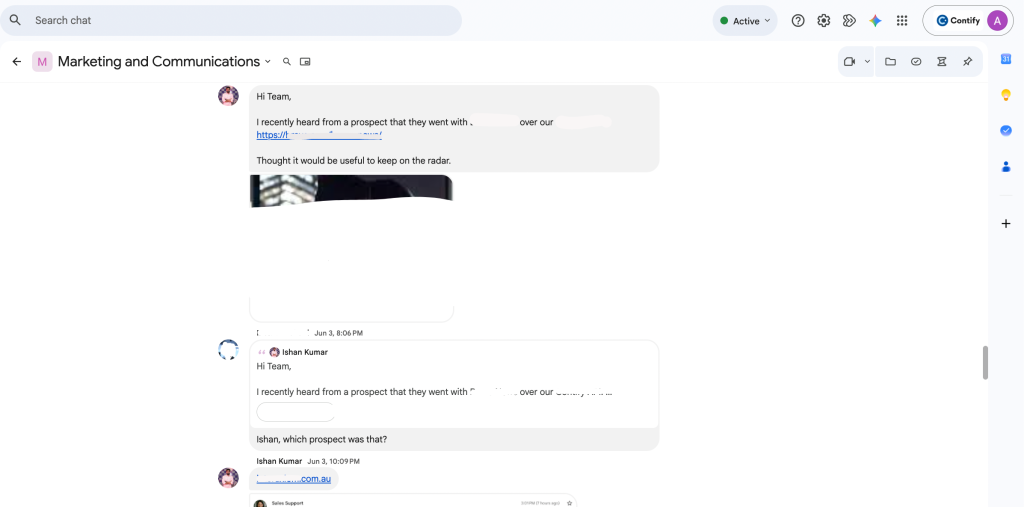
In every organization, non-CI teams (sales, marketing, or product) frequently observe competitor or market-related mentions, such as a competitor’s ad, a comment dropped by a prospect during a discovery call, or a job posting. But in many organizations, there’s no structured place to put this data. Usually, the CI team has its own dedicated channel, and non-CI teams have theirs. But if this content is captured efficiently, it can become a goldmine of human intelligence that has been directly seen or heard.
What to track:
- Signals that haven’t yet appeared in your formal monitoring feeds.
- Any events, such as webinars or offline summits, that provide relevant signals.
How to use it: Promote a culture within your company where every employee can share competitor or market observations. Every submission should include three details: the company, the observation, and where it was observed. Create an #intelligenceChannel on Slack, Microsoft Teams, or any collaboration platform, and keep the entry barrier as low as possible. Pair it with an AI triage that categorizes these observations and escalates the ones worth noticing, so the channel remains useful and analysts don’t have to manually review every submission.
At Contify, we have built this culture where anyone can share their findings about the market or competitors in an open-to-all group.
Common Sourcing Mistakes in Competitive Intelligence to Avoid
- Missing multilingual sources
If you operate globally and intelligence on your industry is published in non-English languages that you’re not monitoring, you’re operating in an intelligence blind spot. Also, if you’re expanding globally or defending local market share, capturing multilingual insights becomes crucial. These reports help you decode your competitors’ localized strategies and stay up to date on cultural context, local consumer behavior, and regulatory nuances of specific regions.
Including these data in your sources is essential, especially for industries such as BFSI, healthcare, pharmaceuticals, manufacturing, automotive, and consumer goods, where local regulations, market dynamics, and customer preferences vary significantly across regions.
- Relying on horizontal AI tools for sourcing intel and filtering signals
Using generic AI tools like ChatGPT, Claude, and Gemini as sources of intelligence is an extremely risky way to make strategic decisions and equip frontline customer-facing teams with unverified information. This is because generic AI tools are built for broader, cross-industry workflows that understand and generate answers in natural language from publicly available data. These tools frequently generate fabricated, hallucinated, or unverified responses. Additionally, they lack your organization’s business context and can’t connect to your internal datasets to generate centralized intelligence useful for decision-making.
Moreover, generic AI tools lack historical context, making it difficult to distinguish material changes from general minor ones. For example, if a competitor updates its pricing page or website messaging, a generic AI tool can summarize the latest changes. But it cannot explain why those changes matter in the context of your offerings, how they compare with previous changes, what strategic shift they indicate, or whether similar changes are happening across competitors. That’s because it doesn’t have your organization’s context and doesn’t maintain a structured repository of historical intelligence on competitor activities.
- Over-index on one source category
If you’re obsessively monitoring only your competitors’ websites while giving less priority to your internal data, or vice versa, you’re likely missing a complete 360-degree view of your market context. This is because a single source often doesn’t provide the complete picture of your competitors’ strategy or market shifts.
An effective intelligence program is one that understands how much weight to assign to external and internal sources, based on which source provides the most relevant signals for the intelligence question being answered. Every category in the Pentagon Framework above exists because no single vertex alone tells the complete story. It’s the combination of all five intelligence dimensions that enables a true 360-degree view of your market and competitors.
- No triangulation of source data
Ensure that your market and competitor findings are triangulated so that the validity and credibility of the data are verified before making any sensitive business decisions. Whatever data is drawn from market and competitive analysis, it’s best that it aligns with primary, secondary, or HumanINT, so that only accurate and relevant insights reach your stakeholders.
For example, if your sales team reports that customers are increasingly asking for AI capabilities, validate that signal against competitor product updates, customer reviews, analyst reports, or industry news before concluding that AI has become a key buying criterion. But for intelligence analysts, it’s practically impossible to deliver triangulated intelligence from these source buckets while keeping up with the speed of the market.
Contify is an AI-powered market and competitive intelligence platform that automates the data triangulation process to ensure the insights you deliver are accurate, relevant, and credible.
How Contify Enables a 360-degree View with Market and Competitive Intelligence Sources
Contify is a purpose-built market and competitive intelligence platform, powered by agentic AI, RAG, and a customizable knowledge graph, that helps organizations gain a 360-degree view of the complete business ecosystem in which they operate.
A major challenge that intelligence professionals face is categorizing which insights have come from which sources. This is a highly complex process because organizations monitor hundreds of external and internal sources simultaneously, making it difficult to trace the origin of every insight manually. Another significant challenge is collecting signals from all five Pentagon dimensions manually is possible in theory but extremely difficult in practice. As the number of monitored sources grows, organizing, validating, and connecting those signals becomes the real struggle for most organizations.
Out-of-the-box Taxonomy
Contify automatically organizes the massive influx of unstructured data coming from external and internal sources and categorizes it based on pre-built “Source Type” and “Channel” taxonomies. As a result, you always know the original source of every insight, making it easier for you to judge its relevance, context, and intent. You can even create your own custom taxonomies based on your organization’s internal operating structure.
Add Custom Sources
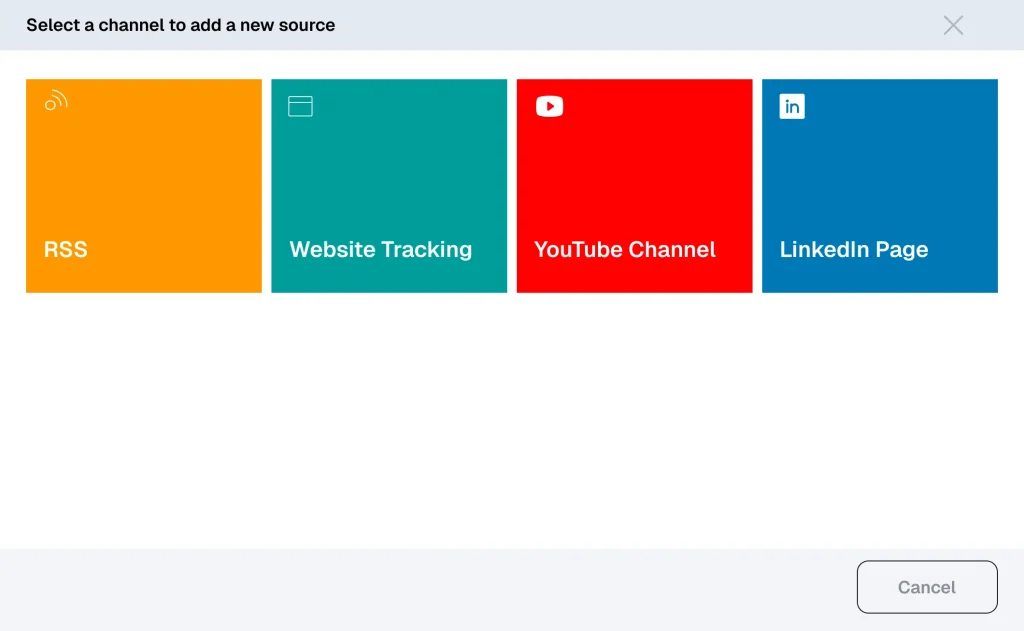
Many companies rely on third-party data aggregators, but Contify owns its own proprietary web crawling infrastructure. It allows users to add highly specific, niche sources, even those without RSS feeds, such as specialized regional regulators, technical GitHub repositories, or custom competitor web pages, without extra cost or integration delays.
Cleanest, Noise-free, and Unified Insights from External and Internal Sources
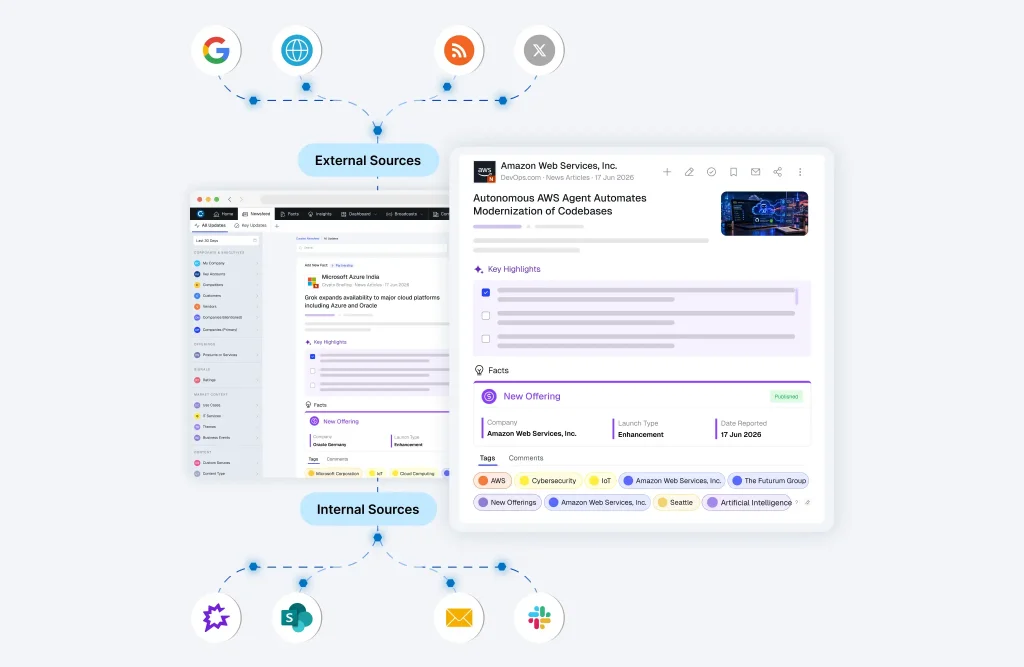
Contify ensures that source monitoring remains always-on rather than a periodic exercise. It continuously monitors, curates, and tags data from more than 1 million external sources, internal datasets from CRM, Gong, sales call transcripts, and other enterprise systems, along with paywalled content to unify intelligence and create a single source of truth for an organization’s strategic decision enablement.
For instance, the battlecard inside Contify isn’t generated solely from a competitor’s website data. Instead, it is automatically merged with the contextual insights coming from internal datasets, such as sales conversations, CRM notes, and customer feedback, to provide a much more complete competitive picture.
Multilingual Intelligence from Data Sources
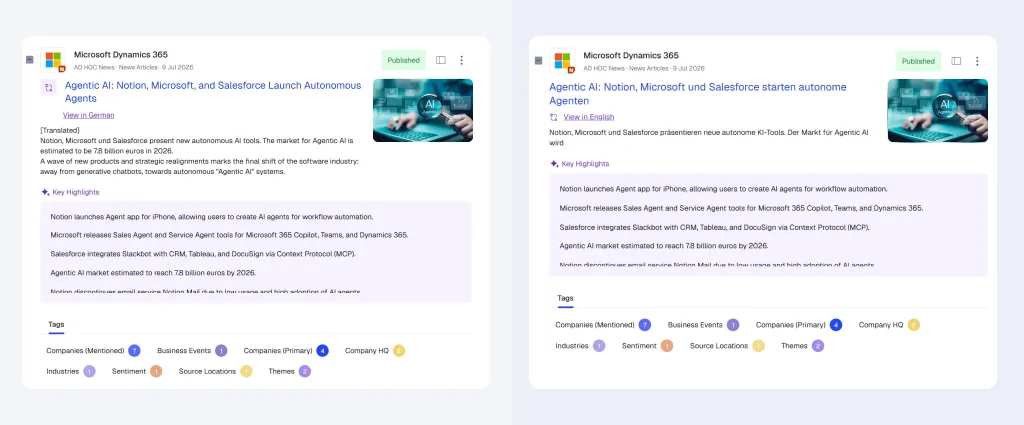
Contify is an AI-powered intelligence automation platform that also monitors insights from 117+ non-English sources and automatically translates and surfaces those insights in English while preserving industry terminology and language nuances. This eliminates intelligence blind spots from multilingual sources and allows your cross-border teams to receive timely, decision-ready insights without losing regional context.
Conclusion
The top 19 market and competitive intelligence sources discussed above provide a 360-degree view of any organization’s environment and accelerate strategic decision-making.
Remember, the value of these sources lies in how you use this intelligence for decision-making, rather than overloading yourself with data. Therefore, digging into the right market and competitive intelligence sources is only half the job.
Next, it requires turning these sources into an always-on intelligence engine that provides relevant, verified, and decision-ready insights to support stakeholders in strategic decisions. To know how you can turn these top intelligence sources into best-in-class CI reports, read our guide.
FAQs
What is a 360-degree view in competitive intelligence?
A 360-degree intelligence view means getting a panoramic view of the entire ecosystem in which your business operates and competes. This includes gathering intelligence regarding a business's customers, partners, market segments, regulatory, and macroeconomic factors, rather than just relying on intelligence that comes from your competitors. A 360-degree intelligence view is crucial today because the market and competitors are interrelated, both influence each other. Therefore, to make strategic decisions that keep you relevant in the market and give you a competitive edge, you need a comprehensive market view.
How many intelligence sources should a company track?
To gain a 360-degree intelligence view, an organization should track five intelligence verticals: Competitor Footprint, Market & Ecosystem, Voice of Customer, Field Intelligence, and Internal Data. Each of these verticals consists of multiple intelligence sources that provide unique signals about different aspects of your competitors, customers, and the market. When these signals are brought together, they create contextual, validated, and decision-ready intelligence instead of isolated observations.