Last updated
Nov 18, 2026




Introduction
Imagine launching a new product in the market, only to realize your competitor introduced a similar one just a week earlier. Without real-time Market Intelligence (MI), organizations risk falling behind in today’s rapidly evolving market landscape.
According to one of McKinsey’s surveys, approximately 72% of companies across the world are extensively leveraging AI not just in building robust products and services, but becoming truly global. And, it’s a number that continues to grow. In this fast-shifting market, staying informed about competitors’ moves and industry trends is crucial. This is where strategic market intelligence becomes invaluable.
Through this blog, we aim to break down,
- The importance of market intelligence and its benefits.
- How it helps businesses make smart, data-driven decisions for sustainable and prolonged growth.
Market Intelligence: Your Strategic Compass
Market intelligence is a systematic process of gathering, analyzing, and interpreting data about markets, industries, and competitors. When this process is combined with artificial intelligence, AI-powered market intelligence empowers companies to mitigate risks, identify competitive threats early, anticipate industry shifts, and build stronger offerings and forward-looking strategies for competitive advantage.
It lays a much stronger foundation for organizations to leverage, achieve agility, and gain a decisive advantage. This is particularly beneficial in terms of identifying new market opportunities and acting upon them when the time is right.
Platforms like Contify empower businesses with business market intelligence to unlock growth. Here’s how:
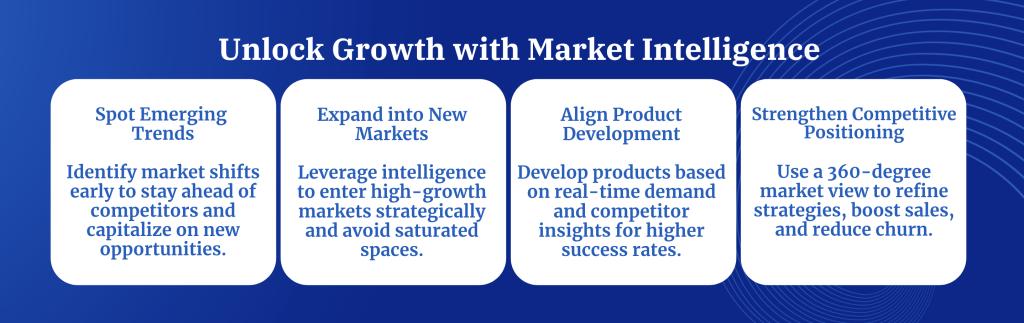
1. Spot Emerging Trends Before They Become Mainstream
Market intelligence help businesses identify shifts in consumer behavior, emerging market trends, industry behavior, and competitor strategies. For instance, early adopters of MI recognized the rise of electric vehicles (EVs) and adjusted their strategies to capture new demand before competitors.
Similarly, many giant tech startups detected the growing need for AI-powered chatbots using marketing intelligence before the world, combined, and developed advanced solutions to solve customer problems on-the-go and gain a competitive edge.
2. Expand into New Markets
By analyzing economic indicators, competitor expansions, and regulatory changes, marketing intelligence systems help identify potential markets with strong growth potential. This approach enables businesses to expand strategically rather than competing in a saturated, existing space.
For example, insurance firms can use marketing intelligence to identify customer pain-points and develop tailored plans that align with the evolving market needs.
3. Align Product Development with Real-Time Demand
Launching a product based on outdated market intelligence research or partial data can lead to costly missteps. Here, MI ensures businesses align their product roadmap with current customer needs and competitor strategies, leading to higher success rate at launch.
A Fintech company, for example, can track competitor innovations and refine its offerings to improve customer retention as well as drive new business conversions.
4. Strengthen Competitive Positioning
With a 360-degree view of the market, organizations can benchmark performance, refine their go-to-market strategies, and seize more sales opportunities. For example, tracking competitor pricing, product launches, and customer reviews helps teams spot where rivals are weak and position their own offerings to win those accounts.
To maximize the benefits of market intelligence, businesses must monitor both quantitative KPIs (e.g., revenue, sales) and qualitative KPIs (e.g., customer feedback, survey results). AI-driven analytics further accelerate insights, and can help companies make informed, timely decisions.
Market Intelligence Vs. Market Research
Many confuse market intelligence with market research and often use the two terms interchangeably. While they may appear similar, they serve different purposes.
To give you an example, market research is a one-time snapshot that helps you gather data on consumer preferences or financial trends at a single point in time. However, market intelligence is an ongoing process that provides awareness from all possible spectrums. It continuously monitors preferences of customers and shares information that influences a company’s long-term business strategy.
The table below highlights key differences between market intelligence and market research.
| Basis of Differentiation | Market Intelligence | Market Research |
| Objective | Assesses the overall functioning of a business by maintaining continuous awareness of the target market. | Evaluates the feasibility of a new product or service through research conducted directly with consumers. |
| Focus | Focuses on market-specific factors. | Focuses on company specific factors. |
| Scope | Encompasses market share, industry investments, competitor strategies, market trends, and customer spending. | Includes consumer preferences, customer perception, customer base, retention, trends, and product features. |
| Strategic role | Offers a comprehensive perspective to shape broader business strategies and market positioning. | Provides insights for specific product or service development decisions. |
This comparison also mirrors the relationship between marketing intelligence vs marketing research, where the former is more dynamic and continuous in nature.
Continuously Monitor Your Market with Contify
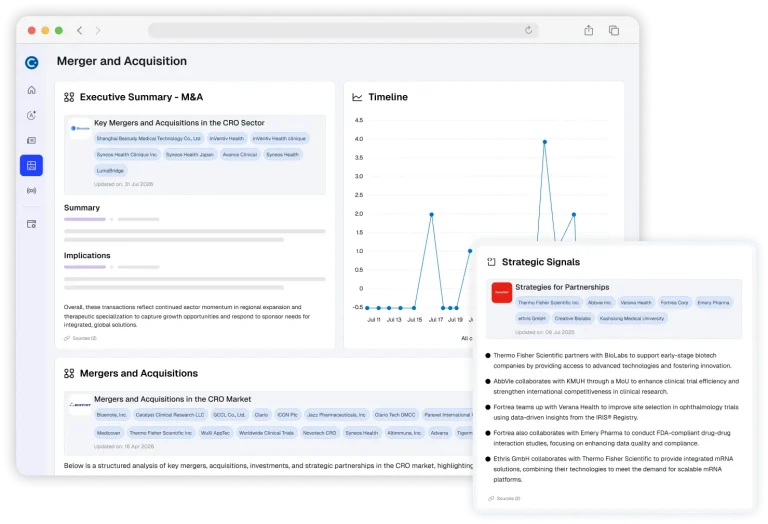
Contify continuously tracks competitors, customers, industry trends, regulatory changes, and other strategic developments to keep your market view current.
How Different Functions Are Using Market Intelligence
Today, marketing intelligence trends show a growing emphasis on personalization, real-time data, and integrated decision-making.
According to a 2023 survey by Gartner, 70% of organizations have a MI initiative in place, compared to just 30% in 2018. Contify, an AI-powered market and competitive intelligence (M&CI) platform, offers the best market intelligence across the globe.
At present, it’s leveraged by 100+ global organizations across diverse industries to not only gather the right insights at the right time, but use them to stay ahead.
Here are examples of how different teams benefit from types of market intelligence:
Marketing Team: Getting A Holistic View
With marketing intelligence, businesses can analyze all aspects of a market. These insights help tailor customer engagement strategies, enabling organizations to gain a deeper understanding of their markets by gathering data in near real-time. For instance, marketers can track individual competitor campaigns and messaging to understand strategies that work well.
According to Hubspot, 96% of buyers research before talking to sales. With a marketing intelligence system, marketers can align messaging to match customer expectations and behavior.
Sales Teams: Boosting Wins
Without MI, there are often gaps in how and where businesses can market their products. One market intelligence example comes from a semiconductor manufacturer that struggled to run comprehensive research on its own while looking for new sales opportunities. By using Contify’s competitive market intelligence to identify upsell and cross-sell opportunities, a vital use case of marketing intelligence, it increased its sales pipeline by 25% and reduced customer churn by 50%.
Sales battlecards, created using market intelligence research, also help reps position better during pitches.
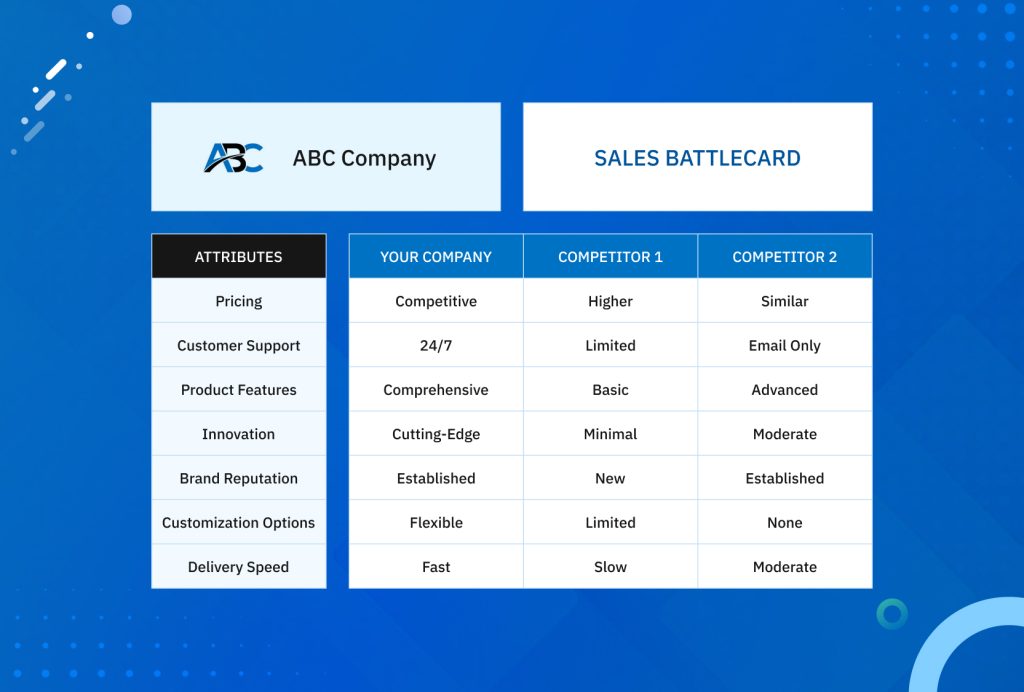
Battlecards provide concise intel that helps you understand your positioning as compared to your competitors. This is great for identifying gaps and performing market segmentation effectively.
Strategy Team: Gaining Competitive Advantage
What is marketing intelligence good for at a strategic level? Monitoring competitor website updates, integrations, and patent filings provides valuable insights into their product roadmaps and strategic direction. Analyzing competitor product demos can also reveal new features or capabilities that may be overlooked.
Product Marketing: Making The Difference
With marketing intelligence, product teams can benchmark features and assess market gaps. For example, Ford responded to Tesla’s EV push by tracking demand signals and aligning its roadmap accordingly, a classic case of strategic market intelligence at work.
Market intelligence also helps teams differentiate their offerings. By tracking how competitors position features, price their products, and respond to customer feedback, product marketers can find the gaps rivals leave open and build their messaging around them.
Whether it’s marketing, sales, strategy, or product, every team needs the same intelligence, delivered in the context of its own work.
See How Contify Handles Market Intelligence End to End
Explore how Contify continuously monitors market and competitor developments, turns relevant signals into insights, and keeps teams informed from one platform.
Conclusion
Market intelligence definition goes beyond just data, it’s about deriving real meaning from ever-changing market signals. In today’s competitive landscape, businesses can’t afford to ignore the value of continuous market intelligence monitoring.
While implementing it requires investment, the benefits of market intelligence, from faster go-to-market execution to deeper customer understanding outweigh the costs. And with Contify, the transition becomes seamless.
See How Contify Handles Market Intelligence End to End
Explore how Contify continuously monitors market and competitor developments, turns relevant signals into insights, and keeps teams informed from one platform.
FAQ’s
How is market intelligence different from marketing intelligence?
Though they often overlap, market intelligence typically focuses on external factors like competitors, industry shifts, and regulatory changes. Marketing intelligence, a subset of market intelligence, is more focused on customer behavior, campaign performance, and buyer journeys. Together, they form a holistic view that supports smarter business and marketing decisions.
What are the sources of market intelligence data?
Sources of market intelligence include news articles, regulatory filings, social media, analyst reports, financial disclosures, customer reviews, surveys, and competitor websites. Platforms like Contify aggregate and analyze these sources to deliver timely, relevant insights.
Why is market intelligence important for strategic decision-making?
Strategic market intelligence enables organizations to anticipate threats, uncover new opportunities, and shape long-term strategy. It ensures businesses are not reacting to change, but leading it with the right information at the right time.