Last updated
Aug 11, 2026
Last updated
Aug 11, 2026

If your organization has been using Kompyte for competitive intelligence or is actively evaluating CI platforms, you would have likely considered:
- Is Kompyte the right competitive intelligence platform for you in the long term?
- Are there any other better Kompyte alternatives or competitors?
In this article, we give you a clear-eyed, comprehensive overview of:
- What does Kompyte offer?
- Brief history of Kompyte and the Kompyte-Semrush relationship
- What users love about Kompyte and where it falls short
- What is the pricing of Kompyte
- Top 4 Kompyte alternatives and competitors to consider in 2026
Kompyte overview: What it offers
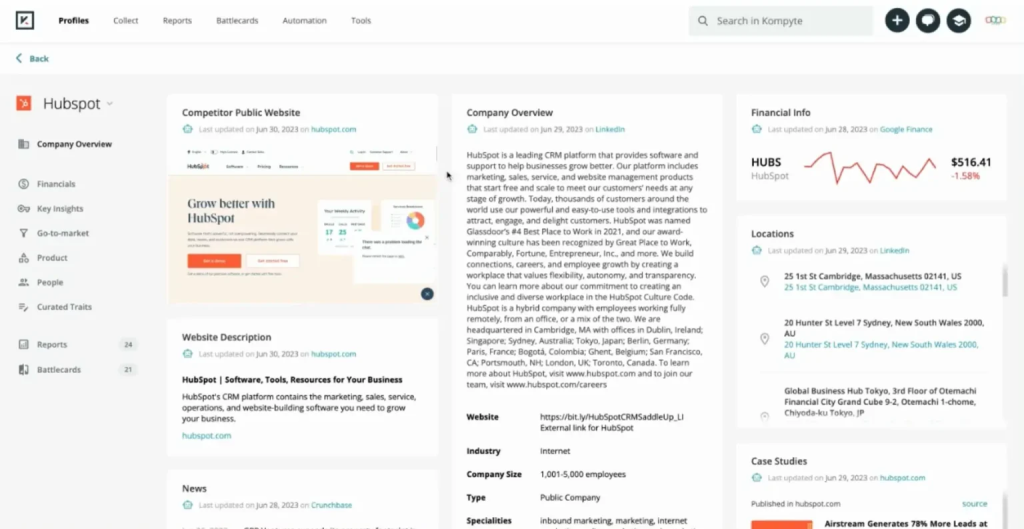
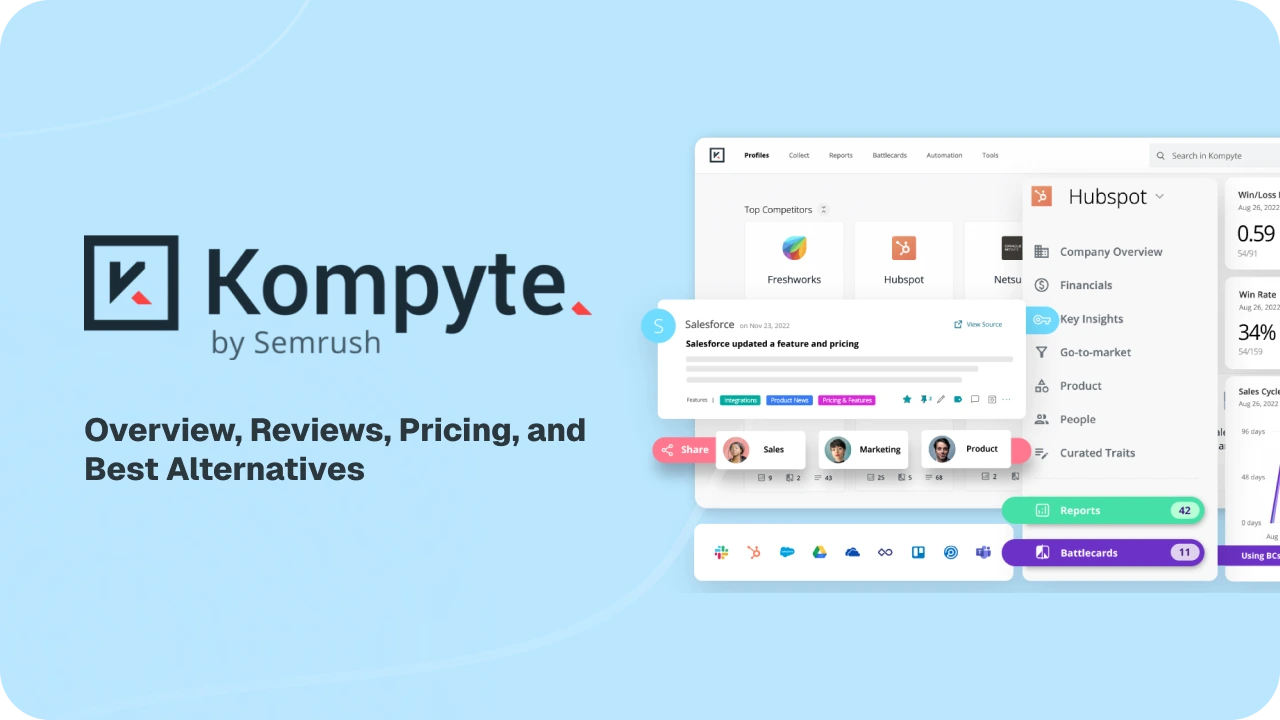
Kompyte is a competitive intelligence and sales enablement platform that automates competitor tracking across digital channels, helping revenue teams compete more effectively against their top competitors. Founded in 2014 and later acquired by Semrush, it is primarily used by product marketing and sales enablement teams to centralize intelligence, create battlecards, and distribute them with sales teams.
The key features of Kompyte include:
- Automated competitor tracking: Kompyte monitors competitors across digital channels, including website changes, social media posts, customer reviews, content updates, and job postings. It uses AI filters to surface relevant updates and deliver daily summaries.
- Dynamic sales battlecards: The platform provides sales-ready battlecard templates that curate intelligence from various sources. These battlecards are integrated bi-directionally with CRMs like Salesforce and HubSpot, equipping sales representatives with competitive talking points during active deals.
- Win/loss analysis: Through its partnership with IcebergIQ, Kompyte combines automated win/loss calculations from CRM data with qualitative buyer feedback.
- AI-powered summaries: Kompyte uses generative AI to analyze competitive data and generate concise summaries, helping teams extract key takeaways without having to read lengthy articles.
- CRM and workflow integrations: By integrating with Slack, Microsoft Teams, Salesforce, and HubSpot, Kompyte places competitive insights directly into the tools revenue teams use every day.
If you are looking at Kompyte for the first time, it is a great starting point for sales-focused CI. However, many teams quickly reach a point where they need a Kompyte alternative that also supports strategy, product, and market intelligence use cases.
History of Kompyte: From startup to Semrush acquisition
Kompyte was founded in 2014 in Barcelona, when most competitive intelligence was still handled manually in spreadsheets. This timeline outlines the key events in Kompyte’s journey, including its evolution into becoming a Semrush product offering:
Pere Codina, Albert Colmenero and Sergio Ramirez started Kompyte to track competitors in real time.
Rose Tech Ventures led the round with Alantis Capital and IDODI Venture Capital also joining in.
Officially launched in the US, most new signups were already coming from North America by this point.
Graduated from 500 Startups Demo Day in San Francisco, helped open doors to US investors and customers.
Caixa Capital Risc, Adara Ventures and Swanlaab came in, bringing total funding to around $3.63M.
Moved legal entity to the US and set up Austin, TX as the main go-to-market base for the team.
Launched the KPHi platform giving GTM teams automated, real-time competitive intel in one place.
Semrush bought Kompyte to push into CI and sales enablement, with the deal reported around $10M.
Became Kompyte by Semrush and was positioned as the CI and sales enablement arm of the Semrush platform.
AI feature that auto-writes battlecards, surfaces daily competitor updates and helps reps handle objections.
Win/loss interview data from IcebergIQ now flows into Kompyte with GPT-powered summaries built in.
Bigger upgrade with automated research, tracking up to 200 companies, SSO support and one-click dashboards.
No events match this filter.
Kompyte reviews: What users love and where it falls short
Understanding Kompyte’s reviews, pros, and cons is critical when evaluating it for your intelligence program. The following summarized breakdown of Kompyte is based on user feedback from G2, Gartner Peer Insights, Capterra, and publicly available reviews:
What users love about Kompyte (Kompyte pros)
- Visual and user-friendly interface: Users appreciate the platform’s intuitive interface, which makes it easy for sales teams to find and act on competitive insights.
- CRM-integrated battlecards: The ability to push updated battlecards and win/loss reports directly into Salesforce or HubSpot ensures that sales reps have just-in-time access to critical information.
- Time savings through automation: Real-time monitoring across hundreds of sources, combined with AI-powered daily summaries, significantly reduces manual research time for product marketers.
- Qualitative win/loss insights: The partnership with IcebergIQ adds a valuable research layer, combining automated CRM analytics with real buyer interviews.
- Strong onboarding support: Customers frequently highlight the strong onboarding experience and the inclusion of a dedicated customer success manager.
These strengths are why Kompyte is often shortlisted alongside other competitive intelligence tools such as Contify, Crayon, Klue, and AlphaSense when teams begin evaluating CI platforms.
Where Kompyte falls short (Kompyte cons)
- Narrow focus on sales enablement: Kompyte is explicitly designed for competitor monitoring and sales enablement. It lacks the infrastructure to support broader market-intelligence use cases, such as tracking customers, partners, supply-chain dynamics, and industry trends, leaving corporate strategy, marketing, and leadership teams without deeper insights.
- Lack of battlecard automation: While the interface is clean, users note that the platform lacks advanced AI automation for battlecard creation. Building and maintaining effective battlecards still requires significant manual intervention.
- No conversational AI interface: Kompyte lacks a conversational AI interface, making it difficult for users to get instant, ad hoc answers from their intelligence datasets.
- Limited global coverage: Kompyte cannot automatically translate content from non-English sources. This creates a blind spot for global intelligence programs that require multilingual coverage.
- Weak search and filtering: Users report that the platform’s search and filtering capabilities are not robust. The lack of a deep business taxonomy means relevant updates are occasionally missed or buried in long lists.
- Data inaccuracies and noise: Some users report occasional inaccuracies and irrelevant data, resulting in noise.
- Restrictive source management: Adding new companies or data sources is not fully self-service and often comes with restrictions or additional costs.
These limitations usually prompt teams to look for Kompyte alternatives and competitors rather than simply renewing the existing subscription.
Kompyte pricing: The cost of scaling
As a standalone app, Kompyte’s pricing model poses challenges for growing teams. It relies on per-competitor and per-user pricing, which can lead to higher costs as you expand its tracking scope or roll out the platform to more stakeholders.
Furthermore, customer feedback suggests that vendor support focuses mainly on product fixes rather than on strategic analysis or expert curation.
Top 4 Kompyte alternatives to consider
Whether you are switching from Kompyte or evaluating a dedicated Market and Competitive Intelligence (M&CI) platform for the first time, your organization has a unique opportunity to move beyond a narrow sales-focused CI program to a comprehensive 360° M&CI program. Here are the top alternatives of Kompyte to evaluate:
Contify
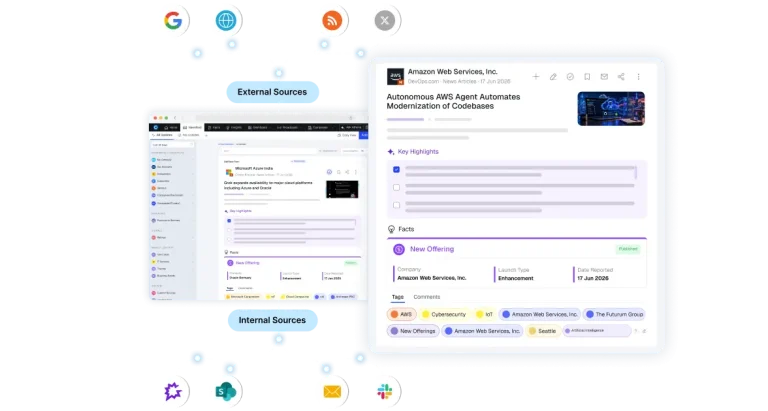
Contify is a purpose-built, AI-native M&CI Platform that provides verified, decision-ready insights and battlecards on markets, industries, competitors, key accounts, and other strategic entities. Contify is the best Kompyte alternative, because unlike Kompyte’s narrow focus on sales enablement, it powers a 360° intelligence program that serves cross-functional teams across strategy, product, marketing, and sales.
Contify monitors over 1 million vetted global sources and can also ingest internal data from Gong and SharePoint. Moreover, it also provides auto-translated intelligence from 117+ languages, helping you monitor regional and cross-continental competitors and niche sites.
Key differentiators that make Contify the best alternative to Kompyte:
- Industry’s cleanest intelligence feeds: Contify is widely recognized for providing the cleanest intelligence feeds in the M&CI space. It utilizes a 7-step pipeline that combines AI deduplication, disambiguation, GenAI-validated tagging, and a native human-in-the-loop (HITL) curation layer to ensure delivery of highly relevant insights.
- Advanced custom taxonomy: Unlike Kompyte’s rigid categorizations, Contify’s Taxonomy Manager lets you create custom tags and AI-based tagging rules that mirror your organization’s unique structure and strategic priorities.
- Unrestricted custom sourcing: You can add all types of sources without limits, including subscription databases, sites without RSS feeds, internal intel, customer call transcripts from Gong, and documents.
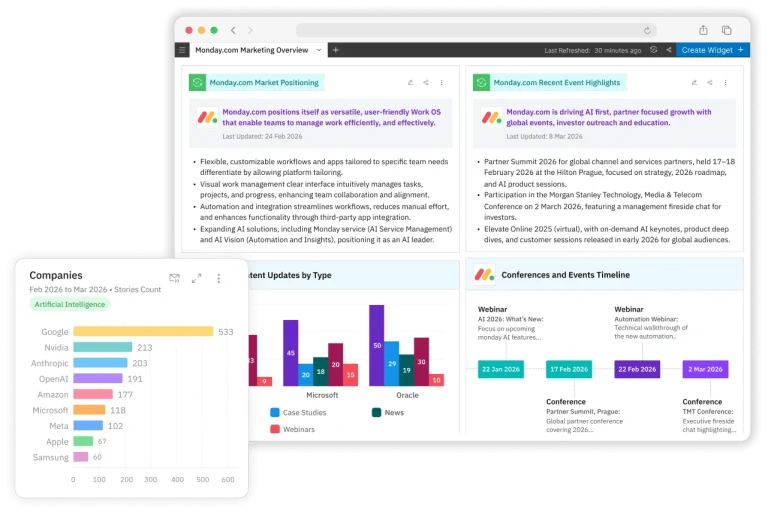
- Automated insights and Ask Athena: Contify autonomously extracts structured facts from unstructured updates. It connects these facts to generate auto-updating insights, battlecards, SWOT analyses, ansoff matrix, and more without requiring manual intervention. Furthermore, Ask Athena serves as a conversational AI assistant, allowing users to ask ad hoc intelligence questions in natural language and receive trusted answers grounded in verified sources.
- Unlimited platform users: Unlike Kompyte’s per-user pricing model, Contify includes unlimited platform users and subscribers at no extra cost, enabling seamless enterprise-wide adoption.
- Organization-wide newsletters and seamless integrations: Contify features a powerful newsletter builder with AI-generated summaries that can be shared with unlimited subscribers. It integrates natively with Slack, MS Teams, Salesforce, Snowflake, and SharePoint.
If you want a Kompyte alternative that goes beyond sales battlecards and supports a full-funnel M&CI program, Contify is a strong fit.
Contify cons:
- Requires an initial learning curve to fully configure taxonomy, dashboards, and workflows to your organization’s needs.
- Not a fit for PR/brand mention tracking, as it filters out duplicate media coverage to focus purely on strategic signals.
Customer reviews of Contify:
Customers praise Contify for its clean feeds, strong AI automations, and analyst-grade insights. Take a look at few reviews yourself:
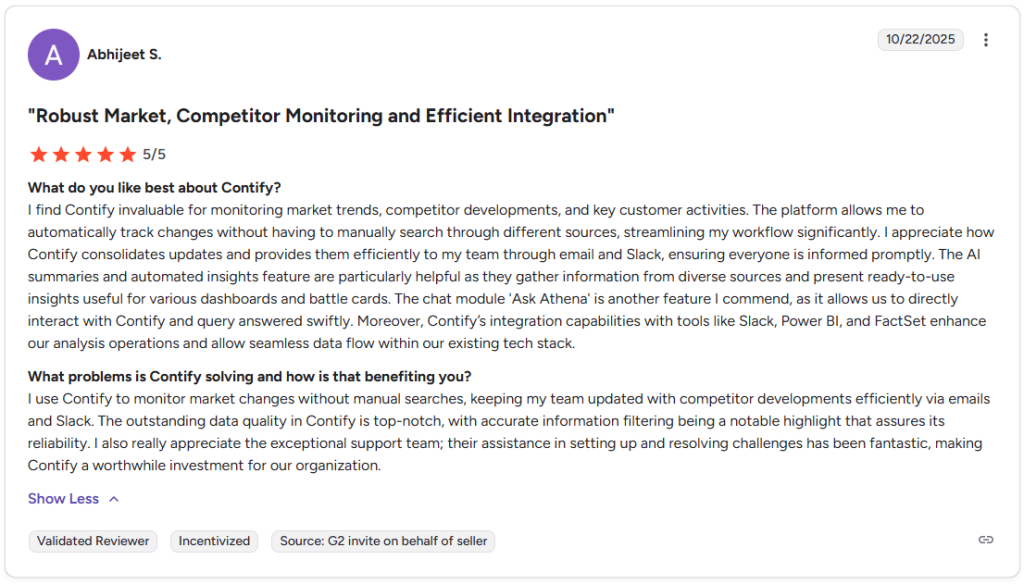
Source – G2
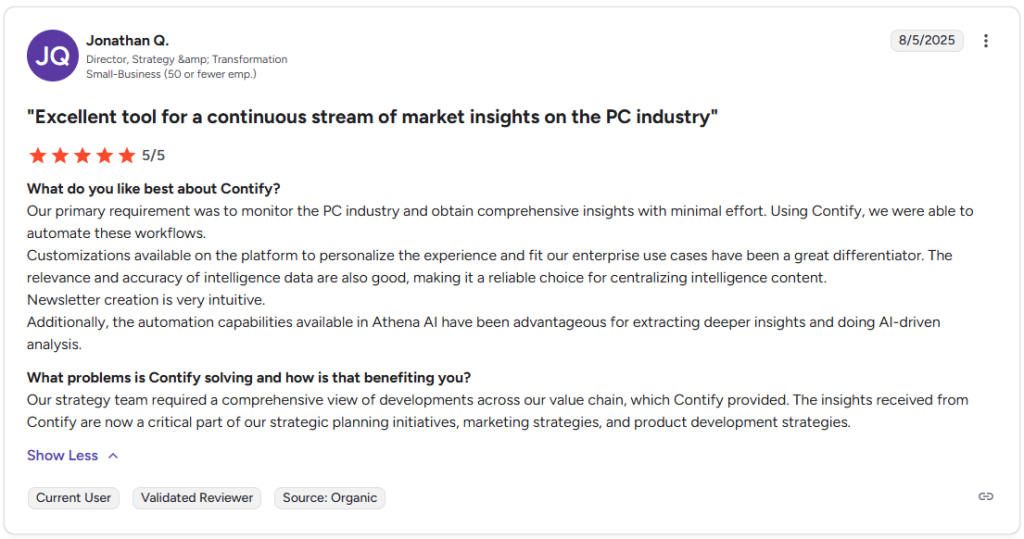
Source – G2
Related reading: How Lenovo built 360° value chain resilience with Contify

Klue
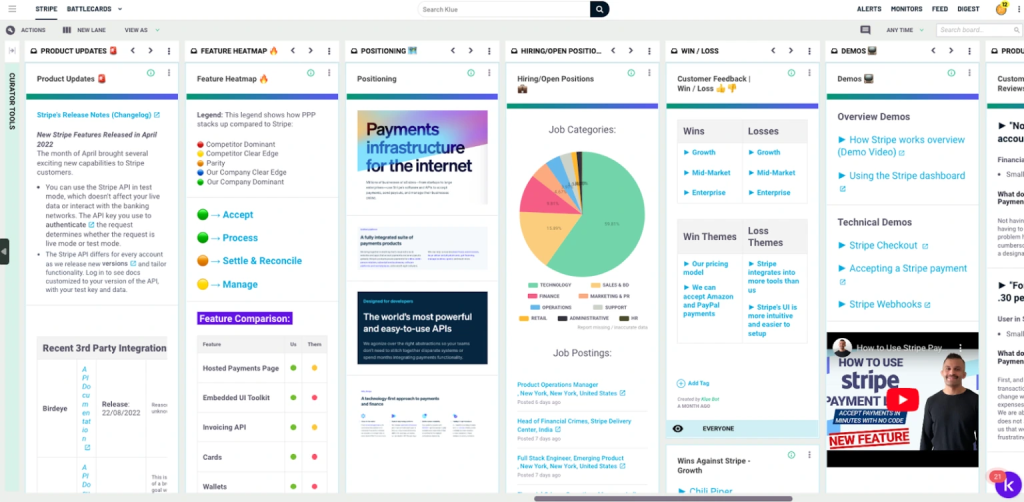
Klue is another strong alternative if your primary focus is on competitor-specific intelligence for sales enablement. Klue’s competitive enablement platform collects intelligence from public web sources and internal systems, such as Gong and Chorus. It uses AI to generate seller-ready outputs, such as objection-handling guides.
Klue pros:
- Excellent drag-and-drop interface for creating visual battlecards.
- Integrated win/loss analysis that captures objective buyer feedback.
- Strong AI-generated insights specifically tailored for sales conversations.
Klue cons:
- A narrow focus on battlecards that leaves non-sales stakeholders (strategy, product, executives) without the deeper market insights they need.
- Does not support broader market-intelligence use cases, such as monitoring regulatory changes or industry trends.
- Limited evaluation access during the trial phase.
Crayon
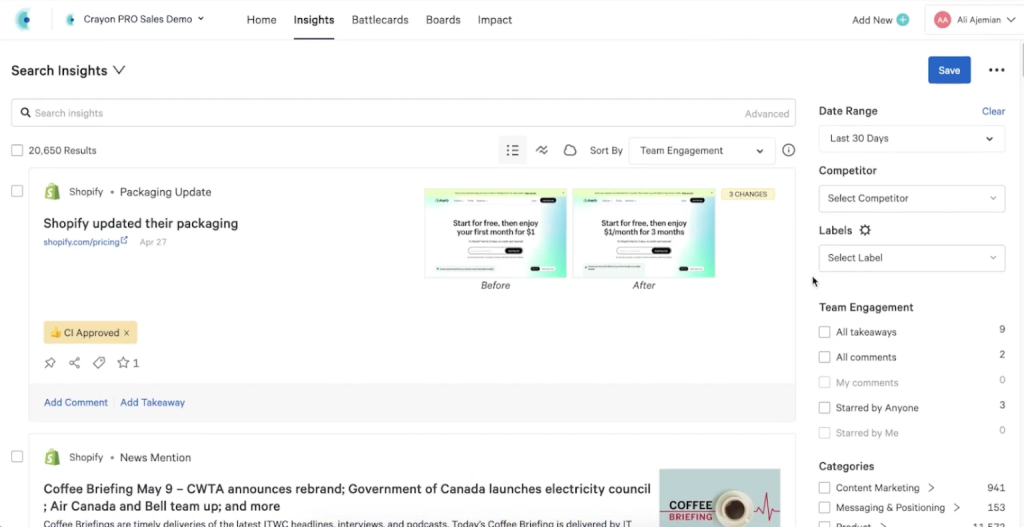
Crayon is another good alternative for competitor tracking and sales enablement. Crayon tracks competitors’ digital footprints, including website changes, pricing updates, and content shifts, and helps in building dynamic battlecards.
Crayon pros:
- Strong capabilities for tracking and highlighting specific website changes.
- Good integrations with the standard sales and marketing tech stack.
- User-friendly interface for revenue teams.
Crayon cons:
- Users frequently report that Crayon delivers noisy intelligence feeds. Its deduplication and relevance filtering often fall short, requiring analysts to spend significant time manually cleaning up alerts.
- Adding new data sources is not fully self-service and often incurs extra charges.
- Historical data is limited, making it difficult to conduct long-term retrospective analysis.
- Less suited for enterprises requiring customizations, flexibility, and a greater variety of information tracking.
AlphaSense
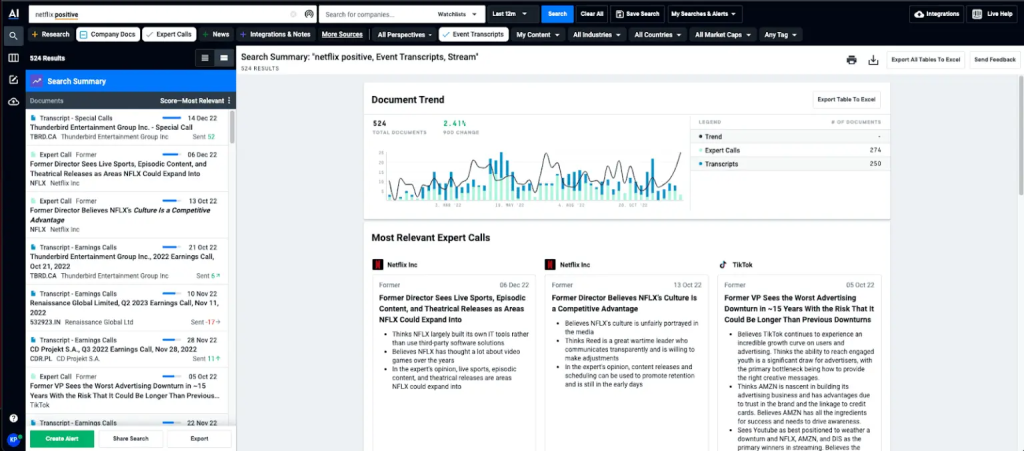
AlphaSense is a good choice if your focus is market intelligence. It is designed for financial and business professionals, providing comprehensive, reliable insights into public and private companies and industry trends. The platform aggregates premium content sources, including broker research, expert transcripts, company filings, internal research, financial data, and market news. It makes all of this content searchable using AI and natural language processing.
AlphaSense pros:
- Access to exclusive, paywalled content, including expert call transcripts, broker research, and SEC filings.
- Generative AI suite (Deep Research, Generative Grid, Smart Summaries) that turns wide information into fast-cited, verifiable outputs.
- Conversational AI assistant for generating financial reports grounded in AlphaSense content.
- Internal content integration with SharePoint, Box, OneNote, and Evernote allows teams to unify external and proprietary research into a single knowledge base.
AlphaSense cons:
- Less coverage of broader digital signals like social media, review sites, and website changes, which are critical for holistic competitive intelligence.
- Fixed offering that isn’t highly customizable to specific organizational taxonomies and non-financial M&CI use cases.
- Per-user pricing escalates costs quickly, making it prohibitively expensive for organizations to share intelligence.
How to choose the right Kompyte alternative for your intelligence program
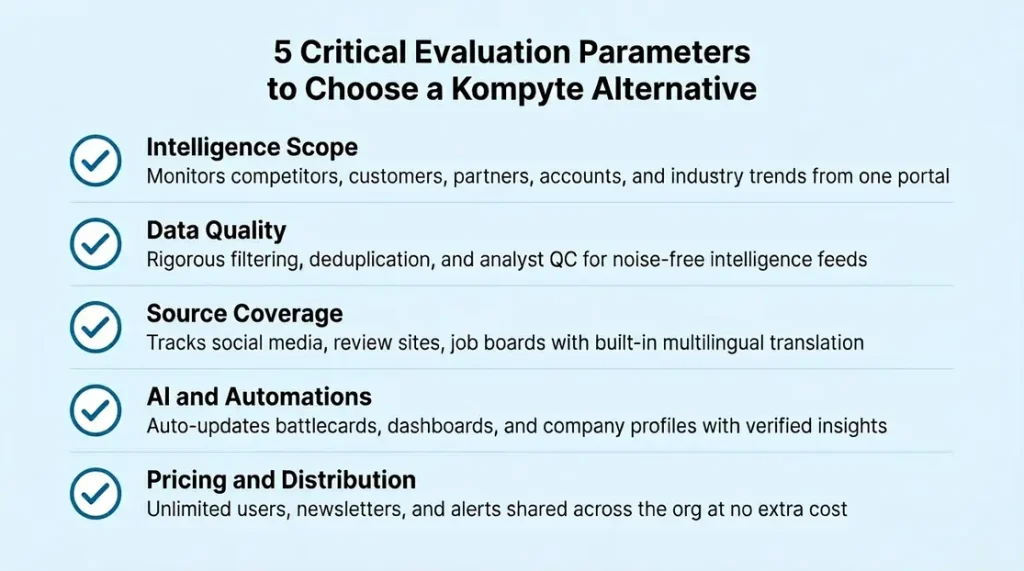
Selecting a replacement or alternative for Kompyte requires looking beyond basic feature parity. To build a resilient and scalable intelligence program, evaluate vendors against these critical criteria:
- Intelligence scope: Assess whether your program needs intelligence solely on competitors or across multiple market forces. If your intelligence program serves strategy, product, and marketing teams in addition to sales, look for a platform like Contify that monitors competitors, customers, partners, key accounts, and industry trends from a single portal.
- Data quality and noise reduction: Getting drowned in irrelevant data is the most time-consuming activity for any M&CI practitioner. Evaluate how vendors handle deduplication, disambiguation, and tagging. Look for a platform that enforces a rigorous filtering mechanism and an analyst QC layer to deliver noise-free feeds.
- Source coverage and translation: Ensure the platform tracks the full digital footprint, including social media, review sites, and job boards, and provides built-in multilingual translation. Also, evaluate whether you can add custom sources for free.
- AI context and automations: A conversational AI assistant is table stakes today. A dedicated M&CI platform should provide dynamically updated insights based on verified information. Assess whether the platform can automatically update deliverables such as battlecards, dashboards, and company profiles with new intelligence. Also, ensure the AI understands your company and offerings to generate tailored insights.
- Pricing and intelligence distribution: Intelligence is only valuable if it reaches the right stakeholders. Avoid prohibitive per-seat pricing models. Look for platforms that offer unlimited users and let you share newsletters and alerts with unlimited subscribers across your organization at no additional cost.
Future-proof your intelligence program with Contify.
While Kompyte served well as a sales-focused competitor-tracking tool, the expectations placed on product marketers and M&CI practitioners like you have grown significantly. You are expected to deliver deeper insights, serve more stakeholders, and cover a broader competitive landscape, all with the same or fewer resources.
Contify is purpose-built for exactly this modern-day reality. You no longer need to spend hours manually analyzing updates to build a battlecard. It actively monitors your entire market landscape across 1 million+ vetted sources, filters the noise, and uses agentic AI to deliver structured, citation-backed battlecards and strategic insights directly into your daily workflows.
If you are evaluating Kompyte alternatives and want a single platform that can support product marketing, strategy, sales, and leadership, Contify is designed to be that 360-degree Kompyte replacement.
Contify helps product marketers and intelligence practitioners like you to focus on what actually matters – supporting stakeholders strategically to make informed decisions and respond fast to changing conditions.
Start your 7-day free trial today and experience the difference.