Last updated
Sep 21, 2026
Last updated
Sep 21, 2026


Summary
Market intelligence tools can be divided into three categories, based on their use cases, functionalities, sources they cover, outcomes they deliver, and which teams use them. These three categories are: purpose-built market and competitive intelligence tools, digital traffic and SEO intelligence tools, and B2B data and sales intelligence tools.
The best marketing intelligence tools in 2026 are: Contify, Valona Intelligence, Crayon, Klue, SE Ranking, Ahrefs, Semrush, ZoomInfo, Apollo, and Sales Navigator.
Each tool we have mentioned in this list caters to performing market analysis, research and intelligence workflows. But to choose one for you, start by defining your focus of market intelligence. After having this clarity, you can identify which category of tools will help you achieve your goals of market intelligence, and then evaluate vendors on the basis of features, market segment, and pricing.
Market intelligence tools automatically gather and analyze useful data and provide enterprises with actionable insights into their competition, customers, and overall market developments.
These tools enable businesses to make accurate, informed, and timely decisions with confidence.
Choosing the right market intelligence platform, however, starts with understanding what your business needs to know and what outcomes you want to achieve. “Market intelligence” is a broad category, and the tools within it serve different use cases, functions, and business outcomes.
For example, a market & competitive intelligence (M&CI) professional might need to track competitor moves and emerging market trends to guide strategic planning. A sales manager might use intelligence to identify promising accounts, find decision-makers, and prioritize outreach. A digital marketer might analyze competitors’ search rankings, traffic, and content to identify opportunities to improve visibility.
Though all fall under the market intelligence process, each use case needs different market intelligence software with distinct capabilities. This includes capturing various use-case-specific signals and delivering different outcomes. That’s why selecting the right market intelligence tools requires detailed research and a thorough evaluation to fully understand these platforms.
To simplify this and help you develop your understanding of these tools, we have divided tools for market intelligence into three categories:
- Purpose-built market and competitive intelligence tools: For continuously tracking competitors and market developments to inform strategic business decisions.
- Digital traffic and SEO intelligence tools: For analyzing search performance, website traffic, and content opportunities to improve visibility.
- B2B data and sales intelligence tools: For identifying target accounts, finding decision-makers, and prioritizing outreach using buying signals.
For each tool, we examine its best-fit teams, practical use cases, key features, pros and cons, and official pricing to help you choose based on the decisions your team needs to make.
The 10 best market intelligence tools in 2026: A brief shortlist
- Contify: fits continuous, cross-functional market and competitive intelligence programs for targeted insights about competitors’ moves, market shifts, and overall market developments across strategy, product, marketing, sales, and other enterprise teams.
- Valona Intelligence fits enterprise market monitoring and research programs that need global coverage, internal knowledge, and analyst support.
- Klue fits competitive enablement programs that connect competitor intelligence, buyer feedback, and support for active deals.
- Crayon fits teams turning competitor monitoring into maintained battlecards, competitive content, and sales enablement.
- SE Ranking fits marketing teams and agencies managing competitor SEO research, rankings, reporting, and AI search visibility.
- Semrush fits digital marketing teams comparing search performance, traffic channels, audiences, and visibility in AI answers.
- Ahrefs fits SEO and content teams investigating competitors’ pages, backlinks, search demand, and AI citations.
- ZoomInfo fits revenue teams combining account and contact data with buying signals, enrichment, and go-to-market workflows.
- Apollo fits teams that want prospect discovery, enrichment, and outbound execution in one working environment.
- LinkedIn Sales Navigator fits sellers mapping buying groups, monitoring professional changes, and finding relationship paths into accounts.
What is a market intelligence tool?
Market intelligence platforms are intelligent software that automates the monitoring, collection, and analysis of data on competitors, customers, partners, suppliers, market trends, account information, search demand, regulatory changes, and industry developments, and turns it into reports that businesses can act on. These tools help businesses anticipate market moves, identify strategic patterns, spot emerging opportunities, and make informed decisions.
Since market intelligence tools differ in functionality, they should be evaluated against the questions you need to answer, the evidence needed to answer them, the outputs they produce, and the guidance they offer to inform action.
Market intelligence tools vs marketing intelligence tools
Market Intelligence (MI) tools help organizations understand the broader market environment. They track industry trends, regulatory developments, shifts in customer behavior, macroeconomic signals, emerging technologies, and new entrants. The goal is to answer strategic questions like: Where is the market heading? Which segments are growing? What external forces could impact demand? These tools are commonly used by marketing, strategy, sales, corporate development, and leadership teams.
Marketing intelligence tools, on the other hand, help you understand digital marketing strategies and traffic share of your competitors. They also give insights into what your consumers are searching for on search engines, how search happens digitally, and what you can do about it. These tools answer questions like: What content topics are competitors covering? What keywords are trending? How to optimize content for better visibility and conversion? These tools are used by marketers.
The best market intelligence tools at a glance
| Tool | Category | Primary workflow | Best for | Starting price | Free plan/trial |
| Contify | Market & competitive intelligence | Monitor external and internal intelligence; generate and distribute strategic insights | Enterprise M&CI, strategy, and product teams running continuous, cross-functional intelligence programs | Custom quote | 7-day free trial |
| Valona Intelligence | Market & competitive intelligence | Monitor global markets, centralize knowledge, and support strategic research | Enterprise intelligence and research teams needing global coverage and analyst support | Custom quote | Demo available; free trial not publicly specified |
| Crayon | Market & competitive intelligence | Turn competitor changes into battlecards, alerts, and sales guidance | Product marketing and sales enablement teams keeping competitive content current | Custom quote | Demo available; free trial not publicly specified |
| Klue | Market & competitive intelligence | Combine competitive intelligence and win/loss insights to support active deals | CI, product marketing, and revenue teams improving positioning and competitive deal execution | Custom quote | Demo available; free trial not publicly specified |
| SE Ranking | Digital traffic & SEO intelligence | Research competitor keywords, track rankings, and monitor search visibility | Marketing teams and agencies managing recurring SEO research and reporting | $129/month | 14-day free trial; no credit card required |
| Ahrefs | Digital traffic & SEO intelligence | Analyze competitors’ backlinks, keywords, pages, and content opportunities | SEO and content teams investigating organic acquisition strategies | $29/month — | Limited free plan for verified websites |
| Semrush | Digital traffic & SEO intelligence | Compare search visibility, traffic channels, audiences, and digital competitors | Digital marketing teams combining SEO with broader online market analysis | $139/month | 7-day free trial on eligible plans |
| ZoomInfo | B2B data & sales intelligence | Find and enrich accounts and contacts; prioritize outreach using buying signals | Sales, RevOps, and demand generation teams scaling account targeting and enrichment | Custom quote | Free trial, typically 7 days; terms vary |
| Apollo | B2B data & sales intelligence | Find prospects, enrich records, and run multichannel outreach | Sales teams wanting prospecting data and outbound execution in one platform | $65/user/month | Free plan; 14-day trials of Basic and Professional |
| LinkedIn Sales Navigator | B2B data & sales intelligence | Map buying groups, track professional changes, and identify relationship paths | B2B sellers researching decision-makers and building account relationships | $119.99/license/month | Free plan; 14-day trials of Basic and Professional |
Best market intelligence tools for market and competitive intelligence
Market and competitive intelligence tools automate monitoring, gathering, analyzing, and distribution of market signals such as competitor moves, regulatory shifts, customer preferences, and overall market developments. These tools help you identify rivals’ threats, uncover opportunities, and anticipate the market for strategic planning and decision-making.
This category of market intelligence tools covers distinct strategic signals from publicly available data such as website changes, social media, news, paywalled content, research portals of your competitors and market bodies, and internal insights from tools such as CRM, Slack, stakeholders, and other sources. These tools serve teams across enterprises, including PMM, marketing, strategy, sales, and leadership.
Contify
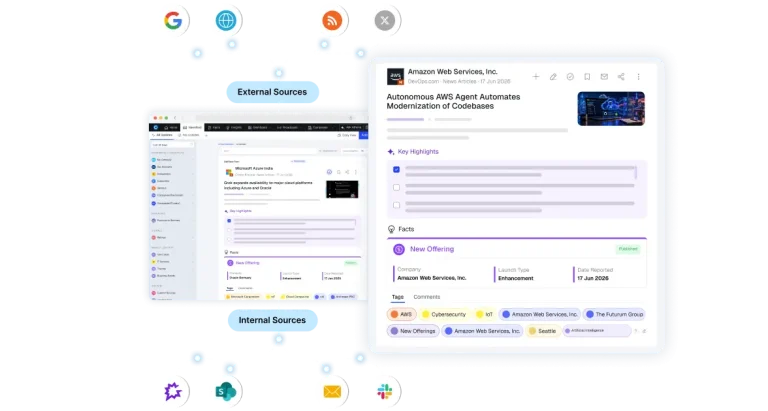
Contify is an AI-native, purpose-built market and competitive intelligence platform, built to deliver a 360-degree intelligence view across the entire market spectrum, including competitors, customers, industry segments, partners, suppliers, regulatory updates, and other developments. It continuously tracks data across 1M+ vetted external sources and the company’s internal datasets, filters signals from noise, contextualizes them against your strategic priorities, and disseminates intelligence reports directly to key stakeholders. A trusted M&CI platform for the last 17+ years, Contify has recently been recognized in Gartner’s Magic Quadrant for Competitive and Market Intelligence Platforms in April 2026 and The Forrester Wave™: Market and Competitive Intelligence (M&CI) Platforms.
Best Fit For:
Contify is best suited for mid-to-large enterprises (typically 200+ employees) and high-growth companies in fast-moving or complex sectors such as IT/SaaS, BFSI (Banking & Financial Services), Pharmaceuticals & Healthcare, Management Consulting, and Manufacturing. It is engineered to serve both Intelligence Producers (analysts looking to scale research output) and Intelligence Consumers across Strategy, Marketing, Product, and Sales teams on a single platform.
Key features:
Athena AI & Auto-updating insights: At the core of the Contify platform sits its proprietary agentic AI engine (Athena AI) that continuously extracts structured facts from unstructured text, connecting them in a dynamic knowledge graph. It keeps the intelligence engine always on by automating signal sourcing, customized taxonomy, deduplication, disambiguation, and curation, so you can focus on interpreting data rather than gathering and analyzing it.
Ask Athena: Contify offers a state-of-the-art conversational AI assistant that answers your on-demand intelligence queries, ensuring that every response is verified and links back to its original sources. This lets enterprise-wide teams meet ad hoc intelligence requirements by conversing with AI in natural language.
Smarter Feeds experience: Feeds experience is designed around how people actually consume intelligence: quickly finding what matters, going deeper when needed, and keeping the broader market in view without getting buried in information.
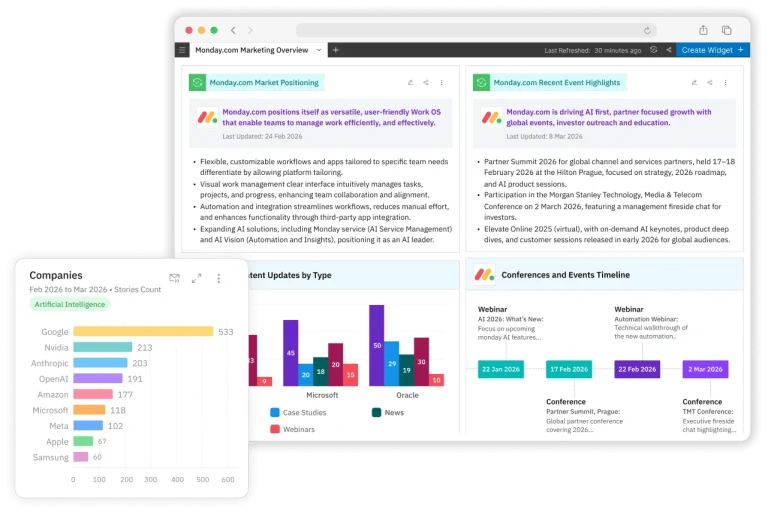
Intuitive insights & battlecards: Contify converts market insights into popular analysis models, such as PESTEL, SWOT, and the Ansoff matrix, making it easier to compare competitors, threats, opportunities, and strengths. It also automates battle card creation with an extensive library of predefined templates and keeps them auto-updated in real time, so the sales team can use them for objection handling and to provide data-driven insights.
Automated newsletters: For most intelligence teams, intelligence dissemination is just as hard as gathering and analyzing it. Contify delivers auto-populated, role-specific, and branded newsletters, including AI-generated executive summaries, custom sections, and taxonomy tags. Non-platform users can also access these newsletters without logging in and at no extra cost, ensuring intelligence is delivered across the enterprise. You can also measure intelligence adoption rates with an in-built tracking system that captures recipient-level opens, clicks, content engagement, and ratings.
MCP server: You can give your AI agents access to Contify’s curated, contextualized intelligence, through which you can get faster and evidence-backed answers for market analysis, market research, and competitor landscape analysis for strategic decision-making, instead of switching between tools and AI models.
Pros:
- Covers 700k+ companies, 100+ industry segments, and extensive business topics.
- Known for an exceptional signal-to-noise ratio, targeted source coverage, and clean intelligence that aligns strictly with your strategic objectives.
- Use multi-stage AI deduplication, entity disambiguation, and optional human curation to ensure verified, reliable intelligence.
- Embed intelligence into tools and workflows you already use, such as Slack, MS Teams, and others.
- The pricing model is based on monitoring scope, rather than seat adoption, allowing non-platform users to access the platform at no extra cost.
- Appreciated by global customers for its automatic intelligence dissemination system via newsletters, insight alerts, and dynamic dashboards.
Cons:
- Since the product is equipped with several features, users may face a learning curve.
- The platform is specifically tailored for market intelligence workflows for strategic decision-making, making it unsuitable for general-purpose market research or users looking for a simple data discovery tool.
- The user interface and generated report outputs are available only in English.
Recent developments worth evaluating:
The recent developments with Contify are related to capabilities expansion for a continuous, cross-functional intelligence program with targeted, relevant, and actionable insights. With Contify’s insight alerts and upgraded MCP server, stakeholders can get insights directly to their inbox and AI assistants as the market moves.
Pricing:
Contify offers flexible pricing models, based on feature sets and market monitoring requirements. Contact sales for a customized quote.
Valona
Valona Intelligence, formerly M-Brain, is a market and competitive intelligence platform that provides comprehensive insights about your competitors, market, and regulations for strategic decision-making. The platform offers proprietary global coverage, domain-specific GenAI, and optional human analyst support for relevant insights.
Best fit for:
According to Gartner, Valona’s primary customers are large enterprises in life sciences, food and beverage, chemical manufacturing, and automotive. Valona Intelligence can be a suitable market intelligence tool if industry coverage and analyst support are your core intelligence requirements.
Key features:
Global and multilingual monitoring: Valona monitors 200,000+ global and local sources and 280+ paywalled content sources. It also monitors competitive and market signals in more than 115 languages.
VAL AI research assistant: The platform provides an AI co-pilot for users to ask intelligence questions in natural language.
Validated financial and trade flow intelligence: Valona enables continuous updating of competitor profiles, battlecards, and frameworks. It also connects competitor developments with company financial, earnings, and trade data.
Knowledge centralization and enterprise distribution: Connects external, internal, and licensed insights into one repository and distributes intelligence organization-wide.
Pros:
- Several G2 reviews have mentioned that users find the platform intuitive and user-friendly, appreciating how easily they can submit queries and get relevant answers.
- Many G2 reviews have talked positively about Valona’s machine learning, document analysis, categorization, and data-refinement capabilities.
- Offers specialized modules and trend radars tailored for complex industrial and manufacturing verticals.
Cons:
- According to G2 reviews, many users have reported lag, slow loading, freezing, and other technical glitches that hinder intelligence workflows.
- Lacks the ability to comprehensively track non-media digital channels like company website HTML changes, social media changes, review sites, and job portals.
- Pricing can increase significantly when adding dedicated analyst support hours or additional power-user licenses.
Recent developments worth evaluating:
Valona has launched its MCP server on 16th June 2026, allowing users to connect enterprise AI systems such as Claude or MS Copilot with its curated intelligence. Read its launch announcement.
Pricing:
Valona doesn’t mention the pricing plan on its official website. Contact sales to know about tailored pricing.
Crayon
Crayon is a competitive intelligence and enablement platform that helps teams monitor competitors’ digital footprints and market developments, and turn intelligence into sales-ready guidance. Governed by the tagline ‘competitive intelligence without limits’, Crayon heavily focuses on improving competitive rates and pipeline by continuously monitoring competitor developments, scoring their importance, and delivering intelligence that supports sales-enablement assets.
Best fit for: Crayon’s primary customer base comes from mid-sized companies to B2B large enterprises and is used by teams like product marketing, sales enablement, competitive intelligence, and executive and leadership. The platform is a strong fit if you frequently compete head-to-head in sales opportunities, measure battlecard usage, competitive win rates, influence revenue, and embed intelligence in sales-enablement workflows.
Key features:
Automated competitor monitoring: Helps you to track changes across competitors’ websites, product pages, social channels, job postings, and other digital sources.
AI-powered analysis: Leverages AI to summarize key developments in your competitors and market, and helps CI teams to get concise takeaways.
Battlecards & content creation: Create and maintain battlecards, newsletters, talk tracks, sales plays, and competitive announcements.
In-workflow sales enablement: Crayon delivers insights where you work. It offers competitive intelligence through Salesforce, Slack, and other popular tools for easy consumption.
Pros:
- Crayon continuously tracks a wide range of competitive sources, which can significantly reduce analysts’ time spent on manual monitoring and data gathering.
- The platform offers strong battlecard capabilities. Many users have reported Crayon’s value in organizing market insights directly into sales content.
- The platform focuses on proving tangible revenue impact, instead of just compiling passive competitors or market research.
Cons:
- Based on Gartner and Reddit reviews, the most common feedback is that it produces noise (irrelevant information), which can often lead to fatigue from information overload.
- Some users have reported Crayon’s clunky interface, limited battlecard editing options, and restricted distribution of intelligence to specific audiences.
- The platform doesn’t offer multilingual intelligence capabilities, which may lead to competitive blind spots for companies operating in different geographies.
Recent developments worth evaluating:
Crayon announced ‘Refine’ in Feburay 2026, a feature that allows users to edit instructions to how AI should produce the future outputs. Instead of getting outputs that doesn’t align with your positioning, you can edit relevant instructions and the AI remembers and reflect that in future responses. Read the full announcement here.
Pricing: Crayon doesn’t publish pricing models on its official website. Contact sales to get custom pricing, based on your intelligence requirements.
Klue
Klue is an AI-powered competitive enablement platform that lets you run your CI and win-loss programs under one platform, helping you identify why you win or lose a deal and what steps you can take for both. Klue majorly positions itself as less of a ‘market research library’ and more of a sales-enablement engine, turning competitor knowledge and win-loss insights into higher competitive win rates, tighter messaging, and faster rep ramp.
Best fit for: Klue is best suited if your primary goals are sales enablement and arming the sales reps with actionable, standardized battlecards and continuous intelligence that helps them close more deals, making it less ideal for broader market research, analysis, and strategic planning. It primarily serves teams in mid-sized companies to B2B large enterprises from SaaS and technology companies.
Key features
Dynamic, AI-assisted Battlecards: Klue offers auto-updated competitor cards with positioning, pricing, objection handling, or ‘why we win’ in context to your active deals. These cards are surfaced in a timely manner so reps can be more confident during client calls.
Win-loss suite: Klue leverages AI and human analysts to provide win-loss analysis that covers the entire pipeline, even the deals where you were not mentioned. This is done by AI that quickly conducts interviews across buyers and sellers, a Story Agent that continuously captures and contextualizes deal notes from sales calls, and human analysts who cover high-stakes accounts.
CRM and sales-tool integrations: Embeds into Salesforce, Slack, Microsoft Teams, Highspot, Seismic, and Gong, so reps get intelligence directly where they work.
Pros:
- The platform sits at the intersection of competitive research, buyer feedback, and deal support.
- Identify deals where you weren’t evaluated by buyers to help you examine your messaging or positioning against the market.
- Recognized category leader in competitive enablement.
Cons:
- Intelligence programs centered around regulations, market trends, industry segments, or targeted strategic themes require different source coverage that Klue may not provide.
- The platform may not always provide sufficient, detailed, or timely updates, as some G2 users have noted.
- May not be ideal for teams running cross-functional intelligence programs for strategic planning, connecting periodic developments, or anticipating market risks.
Recent developments worth evaluating:
On June 4th, 2026, Klue announced it’s upgraded win-loss suite. It was to empower business to automate win-loss interviews with the power of AI. Read the announcement.
Pricing:
Klue doesn’t mention its pricing model on the official website. Contact sales to get custom pricing.
Best market intelligence tools for digital traffic and SEO intelligence
Web traffic and SEO intelligence tools continuously crawl the web to offer your market intelligence on competitor digital presence, online market share, search demand, and customers’ online behavior. Unlike purpose-built market and intelligence tools that capture strategic signals for intelligence workflows, these tools
These tools differ from purpose-built M&CI platforms because they capture completely different signals that support organic growth, paid growth, social media, SEO performance, and overall marketing functions.
Choose this category when your focus of market intelligence is search demand, digital audiences, content investment, or online visibility.
SE Ranking
SE Ranking is a digital marketing and full-stack SEO tool that offers marketing teams insights to understand how their brand is performing online and how competitors show up in traditional searches and AI-generated results. Its market analysis and research are mainly focused on digital search performance. It helps you to audit websites, analyze backlinks, search keywords, measure paid campaigns, and report in one workspace.
Best fit for: SE Ranking is suitable for freelancers and consultants who need to manage multiple projects with affordable pricing. Its customer base also includes several small to medium businesses or agencies. This may be a good fit for you if improving online presence and organic search is your goal without investing heavy budgets.
Key features:
Accurate rank tracker: Benchmark performance against your competitors on SERP by monitoring daily ranks across locations, search engines, and devices.
AI-search visibility tracking: Easily monitor brand mentions, citations, sentiment, sources, prompts, competitive share of voice, and visibility across major AI search.
Reporting and automation: It helps you schedule SEO reports, connect data with GA4 and Google Search Console, and get live data of SEO via APIs or the MCP server.
Competitor Analysis: SE Ranking reveals your competitors’ strategies for organic and paid search, top-performing keywords, and backlink profiles.
Pros:
- Cost-effective with industry-standard features. Offers API and MCP features in the standard plan.
- As per G2 reviews, many users have shared positive experiences with the platform’s user interface and ease of use.
- SE Ranking seamlessly tracks mentions in AI platforms such as ChatGPT, Perplexity, or Gemini.
Cons:
- Backlink coverage and technical-audit depth may be less comprehensive than other industry-leading tools like Ahrefs.
- Workspace projects and keyword lists lack granular privacy segregation if shared among multiple internal team users.
Recent developments worth evaluating:
SE Ranking has added capabilities like AI search for competitive research, expanded API, and a remote MCP server. Read the full updates here.
Pricing: As per SE Ranking’s official website, there are four subscription plans: Core (starts at $129/m, Growth (starts at $279/m), and Enterprise (contact sales).
Ahrefs
Ahrefs is an all-in-one tool for SEO, search intelligence, competitor analysis, and market research. The company is considered the gold standard in SEO intelligence and digital traffic, and is currently ranked at #2 in the entire SEO and SEM category. Offering a proprietary crawler and backed by big data, Ahrefs reverse-engineers competitors’ digital acquisition strategies to reveal ranking strategies, traffic analysis, who links to them, and how they appear in AI search results.
Best fit for: Ahrefs is ideal for experienced SEO teams who want to identify competitors’ online strategies and convert those findings into search, content, link-building, and AI visibility initiatives. The platform can be used by content marketing teams, digital PR teams, performance marketers, agencies, and SEO professionals.
Key features
Site explorer: Helps you analyze organic traffic, ranking keywords, highest-performing pages, backlinking profile, site structure, ads, etc., of any competitor.
Keyword explorer: Easily search for any keyword and get accurate data on its search volume, traffic potential, ranking difficulty, search intent, SERP history, and competing pages.
Brand Radar: Ahrefs lets you monitor brand mentions, citations, sentiment, estimated impressions, and AI share of voice over popular AI platforms.
Rank Tracker: Benchmark your progress against competitors by tracking their ranking fluctuations (daily or weekly) of targeted keywords in more than 170 countries.
Content Explorer (Content & Link Opportunities): Acts like a mini search engine for marketers, where they can search for top-performing articles in any niche, identify backlinking opportunities, and content gaps.
Pros:
- Offers an extensive educational content library that helps SEO professionals to advance in their fields and use the platform in a better way.
- Supports an API and MCP server to connect and fetch Ahrefs data with the help of AI assistants.
- Provides extensive data regarding backlinks, keywords, competitors, content, and historical search data in one platform.
Cons:
- High pricing models can limit adoption to enterprise users.
- The platform is feature-rich and data-heavy, and may require a learning curve to ensure its full utilization.
Recent developments worth evaluating:
Ahrefs, on May 26th, 2026, launches Ask Ahrefs and prompt-based AI overviews and AI Mode indexes in Brand Radar. Read more about it here.
Pricing:
Ahrefs mentions five subscription plans on its official website: Starter ( $29/m), Lite ($129/m), Standard ($249), Advanced ($449), and Enterprise ($1499/m)
Semrush
Semrush is a brand visibility platform that combines AI search, SEO, and competitor and market research in a single system. It equips marketers with insights to identify where competitors are outperforming and what could be the next steps to close those gaps. The platform helps marketers to understand market interests, consumer search behavior, and tap into digital strategies, so they can know how their brands appear on traditional search, AI platforms, paid media, social platforms, and more.
Best fit for:
Ideal for small businesses to large enterprise teams in SEO, content, demand generation, and performance marketing that are looking for one platform to manage organic search, paid media, website traffic, backlinks, content, and AI-generated answers.
Key features:
AI visibility toolkit: Keep a record of your and competitors’ brand mentions, citations, sentiment, share of voice, and prompts on LLM platforms like ChatGPT, Perplexity, and AI mode.
Backlinking and advertising intelligence: Examine referring domains, link-building, paid keywords, ad copy, and estimated advertising performance of your competitors.
Keyword and positioning tracking: The platform allows you to identify keyword opportunities with their search intent and compare search visibility against competitors.
Traffic and market intelligence: Benchmark your competitor’s website traffic, acquisition channels, audience overlap, and market trends via Semrush’s Traffic and Market Toolkit.
Pros:
- All-in-one suite for site auditing, backlink analysis, competitor intelligence, and social media tracking.
- Proprietary database of 28.8 billion keywords, 43 trillion backlinks, 808 million domains, and 317 million AI prompts.
- Many G2 reviews show high satisfaction with getting started and using the product, supported by free educational programs from Semrush Academy.
Cons:
- Restriction to only single-user access for lower and even upper-tier plans.
- Managing a wide range of tools and features may overwhelm some users.
- Some users have reported concerns regarding data accuracy, especially for smaller or non-US markets.
Recent developments worth evaluating:
On June 26, 2026, Semrush announced its expanded capability of AI visibility index. The platform can now analyze 126 million real U.S. AI search prompts across ChatGPT, Gemini, and AI overviews. This unlocks SEO intelligence for AI search, which means marketers can now shift from ‘are we visibile in AI’ to what is shaping AI’s answer and what can we do about it? Read the announcement.
Pricing:
As per the Semrush official website, pricing plans start at $139.95/mo for SEO. Bundled SEO + AI visibility plans are available at higher tiers. Enterprise AIO pricing is custom via demo.
Best market intelligence tools for B2B data and sales intelligence
B2B data and sales intelligence tools are tailored for market and sales teams and for insights such as company insights, verified contact details, and real-time buying signals for potential buyers. These tools help teams to reduce their time in guessing who to pitch next by identifying the right decision-maker at the right time.
These tools fall into the market intelligence tools list because they offer useful data such as verified email addresses, direct dial phone numbers, organizational charts, and other firmographic details. Unlike purpose-built market & competitive intelligence and web traffic & SEO tools, they capture distinct signals that show which accounts are actively looking for your product online, helping you to tailor your strategy proactively.
You can choose this category of market intelligence tools when your desired outputs are account lists, buying-ground map, enriched CRM records, or prospecting action.
Zoom Info
ZoomInfo is an AI-powered GTM intelligence and B2B database platform that is useful for marketing and sales teams in identifying target accounts, people involved in buying decisions, the right type of messaging for outreach, and what action a seller can take ahead.
Best fit for: Since the platform deals in large datasets, it becomes a good fit for mid-level to large B2B enterprises, especially for revenue teams to operationalize their data across sales and marketing workflows.
Key features:
Buying signal and intent data: Know when customers are interested in your business by tracking their digital activities to figure out purchase intent.
Company and contact intelligence: Get a well-curated list of companies and professionals, categorized by firmographic, demographic, technographic, and contact data.
ZoomInfo Copilot: Built-in AI that helps you summarize accounts’ details, prepare personalized messaging, suggest next steps, and automate follow-ups.
Conversation intelligence: ZoomInfo captures your sales calls, meetings, and emails, and analyzes relevant data to uncover deal risks, opportunities, and objections, freeing you from the manual work of sorting data that matters in deals.
Pros:
- Data covers more than 100 million companies, 500 million contacts, and billions of buying signals.
- Across Reddit, users have stated that the platform has the largest and most accurate data on phone numbers for North America.
- Seamless data enrichment workflows and out-of-the-box syncing with major CRMs like Salesforce and HubSpot
Cons:
- Many Gartner reviews and Reddit users expressed that data outside of the US region, especially for SMEs, can be outdated.
- Having large feature sets and tool options may make the platform less intuitive and relatively challenging to navigate.
- AI-generated content and recommendations can sometimes lack context and quality.
Recent developments worth evaluating:
ZoomInfo’s 2026 GTM Studio overview describes parallel enrichment, audience building, and signal-driven workflows. With this, It’s important to consider how much work remains between defining an audience and making them usable in CRM or campaigns.
Pricing: There is no mention of pricing on ZoomInfo’s official website. Contact sales to get a custom price, based on features, functionality, licenses, and credit usage.
Apollo
Apollo is an agentic GTM platform that offers many outbound processes like sales intelligence, dialers, prospecting databases, email sequences, and outreach automation in one platform, so you don’t switch tools for each function. With Apollo, you can easily reach to potential buyers and decision-makers, prioritize accounts, and engage them across multiple channels.
Best fit for: Apollo is relatively more affordable than its competitors, which makes it a good fit for startups, SMEs, and mid-level companies. It serves teams across sales, growth marketing, and revenue ops who are seeking enterprise-grade features at an economical price. Also, if you want to move most of your outbound process into one reliable platform, Apollo is worth evaluating.
Key features
Sales engagement: You can automate multi-step sequences around different channels like emails, calls, LinkedIn tasks, follow-ups, and A/B tests, and track their engagement.
AI assistant & agents: Communicate in natural language to research accounts, identify prospects, build lists, draft personalized messages, and launch campaigns.
Buying signal and lead scoring: Instead of guesswork, you can prioritize which account to choose by identifying their intent, website visits, job changes, and first-party CRM signals.
Pros:
- Covers more than 240 million contacts and 30 million accounts.
- Seamlessly connects with LinkedIn Sales Navigator to extract contacts and build a prospect list.
- Offers a permanent free plan and comparatively affordable self-service subscriptions.
Cons:
- The broad feature set can make the interface feel cluttered and create a learning curve for new users.
- Some users report email bounces despite records being classified as verified, making secondary verification advisable for important campaigns.
- Contact information can be outdated or inaccurate, particularly for direct phone numbers.
Recent developments worth evaluating:
Apollo has recently announced its Perplexity computer connector. Its current MCP page reflects that it enables search, enriching, updating records, and enrolling prospects into sequences from connected AI tools. Read more about it here.
Pricing:
Apollo’s official website mentions four pricing models: Free plan, basic (starts at $65), professional (starts at $99), and organization (starts at $149).
LinkedIn Sales Navigator
LinkedIn Sales Navigator is a premium B2B sales intelligence and prospecting tool that allows you to conduct relationship-led selling at scale. Built on top of LinkedIn members (more than 1 billion), the platform enables sales professionals to better target, understand, and engage with their Ideal customer prospects (ICPs). It helps you find targeted clients for your business, perform advanced profile filtering, identify buyer signals in real time, get relationship intelligence, and automate initial-level prospect messaging with the help of an AI assistant.
Best fit for: At its core, Sales Navigator is a popular tool among SDRs, B2B sales professionals, and account executives. As it offers verified global data on professionals, it becomes a vital tool if your goal is to do relationship-led prospecting, especially in multi-stakeholder deals where warm paths and buyer intent matter.
Key features:
Account IQ: With one click, you can tap into useful details of an account such as financials, strategic priorities, business challenges, key people, executive voices, competitive landscape, and workforce trends.
Advanced Filtering: The platform lets you control what kind of leads you want to see. Customize your preferences and get leads that are filtered on the basis of region, industry, function, seniority level, and more.
Automated messaging: Instead of figuring out how to start the conversation with a prospect, the platform creates a personalized message that relates to your ICPs and your business goals with the help of AI and pre-defined prompts.
CRM Integration: Integrate with your existing tools like Salesforce, Microsoft Dynamics 365, and HubSpot.
Pros:
- Unmatched access to 1B+ continuously updated, self-reported member profiles with 50+ precision search filters.
- 180+ first-party buyer intent signals tied to real LinkedIn member activity.
- InMail response rates run well above cold email.
Cons:
- No native CSV or Excel export; data portability requires CRM Sync
- No verified emails or direct-dial phone numbers at any tier, forcing teams to add a separate enrichment layer.
- Key AI features (Account IQ, Lead IQ, Buyer Intent, TeamLink) are locked to Advanced and Advanced Plus tiers.
Recent developments worth evaluating:
For Advanced and Advanced Plus users, LinkedIn has introduced an AI-assisted personalized message draft in public beta, helping users to save time and lead conversations faster. Learn more about it here.
Pricing:
LinkedIn Sales Navigator offers three pricing models: Core (starts at $119), Advanced (starts at $159), and Advanced Plus (get a custom quote).
How to evaluate market intelligence tools before buying
There are plenty of market intelligence tools available in the market, each catering to different use cases and functions.
Choosing the right one gets easier once you can explain:
- your intelligence needs
- the sources you need to cover
- the outputs you expect
- the teams that will use them
- the business decisions they should support
The ten top market intelligence tools that this guide covers span the three categories of market intelligence we discussed.
Their primary distinction is their focus: the questions they help you answer and the decisions they support.
Once the intelligence requirement is clear and you know which tool category you need, features, price, and brand reputation become useful comparison criteria.
To choose the best market intelligence tool for your business, start by defining whether:
- You need market and competitive intelligence: Your requirement is to continuously monitor competitors, customers, industry trends, regulatory changes, and other strategic developments. M&CI, strategy, product, and leadership teams need that information translated into competitor assessments, market insights, and executive briefings to support decisions such as market entry, product investment, and competitive response.
- You need digital traffic and SEO intelligence: You want to understand how competitors attract traffic, which keywords and content drive their visibility, and where your digital presence has gaps. Marketing, SEO, and content teams need these insights to prioritize content, improve search visibility, and decide where to invest their digital marketing resources.
- You need B2B data and sales intelligence: Your focus is on identifying target accounts, finding relevant decision-makers, and understanding which prospects to prioritize. Sales, business development, and revenue operations teams need accurate company and contact data, buying signals, and account context to guide prospecting and outreach.
Once you are clear on the category, shortlisting a vendor becomes simple. If you have requirements for more than a category, you may need complementary tools.
Then ask shortlisted vendors to demonstrate the same business question using your priority sources and a deliverable your team actually needs.
This gives you a practical basis for comparing how well each tool supports your decisions, how much manual work remains, and what the complete workflow will cost.
What is the difference between market intelligence tools and competitive intelligence tools?
Market intelligence tools provide strategic reports on competitor developments, regulatory shifts, voice of the customer, industry updates, analyst reports, and all other relevant, business-critical trends to give you a 360-degree view of the entire market you operate in. On the other hand, competitive intelligence tools offer strategic insights on your direct and indirect competitors, such as website changes, M&A, leadership changes, earnings, and more.
What features should a market intelligence platform include?
A market intelligence tool should cover all the sources that are relevant to your business priorities. But capturing data is not enough, a tool should also filter out noise, contextualize signals with business focus, and surface insights at the right time within decision windows. Therefore, look for customizable monitoring, internal and external information integration, grounded AI analysis, editable reports, alerts, and stakeholder-specific distribution.
Market intelligence vs marketing intelligence
Market intelligence is a continuous process to gather strategic insights about your broader market that includes competitors, customers, industry segments, regulatory bodies, and other market developments that influence your business. The primary functions of these insights are to facilitate strategic planning, guide business strategy, anticipate market moves, or improve competitive decisions.
Whereas, marketing intelligence is a project-based process to track your marketing team's digital efforts, uncover online trends in your market, and understand opportunities for targeted campaigns and improved customer engagement. Its primary function is to equip marketing teams with insights for audience research, messaging development, and allocation of marketing resources across channels.