Last updated
Sep 14, 2026
Last updated
Sep 14, 2026



Introduction
A robust competitive and market intelligence program should provide intelligence to all cross-functional teams throughout the organization. Competitor updates, customer developments, and industry patterns are scattered across company websites, news publications, regulatory filings, and internal conversations. So the first question to ask is how much of this intelligence your chosen platform can deliver.
If you have evaluated Klue or currently use it, but your requirements go beyond its capabilities, choosing an alternative starts with the scope of its intelligence program. What platform supports the coverage, workflows and distribution your teams require?
This guide reviews six Klue alternatives in 2026, highlighting key features, strengths and limitations to help you find the right fit for your M&CI program.
What is Klue?

Klue is a competitive intelligence and win-loss platform that helps organizations understand competitors, learn why buyers choose or reject them, and equip CI professionals and sales teams with relevant deal-level insights and competitor sales battlecards. Its offerings include deal tips, Ask Klue, auto-insights, compete agent, and more.
Key features of Klue
- Competitive research and profiles: Compete Agent continuously gathers and analyzes intelligence to generate insights and competitor profiles, ensuring teams have up-to-date competitive knowledge.
- Dynamic battlecards: Product marketing and CI teams are able to build and maintain competitive content for positioning, differentiation and objection handling.
- Product marketing and CI teams can create and maintain competitive content that supports positioning, differentiation, and objection handling.
- Company context and deal support: Teams can provide internal documents and product context. Ask Klue and Deal Tips help sellers access competitive answers and guidance relevant to their opportunities.
- Teams can provide internal documents and product context. Ask Klue and Deal Tips help sellers access competitive answers and guidance relevant to their opportunities.
- Intelligence distribution and measurement: Daily workflows insights via email digests and integrations. Reporting includes competitive content adoption, pipeline threats and revenue impact.
- Win-loss research: Klue combines research services and software that include human-led interviews, AI interviews and insights from CRM data and call recordings to help teams understand buying decisions.
Pros:
- Klue integrates competitive intelligence and win-loss analysis into a single platform that helps teams tie competitor activity to buyer and seller feedback.
- Dynamic battlecards, Ask Klue, and Deal Tips provide competitive guidance to active sales opportunities.
- The platform combines external intelligence with internal documents, CRM data and recordings of sales calls to provide company-specific context.
- Integrations with various tools such as Salesforce, Slack and Microsoft help deliver intelligence within seller workflows.
- Reporting assists competitive intelligence and product marketing teams in tracking content usage, competitive threats, and program impact.
Cons:
- Klue is primarily built around competitive deals and revenue team enablement. Therefore, its use case does not match organizations monitoring customers, regulations, technologies and wider market developments.
- AI-generated research and battlecards still require governance. Teams need to connect the right internal sources, review generated content, and maintain approved positioning.
Who is Klue best suited for?
Klue is a strong fit for product marketing, competitive intelligence, and sales enablement teams that are focused on seller adoption, competitive deal support, and a structured win-loss program. Consider this when your primary deliverable is guidance that enables revenue teams to respond to competitors in live opportunities.
Top Klue alternatives and competitors at a glance
The six alternatives below address different intelligence needs. Contify and Valona are for a broader M&CI scope; Crayon and Kompyte are close choices for competitive enablement; AlphaSense emphasizes premium research, while Northern Light emphasizes enterprise research consolidation.
| Tool | Functionality | Best For | Pricing | Free Trial/Demo |
| Contify | Extensive source coverageNoise-free intelligence feedsRobust taxonomy & custom tags Automated insights & company profilesOn-demand research assistant AthenaIntelligence newsletters and dashboards | Enterprise-wide market and competitive intelligence | Custom (contact sales) | 7-day free trial |
| Crayon | Website and digital footprint monitoringCentralized battlecard management AI filtering & summarization Customizable dashboards Enterprise integrations for workflow management | Revenue teams prioritizing competitive enablement | Custom (contact sales) | Demo only |
| Alphasense | Premium content library Expert transcript library (Tegus) Generative AI suite (Deep Research & Generative Grid) AI-powered sentiment tracking Smart alerts & monitoring | Investment and corporate research teams that need premium content and research synthesis | Custom (contact sales) | Free trial available on request |
| Valona Intelligence | Global source coverageVAL research assistantAI market researchCompetitor and earnings analysis | Global M&CI programs with analyst support needs | Custom (contact sales) | Demo only |
| Northern Light | SinglePoint research portalConversational intelligenceContent collection of licensed and curated intelligencePrimary research manager | Enterprises managing distributed research collections | Custom (contact sales) | Customized pilot (vendor-configured trial built around your specific use case) |
| Kompyte | Automated competitor tracking AI insight curationCompany profiles CRM and workflow integrations Win-loss reporting | Sales and PMM teams focused on competitor monitoring and battlecards | Custom (contact sales) | Demo only |
1. Contify

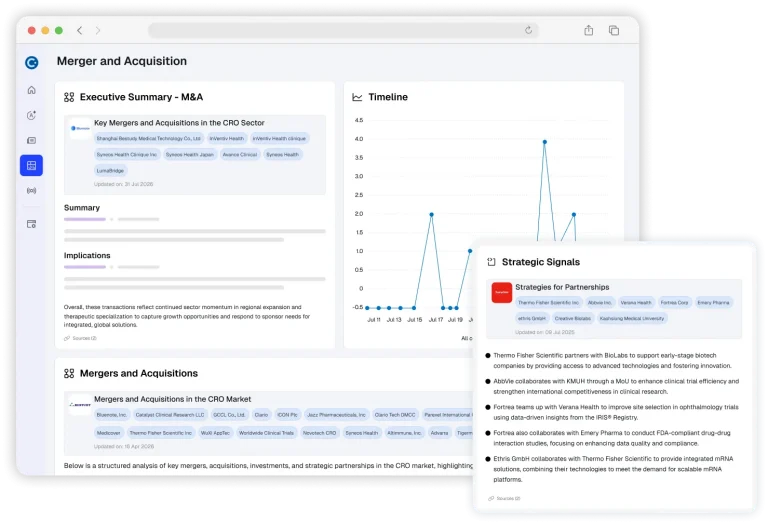
Contify is an AI-native market and competitive intelligence platform that enables organizations to monitor competitors, customers, partners, industry developments, and other strategic entities, as it provides reliable, verified, and actionable insights. It brings relevant intelligence into feeds, dashboards, alerts, and battlecards for teams across strategy, product, marketing, and sales.
Consider Contify when you need to run a broader intelligence program with a focus on continuously gathering relevant information, organizing it around your business priorities, and delivering insights in the formats each stakeholder needs.
Key features of Contify
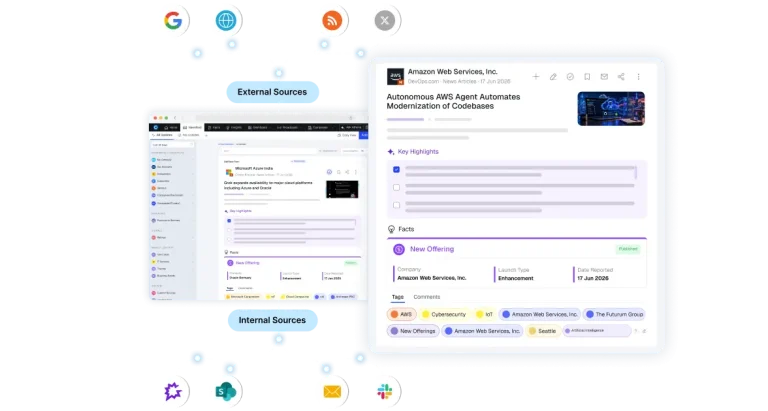
- Broad sourcing and multilingual coverage: Contify aggregates information from more than one million sources and supports the addition of your own sources. Its multilingual coverage includes 117+ languages with English translations, helping teams incorporate regional developments into their intelligence workflows.
- Monitoring aligned to your priorities: Monitoring Scope brings tracking configuration together. Company groups organize monitored businesses by portfolio, sector, or use case, while Industry Websites and Publishing Rules separate source coverage from relevance controls.
- Noise reduction and relevance controls: Contify uses deduplication, disambiguation, and tagging to organize incoming information. Publishing Rules let teams auto-publish, auto-reject, or let Athena assess updates fetched from tracked URLs. Tags can be managed within their categories, helping analysts maintain consistent classification.
- Athena AI for facts, analysis, and answers: Athena AI extracts structured business facts, generates continuously updated insights, and supports questions grounded in curated intelligence. Fact Templates and Insight Templates help adapt outputs to specific business needs. This gives analysts a way to work with connected developments and individual updates. Explore Athena AI and its capabilities.
- Stakeholder-specific intelligence delivery: Dashboards, battlecards, newsletters, and alerts help teams consume intelligence in the formats they need. Newsletters support branded templates, custom HTML headers, and section navigation. Contify also supports unlimited user access and integrations with Slack, Microsoft Teams, and Salesforce.
Contify pros
- Delivers clean, noise-free intelligence from over 1 million vetted external sources and multilingual translation capability covering over 117 non-English languages.
- Supports a shared intelligence program across business functions, with outputs tailored to different stakeholder needs.
- Gives analysts control over what is monitored, how updates are classified, and what reaches the curated feed.
- Combines recurring monitoring with AI-generated analysis and intelligence distribution.
- Unlimited users can use the platform at no additional cost, making intelligence reach the whole organization.
| A global data infrastructure company already had a system for battlecards and sales content but needed a consistent way to monitor external developments. It used Contify to centralize relevant updates and track competitor website changes, reducing manual monitoring while retaining its existing internal sharing workflow. Read the case study. |
Contify cons
- Teams need to invest time in defining monitoring scope, taxonomy, and workflows to their organization’s needs.
- Contify’s extensive feature set and customization for taxonomies, dashboards, and workflows can create a learning curve for users.
Who is Contify best suited for?
Contify is best suited for mid- to large-sized enterprises that need cross-functional, continuous, and prescriptive competitive and market intelligence to improve strategic decision-making across marketing, sales, product, and corporate strategy.
2. Crayon
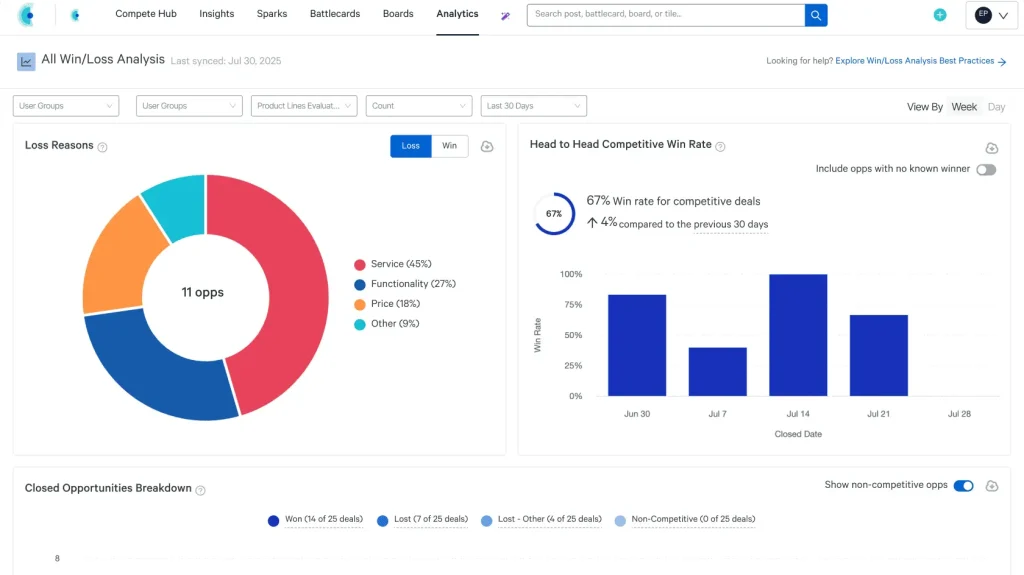
Crayon is a competitive intelligence platform that connects automated competitor monitoring with sales enablement. It is a relevant Klue alternative when you want to retain a focus on battlecards, competitor updates, and helping sellers respond in competitive deals.
Key features of Crayon
- Competitor monitoring: Crayon tracks developments, including website changes, pricing updates, job postings, release notes, customer reviews, and filings.
- AI prioritization and summaries: Crayon Picks surfaces updates its AI identifies as relevant, while summaries and daily emails help analysts review new intelligence.
- Competitive content and distribution: Battlecards, announcements, and newsletters help teams share key insights with stakeholders.
- Program measurement: Engagement and performance reporting connects battlecard use with competitive deal outcomes and influenced revenue.
- Integration Capabilities: Seamlessly integrates with various existing business tools, such as Salesforce, HubSpot, Slack, and Microsoft Teams, ensuring competitive intelligence is accessible within daily workflows.
Crayon pros
- Brings competitor tracking, content creation, and sales enablement into a connected workflow.
- Battlecard templates that are comprehensively designed for different sales roles and scenarios.
- Helps teams prioritize incoming updates and measure adoption of competitive content.
Crayon cons
- Focused primarily on competitive intelligence and does not provide intelligence on other market forces like customers, partners, or broader industry trends.
- Noisy intelligence feeds with duplication issues.
- Limited historical data availability, which is typically provided at an additional cost.
Who is Crayon best suited for?
Crayon fits B2B CI and product marketing teams whose main objective is turning competitor activity into useful sales guidance.
For a deeper evaluation, read our guide to Crayon alternatives and competitors.
3. AlphaSense
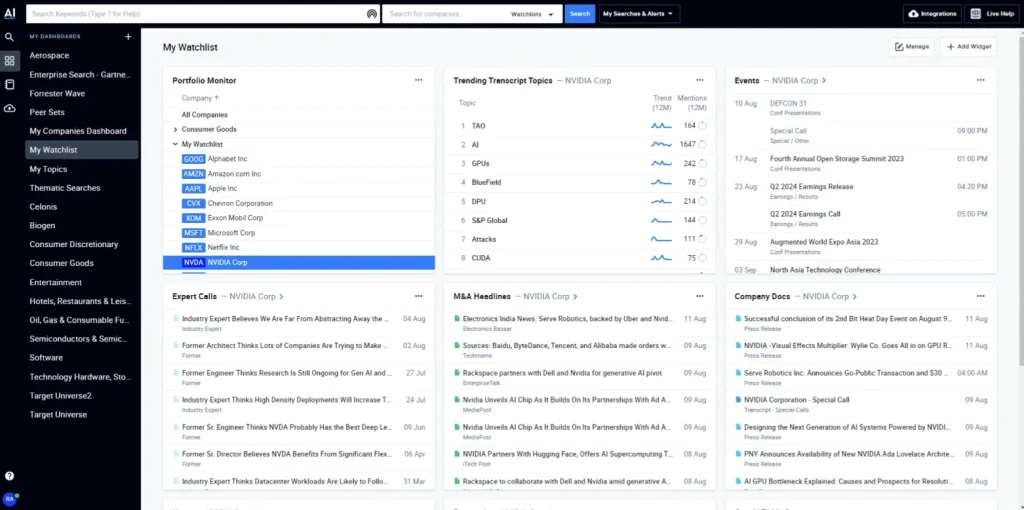
AlphaSense is an AI-powered research platform for teams analyzing companies, industries, and financial markets. It is relevant when your search for a Klue alternative is driven by a need for premium research and deeper document analysis. Its content includes broker research, expert transcripts, company filings, internal research, and news.
Key features of AlphaSense
- AI search and synthesis: Generative Search helps users investigate questions across research content and internal knowledge.
- Deep Research: AI agents produce research outputs and briefings by synthesizing relevant material.
- Enterprise Intelligence: Teams can connect internal memos, meeting notes, and presentations to make proprietary knowledge searchable.
- Monitoring and recurring research: Dashboards, alerts, and scheduled agents support ongoing research into companies, industries, and market themes.
- Sentiment Tracking: The platform’s AI identifies sentiment in earnings transcripts and expert calls, tracking how companies discuss specific topics in positive, negative, or neutral terms. This helps analysts detect changes in management tone and identify inflection points.
AlphaSense pros
- Combines premium content access with tools for searching and synthesizing research.
- A context-aware Smart Synonyms search understands business language and intent, reducing reliance on complex Boolean queries.
- Helps teams examine internal and external information within a shared research workflow.
AlphaSense cons
- No native translation capabilities. While non-English content is available in 37 languages, teams operating primarily in English still need separate translation workflows, slowing down global intelligence programs.
- Built primarily for finance and investment research workflows. Teams that require continuous competitive intelligence for product, marketing, or sales enablement use cases will find the platform’s sourcing and workflows less suited to their needs.
- Steep learning curve and information overload. The sheer volume of features and content makes navigation challenging, especially for new users who are not financial analysts by training.
Who is AlphaSense best suited for?
AlphaSense fits corporate research, strategy, consulting, and investment teams that need evidence from premium documents and expert perspectives. Consider it when deeper company and market research is the main requirement.
For a complete assessment, read our guide to AlphaSense alternatives and competitors.
4. Valona Intelligence

Valona Intelligence provides market and competitive intelligence through global monitoring, AI research, and analyst support. It is relevant to Klue buyers whose requirements include broader industry developments, technologies, regulation, and market opportunities.
Key features of Valona Intelligence
- Global source monitoring: Valona describes coverage across 200,000+ sources and 115+ languages, including local and industry-specific publications, corporate sources, and specialist information.
- VAL research assistant: Users can ask questions across market intelligence and internal knowledge, with traceable sources. VAL also supports recurring analyses that update as new intelligence becomes available.
- Intelligence delivery: Dashboards, alerts, and newsletters support sharing with stakeholders.
- Analyst support: Tailored packages can include content and analyst assistance.
- Real-Time Competitor Profiles: Valona provides competitor profiles that include earnings data, validated financials sourced from A-INSIGHTS, and auto-generated analysis helping visualize performance gaps, risks, and strategic opportunities.
Valona Intelligence pros
- Covers market developments beyond direct competitor activity.
- Strong global news and media coverage with monitoring across 200k+ sources in 115+ languages, including paywalled publications.
- Offers an option for teams that want software and analyst support within their intelligence program.
Valona Intelligence cons
- Limited coverage beyond news and media. Critical digital intelligence sources like company websites, social media platforms, review sites, job boards, and YouTube are not comprehensively tracked.
- Advanced AI features, including VAL, are restricted to power users (analysts), which limits broader adoption across the organization.
- Buyers need to define which analyses the platform generates and which require analyst support, including the agreed scope and cadence.
Who is Valona Intelligence best suited for?
Valona fits global intelligence and strategy teams that need ongoing market monitoring with access to research support.
5. Northern Light
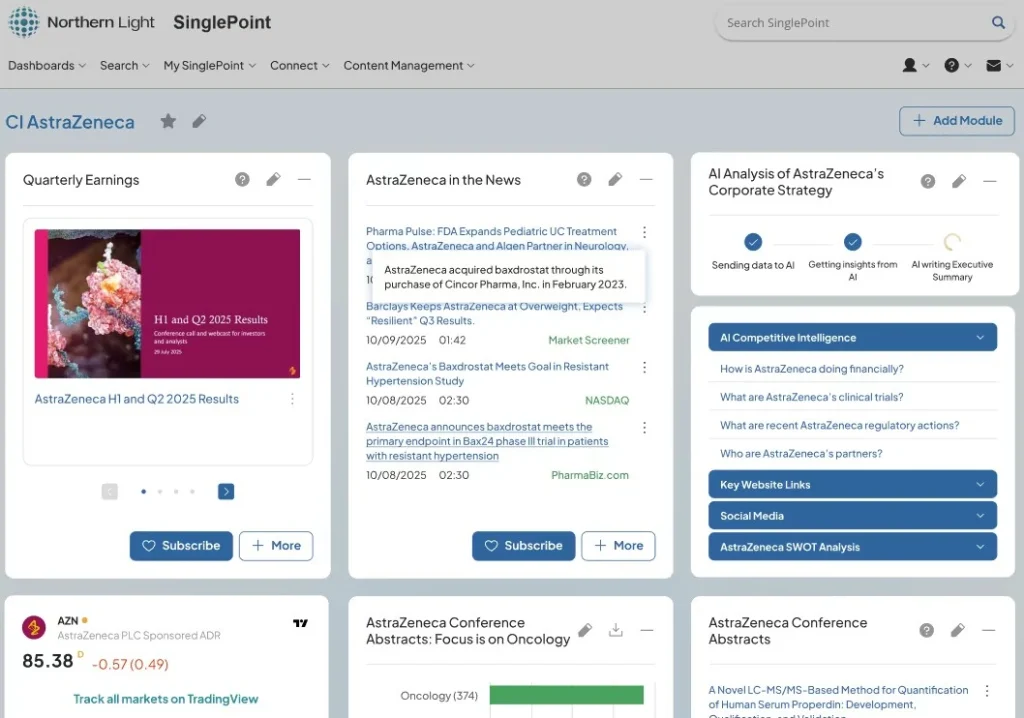
Northern Light’s SinglePoint platform brings internal research, licensed content, and market intelligence into a central enterprise portal. It is relevant when the main problem behind your Klue evaluation is that useful knowledge sits across subscriptions, reports, and departmental repositories.
Key features of Northern Light
- Unified research access: SinglePoint combines internal reports, subscriptions, news, dashboards, and subject-matter expertise in a branded hub.
- Search and curation: Teams can search across sources and filter findings by criteria such as topic, date, and role.
- AI-generated outputs: The platform supports cited outputs and role-specific summaries to help users move from discovery to synthesis.
- Stakeholder distribution: Role-based dashboards, alerts, newsletters, and integrations support intelligence sharing across functions.
- Primary research management: Northern Light’s Primary Research Manager automates research approvals, tracks project progress, and manages access for internal teams and external suppliers.
Northern Light pros
- Supports reuse of internal and licensed research across the enterprise.
- Combines content discovery with intelligence delivery for different stakeholder groups.
- Provides customer success support from strategy experts, helping teams implement and manage their enterprise intelligence program
Northern Light cons
- A research-consolidation project requires clear decisions about the collections to include, access rights, and ownership of the portal.
- Northern Light lists a daily update frequency for its Social Content Collection. Teams that need immediate visibility into competitor posts or hiring changes should assess whether that frequency meets their monitoring requirements.
- Bringing licensed research into SinglePoint does not automatically make every report available for AI analysis. Publisher restrictions can limit which sources contribute to generated answers, potentially leaving gaps when synthesizing findings across research collections.
Who is Northern Light best suited for?
Northern Light fits enterprise research, knowledge management, and intelligence teams that need to make distributed research easier to find and use.
6. Kompyte
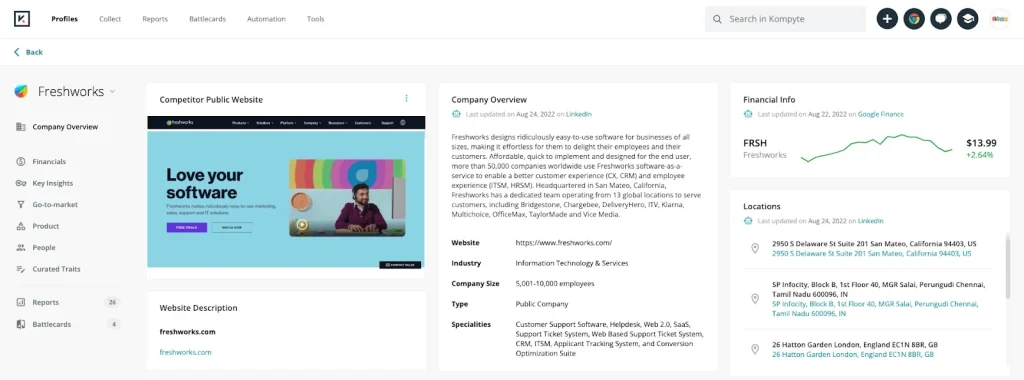
Kompyte is a competitor monitoring and sales battlecard platform. It is a relevant Klue alternative for product marketing teams that want to automate tracking and make competitive information available within sales workflows.
Key features of Kompyte
- Digital competitor tracking: Kompyte monitors websites, reviews, social content, ads, and job postings, using AI to prioritize updates.
- AI summaries: Daily roundups and individual summaries help users review competitor developments. Teams can edit summaries to add context and analysis.
- Sales battlecards: Templates organize competitive information, while CRM integrations make it accessible where sellers work.
- Win-loss reporting: Sales-tool integrations support reporting on competitive outcomes and battlecard adoption.
- Company Profiles: Kompyte’s Company Profiles dashboard lets users organize and analyze competitors by grouping them into categories such as “top competitors” or “emerging competitors.” Each profile includes company overviews covering financials, products, leadership, and more.
Kompyte pros
- Real-time monitoring across hundreds of sources with AI-powered noise filtering and daily summaries saves significant manual research time.
- Connects recurring competitor monitoring with practical seller content.
- Provides summaries and workflow integrations that can reduce the effort of reviewing and sharing updates.
Kompyte cons
- Teams expanding beyond seller enablement should demonstrate their broader market and strategic analysis requirements during evaluation.
- Automated win-loss reporting should be assessed separately from the qualitative buyer research required by your program.
- Lacks translated content from non-English sources, which limits its usefulness for global intelligence programs that need multilingual coverage.
Who is Kompyte best suited for?
Kompyte fits sales and product marketing teams whose priorities are competitor monitoring, battlecards, and CRM delivery.
Related Reading: Kompyte: Overview, Reviews, Pricing, and Best Alternatives
How to choose an alternative to Klue:
Klue brings competitive intelligence and win-loss together, helping teams turn competitor developments and buyer feedback into guidance for sellers. But your requirements may extend to tracking customers, partners, regulations, and technologies, or making internal research easier to find and use.
Your reason for evaluating an alternative should be specific to your program. A different platform might better support your monitoring scope, research needs, or stakeholder deliverables. If you are looking for an alternative to Klue, consider the following criteria in your search:
1. Intelligence needs extend beyond competitive deals
A competitor launching a product is one development to track. A customer entering a new market, a regulator changing requirements, or a technology gaining adoption can also affect your business.
If your remit includes these developments, evaluate how each platform supports ongoing market and industry intelligence. Ask vendors to demonstrate your actual companies, topics, and sources, including those outside your direct competitor list.
2. Different teams need different intelligence outputs
Sales need a battlecard before a call. Product teams may need a view of competitor launches and positioning changes. Leadership may need a short briefing that connects developments to strategic priorities.
Start with the outputs your stakeholders already use. Assess how much work is required to produce, update, and distribute each one. A platform can generate a useful summary while still leaving an analyst with substantial editing before the result is ready to share.
3. Coverage needs are specific to local market
A large source library doesn’t establish whether a platform covers your niche competitors, private companies, local publications, or specialist industry websites.
Test those sources directly. For multilingual requirements, check the relevance and timeliness of actual results as well as translation quality. For private companies, distinguish between available public information and financial details that may never have been disclosed.
4. Your team needs more control over relevance
Useful intelligence depends on how information is classified and filtered. Your team may organize research around product lines, regions, customer segments, or strategic themes that don’t fit a standard competitor profile.
Evaluate how easily you can adjust tags, queries, sources, and publishing criteria. Check whether those changes are self-service, require vendor assistance, or add to the contracted scope.
The best Klue alternatives should make it easier to deliver the intelligence your stakeholders need. For teams combining competitive intelligence with broader market monitoring and organization-wide distribution, Contify is worth evaluating against that brief.
Start your 7-day free trial to assess Contify using your companies, topics, and intelligence requirements.
FAQs
Do I need a win-loss program as part of my competitive intelligence platform?
That depends on how you currently learn from closed deals. A win-loss program helps you understand buyer priorities, competitive perceptions, and why deals were won or lost. Klue includes win-loss capabilities alongside competitive intelligence. If buyer interviews or analysis of sales-call data are central to your requirements, evaluate the research method, data sources, and how quickly findings reach product marketing and sales.
How is Klue different from Crayon?
Both support competitor monitoring and sales enablement. Klue also presents an integrated win-loss research offering, while Crayon connects monitoring and competitive content with engagement and revenue reporting. Compare the specific research methods and seller workflows you require. Our Crayon alternatives guide covers the comparison in more detail.
How much configuration does a market and competitive intelligence platform require?
Every enterprise platform needs some setup. Your team will need to define tracked companies, topics, sources, Tags, relevance criteria, and delivery workflows. Ask each vendor what your team can manage independently and what needs vendor support. The right platform should make it easier to refine coverage as your priorities change.
How does Contify distinguish itself from Klue?
Contify's emphasis is an organization-wide M&CI program spanning competitors, customers, partners, and market developments. Klue emphasizes competitive research, seller guidance, and win-loss. Both can support competitive content; the choice depends on the intelligence scope, research methods, and stakeholder outputs your program needs. Compare those requirements using a configured demonstration or trial.